Every so often a legal case becomes a landmark not because the facts were subtle but because they were so stark that the law had no choice but to confront a basic question head-on. For New York tenants, one such case involved garbage piled to the height of first-floor windows, extermination services that stopped while rats and roaches multiplied, and a city health emergency—all in a large Manhattan apartment complex. The question the case forced was simple and fundamental: when a building becomes unlivable, can the landlord avoid responsibility by pointing to someone else's actions? New York's highest court answered no, and in doing so it gave tenants one of the most important protections they have.
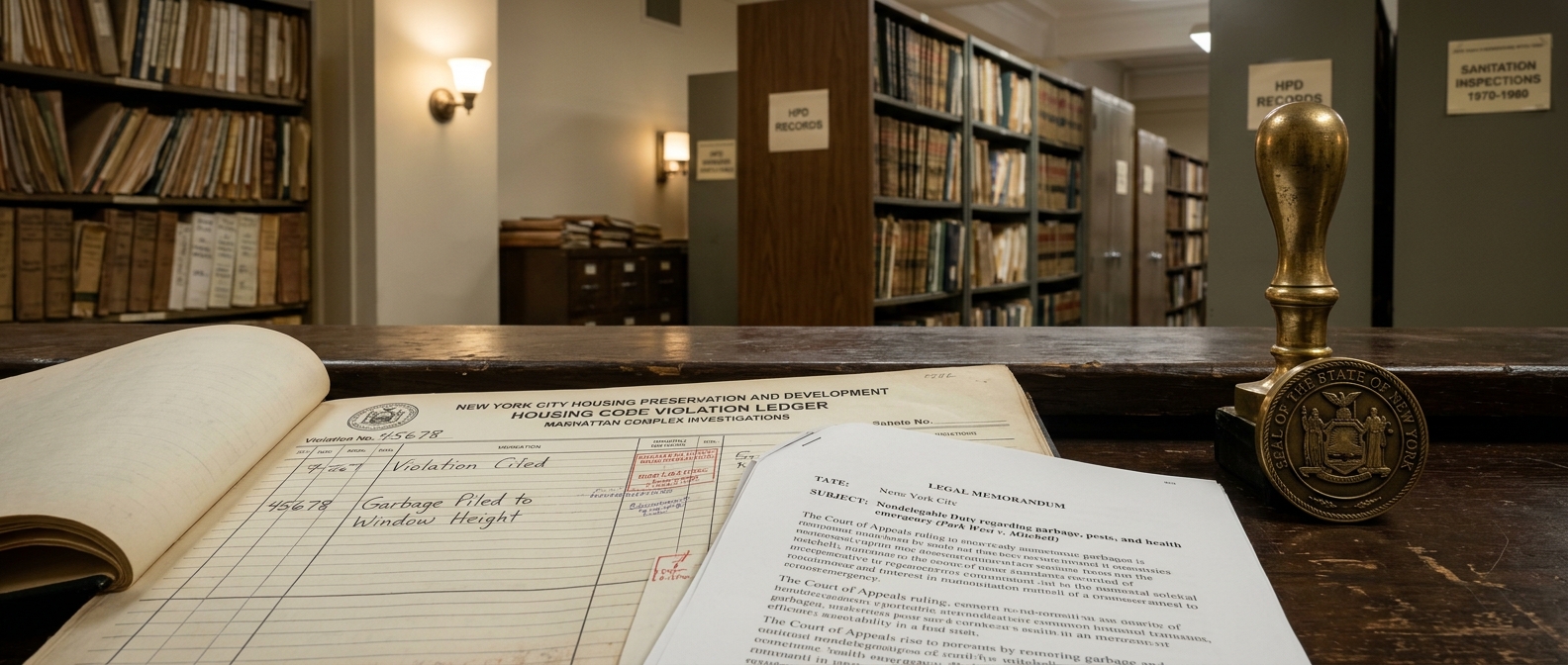
The case is Park West Management Corp. v. Mitchell, decided by the New York Court of Appeals in 1979. During a seventeen-day strike by the building's maintenance and janitorial employees at the Park West Village complex, conditions collapsed. Garbage accumulated until it reached first-floor-window height. Extermination stopped, and rats, roaches, and other vermin flourished. The city declared a health emergency. Some tenants, living amid the filth and the pests, withheld their rent, and the landlord responded by bringing a nonpayment proceeding to collect it. The dispute climbed all the way to the Court of Appeals, which upheld a ten-percent reduction in the tenants' rent and explained, in reasoning that still governs New York habitability law, why a landlord cannot escape its duty to provide a livable home by blaming a strike.
Park West is a foundational decision interpreting New York's warranty of habitability—the implied promise, codified in the Real Property Law, that a residential landlord will keep the premises fit for people to live in. The case established several principles that remain central: that the duty to maintain habitable housing is nondelegable, meaning a landlord cannot shift the blame to a third party like striking workers; that serious conditions affecting health and safety are what the warranty protects, as distinct from cosmetic defects or minor inconveniences; and that housing-code violations are one way, but not the only way, to establish a breach. This guide explains what happened at Park West Village, why common-area sanitation can breach the warranty of habitability, how courts weigh the severity and duration of conditions and the landlord's efforts to fix them, and why a tenant need not point to a formal code violation to prove a building has become unlivable.
Park West Village was a large residential complex in Manhattan. In the spring of 1976, the building's maintenance and janitorial staff went on strike, and for seventeen days the services that keep a large apartment building livable simply stopped. The consequences were not subtle. With no one collecting the trash, garbage accumulated throughout the complex—piling up, by the case's account, to the height of the first-floor windows. Extermination services, which in a building of that size are a constant necessity, ceased. And in the absence of sanitation and pest control, the predictable happened: rats, roaches, and other vermin flourished amid the accumulating refuse.
The conditions became severe enough that the city stepped in. The New York City health authorities declared a health emergency—an official recognition that the state of the complex posed a genuine danger to the people living there. This was not a matter of aesthetic complaint or ordinary wear; it was a public-health crisis unfolding inside residents' homes.
Faced with living in these conditions, some tenants withheld their rent. The landlord, Park West Management, responded by bringing a nonpayment proceeding—a court action to collect the withheld rent and, ultimately, to evict tenants who did not pay. The tenants defended on the ground that the landlord had breached the warranty of habitability: the building had become unfit to live in, and the rent should be reduced to reflect that. The landlord's central argument in response was that the conditions were the fault of the striking workers, not the landlord—that a strike was an extraordinary circumstance beyond its control, which should excuse it from responsibility for the resulting filth and vermin.
The case made its way up through the courts to the New York Court of Appeals, the state's highest court. The Court of Appeals upheld a ten-percent reduction in the tenants' June rent, agreeing that the landlord had breached the warranty of habitability. In reaching that result, the court rejected the landlord's strike defense and articulated the principles that have governed New York habitability law ever since. Notably, the parties had agreed that the court's decision would affect roughly four hundred similarly situated tenants in the complex—so the ruling was not merely about a handful of apartments but about the rights of a large body of residents who had endured the same conditions.
The ten-percent figure is worth noting for what it is and is not. It was a reduction in rent reflecting the diminished value of the apartments during the period of the breach—compensation for having to live in a building beset by garbage and vermin. It was calibrated to the conditions, not a windfall, and it applied to the rent for the affected period. The significance of Park West lies less in the size of the reduction than in the reasoning the court used to justify it, which is where its lasting importance lies.
The heart of Park West, and the reason it is a landmark, is its answer to the landlord's central argument: that the strike excused the conditions. The Court of Appeals held that the landlord's duty to maintain habitable premises is nondelegable—meaning the landlord cannot hand that responsibility off to someone else and escape liability when it is not fulfilled. A strike by the building's workers, however disruptive, does not automatically excuse the landlord from its obligation to provide a livable home.
The concept of a nondelegable duty is worth understanding, because it is what gives the warranty of habitability its strength. Some obligations can be delegated: a person who owes a duty can sometimes satisfy it by hiring someone else to perform it, and if that someone else fails, the person who hired them may not be responsible. But a nondelegable duty is different. It stays with the party who owes it no matter who is supposed to perform the actual work. The landlord can hire maintenance staff, janitors, exterminators, and managers to do the day-to-day work of keeping a building habitable—but the duty to provide habitable housing remains the landlord's own, and if the building becomes unlivable, the landlord is answerable regardless of which hired hands dropped the ball or why.
Applied to the strike, this principle is decisive. The landlord argued, in effect: "It wasn't us—it was the striking workers. The garbage piled up and the vermin spread because our employees walked off the job, which was beyond our control." The Court of Appeals rejected this. The duty to keep the building habitable was the landlord's, and it did not evaporate because the workers who normally performed the maintenance were on strike. A strike might make the duty harder to fulfill, but it did not transfer the responsibility to the workers or excuse the landlord from the consequences of a building that had become a health hazard. The landlord remained responsible for the habitability of the premises even in the face of the strike.
The logic is sound, and its implications are protective. If a landlord could escape the warranty of habitability by pointing to a strike, then the warranty would be hollow whenever the people the landlord hired to maintain the building stopped doing so. Tenants would bear the risk of every labor dispute, every contractor's failure, every breakdown in the chain of people the landlord relies on. By making the duty nondelegable, the court placed that risk where it belongs: on the landlord, who owns the building, collects the rent, and bears the responsibility for keeping it livable. The tenant's right to a habitable home does not depend on the smooth functioning of the landlord's labor relations.
For a tenant, the lesson is broad and empowering. When your building becomes uninhabitable, the landlord cannot escape responsibility by blaming someone else—striking workers, a contractor, a management company, a vendor who failed to show up. The duty to provide you a habitable home is the landlord's own, and it stays with the landlord no matter who was supposed to do the actual work. "It's not our fault, it was the strike" is not a defense. "It's not our fault, our contractor failed" is not a defense. The landlord took on the obligation to keep the building livable, and the law holds the landlord to it regardless of the excuse offered. This is one of the most important things Park West established, and it applies far beyond the specific facts of a strike.
Park West also makes clear something that tenants sometimes do not realize: a breach of the warranty of habitability does not have to occur inside the individual apartment. Conditions in the common areas of a building—the hallways, the grounds, the shared spaces where garbage is collected and pests are controlled—can breach the warranty, because they affect whether the residence as a whole is fit to live in. The garbage and vermin at Park West Village were building-wide, common-area conditions, and they breached the warranty for the tenants whose homes were engulfed by them.
The warranty of habitability, codified in New York's Real Property Law, is an implied promise that the premises are fit for human occupancy and that tenants will not be subjected to conditions dangerous to their health and safety. Fitness for human occupancy is not confined to the four walls of an apartment. A person does not live solely inside their unit; they move through the building, breathe its air, pass through its hallways, and depend on its shared systems for sanitation and safety. When those shared systems fail—when garbage piles up throughout the complex and vermin infest the common spaces—the home as a whole becomes unfit, even if the problem did not originate inside any particular apartment.
The conditions at Park West Village illustrate this vividly. Garbage accumulated to first-floor-window height throughout the complex; rats and roaches spread through the shared spaces; the city declared a building-wide health emergency. These were not problems confined to one tenant's kitchen; they were conditions pervading the premises, and they made the entire living environment hazardous. A tenant living in a clean apartment could still be living in an unlivable building if the hallways were overrun with vermin and the grounds buried in rotting garbage. The warranty of habitability protects against that, because it protects the fitness of the residence, and the residence includes the shared environment.
This matters because tenants sometimes assume that habitability is only about the condition of their own unit—the heat, the plumbing, the walls inside their apartment. Those are indeed central to habitability. But common-area conditions can breach the warranty too, when they are serious enough to affect the health, safety, or basic livability of the residence. Pervasive garbage and vermin are a classic example. So are other building-wide failures—a collapsed sanitation system, a building-wide pest infestation, dangerous conditions in shared passageways—that make the home unfit even though they are not inside any single apartment.
For a tenant, the practical point is to recognize that habitability problems in the common areas of your building can be the basis for a habitability claim. If the shared spaces of your building have become hazardous—overrun with pests, buried in garbage, or otherwise dangerous to health and safety—that can breach the warranty of habitability as to your home, because it affects whether your residence is fit to live in. You are not limited to complaining only about conditions inside your own four walls. The livability of the whole building is part of what the warranty protects, and a landlord who lets the common areas become a health hazard has breached it.
Park West did not hold that every imperfection in a building breaches the warranty of habitability. The court was careful to distinguish serious conditions that affect health and safety from cosmetic defects and minor inconveniences, and it indicated that courts assessing a habitability claim consider factors like the severity of the conditions, how long they lasted, and what the landlord did in response. Understanding these factors helps a tenant assess whether a given problem rises to the level of a breach.
Begin with severity. The warranty of habitability protects against conditions that materially affect the health and safety of tenants or that deprive them of the essential functions a residence is expected to provide. It is not a guarantee of perfection or of every amenity. A landlord is not, as the court put it in distinguishing the warranty's scope, a guarantor of every convenience; the warranty is concerned with genuine fitness for habitation, not with cosmetic flaws or trivial annoyances. A chipped tile, a scuffed wall, a minor and temporary inconvenience—these do not breach the warranty. Conditions that endanger health and safety or render the home unfit do. The garbage and vermin at Park West Village were plainly on the serious side of this line; the city's declaration of a health emergency underscored that these were dangerous conditions, not cosmetic ones. Severity is the first question: is the condition the kind that genuinely affects whether the home is livable, or is it a minor imperfection?
Duration matters too. How long a condition persists bears on the extent of the breach and the appropriate remedy. A dangerous condition that lasts briefly is different from one that drags on for weeks or months. At Park West Village, the conditions developed over a seventeen-day strike—long enough for garbage to accumulate dramatically and for vermin to flourish, but a defined period, which bore on the ten-percent reduction applied to the rent for the relevant month. Duration helps calibrate both whether a breach occurred and how significant it was: the longer tenants endure serious conditions, the greater the deprivation and, generally, the greater the remedy.
The landlord's response is a third consideration. Courts look at what the landlord did in the face of the conditions—whether it took reasonable steps to address the problem or simply let it fester. This does not mean that a landlord's efforts automatically excuse a breach; Park West makes clear that the duty is nondelegable and that even a strike does not excuse unsafe conditions. But the landlord's response can bear on the analysis of the breach and the remedy. A landlord that responds promptly and effectively to a developing problem stands differently from one that ignores it. The effectiveness of remedial measures—whether the landlord's efforts actually mitigated the conditions—is part of the picture a court considers.
Taken together, these factors—severity, duration, and the landlord's response—form the framework for evaluating a habitability claim. The question is not merely "was something wrong?" but "was the condition serious enough to affect health, safety, or basic livability; how long did it last; and did the landlord's response mitigate it?" This framework keeps the warranty focused on genuine habitability problems rather than every minor grievance, while ensuring that serious, prolonged, or unaddressed conditions are recognized as breaches.
For a tenant, the lesson is to assess a potential habitability problem along these lines. Is the condition serious—does it affect your health, safety, or the essential functions of your home—or is it a cosmetic or minor matter? How long has it persisted? Has the landlord responded effectively, or has the condition been left to continue? A serious, enduring condition that the landlord has failed to address is the strongest kind of habitability claim. A minor or quickly remedied inconvenience is not. Framing your situation in terms of severity, duration, and the landlord's response helps you understand where it falls and how strong your claim is.
Another important principle from Park West concerns evidence: how a tenant proves that a building has become uninhabitable. The court addressed the role of housing- and health-code violations, and its treatment of them is both useful and liberating for tenants. A recorded code violation is relevant evidence of a habitability breach—indeed, it can serve as prima facie evidence—but it is not the only way to establish that a building is unfit, and the absence of a formal violation does not defeat a habitability claim.
The warranty of habitability sets a standard of fitness for human occupancy, and whether that standard has been breached is ultimately a question about the actual conditions and their effect on the tenants, not solely about whether an inspector happened to record a formal violation. A housing or health code lays out specific requirements, and a documented violation of those requirements is strong evidence that something is wrong—it reflects an official determination that a standard was not met. Park West recognized this, treating code violations as meaningful evidence of uninhabitability. A tenant who has a recorded violation to point to has valuable support for a habitability claim.
But the court was equally clear that code violations are not the exclusive measure of habitability. The warranty is broader than any particular code, and conditions can render a home unfit even where no formal violation has been recorded. A tenant can prove a breach through evidence of the actual conditions—testimony, photographs, documentation of the problem and its effects—whether or not an inspector has issued a citation. The question is whether the conditions in fact made the premises unfit, and that can be shown by the conditions themselves, not only by a bureaucratic record of them. Nor is every code violation automatically a breach; the court recognized that violations vary in severity, so a minor technical violation is not the same as a serious hazard. Code violations are prima facie evidence, informative but not conclusive in either direction.
This two-sided treatment is important. On one hand, it means a tenant with a recorded code violation has strong evidence—the violation helps establish the breach. On the other hand, and just as importantly, it means a tenant without a recorded violation is not out of luck. The warranty of habitability does not require a citation. If the conditions are genuinely serious and render the home unfit, the tenant can prove it through other evidence, and the landlord cannot defeat the claim merely by noting that no inspector ever wrote it up. The reality of the conditions governs, not the presence or absence of a bureaucratic record.
For a tenant, the practical guidance follows directly. If your building has a recorded code violation for the condition you are complaining about, that is valuable evidence—preserve it and rely on it. But if there is no formal violation, do not assume you have no claim. Document the conditions yourself: photographs and video with dates, records of your complaints to the landlord, accounts of how the conditions affected your health and safety, and any other evidence of the actual state of the premises. The warranty of habitability is about whether the home is fit to live in, and you can establish that through the conditions themselves. A code violation helps, but its absence is not a barrier, and its presence is not automatically conclusive. What matters is proving the real conditions and their effect on the livability of your home.
It helps to translate Park West into the situation of an ordinary tenant, because the principles it established apply far beyond a seventeen-day strike at a single Manhattan complex.
Imagine your building has fallen into a dangerous state. Perhaps the garbage is not being collected and is piling up in the halls and on the grounds. Perhaps pests—rats, roaches, or others—have infested the common areas and are finding their way into your home. Perhaps a basic building system has failed, leaving shared spaces hazardous. The landlord, when you complain, offers an excuse: the maintenance company quit, a contractor failed, the workers are in a dispute, something was beyond its control. You might wonder whether the landlord's excuse lets it off the hook, and whether conditions in the common areas rather than inside your apartment even count.
Park West answers both questions in your favor. The landlord's duty to keep your building habitable is nondelegable, so the excuse—"it was the contractor," "it was the strike," "it was beyond our control"—does not relieve the landlord of responsibility. The duty is the landlord's own, and a third party's failure does not transfer it away. And conditions in the common areas can breach the warranty of habitability, because the warranty protects the fitness of your residence as a whole, including the shared environment you depend on. Garbage and vermin pervading the building make your home unfit even if they did not start inside your unit.
The case also tells you how to think about whether your situation rises to a breach. Ask whether the conditions are serious—do they affect your health, safety, or the essential functions of your home—or merely cosmetic or trivial. Consider how long they have lasted and whether the landlord has responded effectively. Serious, enduring conditions that the landlord has failed to fix are the core of a habitability breach. And in proving it, use whatever evidence you have: a recorded code violation is strong support, but if there is none, document the conditions yourself, because the warranty turns on the real state of the premises, not on whether an inspector wrote a citation.
What you would do, understanding this, is document the conditions thoroughly—photographs and video with dates, a record of your complaints to the landlord and its responses, notes on how the conditions affect your health and safety, and any code violations if they exist. You would recognize that the landlord cannot defeat your claim by blaming someone else, and that common-area conditions count. And you would understand that the remedy for a habitability breach can include a reduction in your rent reflecting the diminished value of the home during the breach—the kind of rent abatement the tenants at Park West Village received.
A critical caution, however: withholding rent is risky and should not be undertaken lightly or without advice. The tenants in Park West withheld rent and the landlord brought a nonpayment proceeding—which is to say, withholding rent led to a court case in which the tenants had to defend themselves, and they prevailed only after litigation reaching the state's highest court. Rent-withholding can expose a tenant to eviction proceedings if the habitability claim is not sustained, and the rules for doing it properly are specific and unforgiving. A tenant considering withholding rent, or raising habitability as a defense or a claim, should get advice from a tenant attorney or a local tenant-rights organization before acting. The warranty of habitability is a powerful protection, but asserting it effectively—and safely—usually calls for informed guidance.
The reason the hypothetical tracks the case is that the case is the hypothetical, carried to the state's highest court. Tenants in a complex overwhelmed by garbage and vermin, whose landlord blamed a strike, won a rent reduction and established that the landlord could not escape its nondelegable duty. The pattern—serious common-area conditions, a landlord's excuse, a habitability claim—is one tenants encounter in many forms, and Park West is the decision that governs it.
Knowing the case is one thing; applying it is another. Here is how a tenant can use the principles Park West established.
Understand that the landlord's duty is nondelegable. When your building becomes uninhabitable, the landlord cannot escape responsibility by blaming a third party—striking workers, a contractor, a management company, a vendor. The duty to provide you a habitable home is the landlord's own and stays with the landlord regardless of who was supposed to do the work. Do not accept "it wasn't us, it was someone else" as a reason you have no recourse.
Recognize that common-area conditions can breach the warranty. The warranty of habitability protects the fitness of your residence as a whole, including the shared spaces you depend on. Serious conditions in the common areas—pervasive garbage, building-wide pest infestations, dangerous failures in shared systems—can breach the warranty even if they do not originate inside your apartment. Your habitability rights are not confined to your own four walls.
Assess the problem by severity, duration, and the landlord's response. The warranty protects against serious conditions affecting health and safety, not cosmetic defects or minor inconveniences. Ask whether the condition is genuinely serious, how long it has persisted, and whether the landlord has responded effectively. A serious, enduring, unaddressed condition is the strongest habitability claim; a minor or promptly fixed one is not.
Document the conditions, with or without a code violation. A recorded housing- or health-code violation is strong evidence of a breach—preserve and use it if you have one. But the warranty does not require a violation. If there is none, document the conditions yourself: dated photographs and video, records of your complaints and the landlord's responses, and accounts of how the conditions affect your health and safety. The warranty turns on the real conditions, which you can prove through this evidence.
Be extremely careful about withholding rent. Withholding rent can lead to a nonpayment proceeding and expose you to eviction if your habitability claim is not sustained, as the very posture of Park West shows. The rules for withholding rent properly are specific, and getting them wrong can be costly. Do not withhold rent on your own assumption that you are entitled to; get advice first.
Get knowledgeable help before acting. The warranty of habitability is powerful, but asserting it—whether as a defense to a nonpayment case, as an affirmative claim, or through a proceeding to compel repairs—involves legal rules that reward informed handling. A tenant attorney or a local tenant-rights organization can assess the severity of your conditions, advise you on the safest way to assert your rights, and guide you through the process. Many legal aid organizations across New York assist tenants with habitability matters, and given the risks of acting alone, that help is well worth seeking.
Several intuitive but mistaken beliefs leave tenants unsure of their rights, and Park West speaks to each.
The first misconception is that a landlord can escape responsibility by blaming a third party. It cannot. The duty to maintain a habitable home is nondelegable. A strike, a failed contractor, a departed management company—none of these transfers the duty away from the landlord or excuses an uninhabitable building. "It wasn't us" is not a defense.
The second misconception is that habitability is only about conditions inside your own apartment. It is not. The warranty protects the fitness of your residence as a whole, including common areas. Pervasive garbage and vermin in the shared spaces of a building can breach the warranty even though they did not start inside any single unit.
The third misconception is that any imperfection breaches the warranty. It does not. Park West distinguishes serious conditions affecting health and safety from cosmetic defects and minor inconveniences. The warranty is about genuine fitness for habitation, not every amenity or annoyance.
The fourth misconception is that you need a recorded code violation to prove a habitability breach. You do not. A code violation is strong, prima facie evidence, but the warranty turns on the actual conditions, which you can prove through photographs, records, and testimony even without a citation. The absence of a formal violation is not a barrier.
The fifth misconception is that a code violation automatically proves a breach. Not necessarily. Violations vary in severity, and a minor technical violation is not the same as a serious hazard. Code violations are relevant evidence, not automatically conclusive in either direction.
The sixth misconception is that withholding rent is a safe, simple way to assert habitability rights. It is not. Withholding rent can lead to a nonpayment proceeding and the risk of eviction if the claim is not sustained—exactly the posture the tenants in Park West found themselves in. Withholding rent is risky and should not be done without advice.
Park West was decided in 1979, but its significance has only grown, because the problems it addressed are perennial and the principle it established is foundational. Understanding why the case endures helps a tenant appreciate the strength of the protection it provides.
The warranty of habitability was, in the long arc of landlord-tenant law, a relatively recent development when Park West was decided. For much of legal history, a lease was treated as a transfer of property in which the tenant took the premises as they were and bore the risk of their condition; a landlord had little implied obligation to keep a dwelling livable. The warranty of habitability reversed that, recognizing that a modern residential tenant is renting a place to live, not merely a parcel of space, and that the landlord who collects the rent must keep the place fit for living. Park West came early in the life of this reform and gave it concrete force, showing that the warranty was not a mere aspiration but a real obligation with real consequences for a landlord who failed to meet it.
The case's enduring importance lies in the particular way it strengthened the warranty. A promise of habitability would mean little if a landlord could escape it whenever the people it hired to do the work failed. By holding the duty nondelegable, Park West closed the most obvious escape route and ensured that the warranty would hold even under pressure—even during a strike, even when the immediate cause of the conditions was someone other than the landlord. This is what gives the warranty resilience. A protection that collapses under the first excuse is no protection; a protection that holds the landlord responsible regardless of the excuse is one tenants can actually rely on. Park West made the warranty the latter kind.
The problems the case dealt with, moreover, never went away. Buildings still fall into disrepair. Sanitation still fails. Pests still infest. Landlords still offer reasons why the conditions are not their fault—a contractor, a vendor, a dispute, a circumstance beyond their control. Every one of those situations is governed by the principle Park West established: the duty is the landlord's, and the excuse does not transfer it. A tenant facing an uninhabitable building today stands on the authority of a case decided decades ago precisely because the case addressed a problem that recurs in every generation and answered it in a way that does not depend on the specific facts of a 1970s strike.
The case also continues to shape how habitability disputes are analyzed. Its framework—serious health-and-safety conditions versus cosmetic defects, the relevance but non-exclusivity of code violations, the weighing of severity and duration—remains the template through which New York courts evaluate habitability claims. When a court today asks whether a condition is serious enough to breach the warranty, whether a code violation is dispositive, or whether the landlord's response matters, it is working within the structure Park West helped build. The case is not a historical curiosity; it is living law, cited and applied in habitability disputes across New York.
For a tenant, the significance of this longevity is reassurance. The protection you have when your building becomes uninhabitable is not a recent or fragile innovation; it rests on a landmark decision of the state's highest court that has stood for decades and been applied countless times. When you assert that your landlord cannot blame someone else for an unlivable building, you are invoking a principle that is deeply settled in New York law. The garbage and rats at Park West Village are long gone, but the rule the case established—that the duty to provide a habitable home stays with the landlord—remains as good today as it was in 1979, and it protects you now as it protected those four hundred tenants then.
It is worth being candid about the scope of Park West Management Corp. v. Mitchell. It is a decision of the New York Court of Appeals, the state's highest court, which gives it strong and lasting authority: it is binding precedent that has shaped New York habitability law for decades. That authority is part of what makes it a landmark. But it resolved a particular dispute on particular facts—an extreme set of conditions during a defined strike—and the general principles it announced must still be applied to the facts of each new case.
What the case does not do is guarantee a particular outcome, or a particular rent reduction, in every habitability dispute. The ten-percent reduction at Park West Village reflected the specific conditions, their duration, and their effect on the value of those apartments; a different case with different conditions would warrant a different remedy, or perhaps none if the conditions were not serious enough to breach the warranty. The case does not hold that every building problem is a breach—indeed, it draws the opposite line, distinguishing serious health-and-safety conditions from cosmetic defects and minor inconveniences. And it does not make rent-withholding safe; it illustrates, if anything, that withholding rent leads to litigation that a tenant must be prepared to win.
What is reliable, because it is the holding of the state's highest court, is the framework the case established. A landlord's duty to maintain habitable premises under the warranty of habitability is nondelegable, so the landlord cannot escape responsibility by blaming a third party, and even a strike does not automatically excuse unsafe conditions. The warranty protects against serious conditions affecting health and safety—including conditions in common areas that render the residence unfit—as distinct from cosmetic defects or minor inconveniences. Courts weigh the severity and duration of the conditions and the landlord's response. And housing-code violations are relevant, prima facie evidence of a breach but neither the exclusive way to prove one nor automatically conclusive. Those principles are the enduring legacy of Park West, and they apply to habitability disputes throughout New York.
The lasting power of Park West Management Corp. v. Mitchell lies in a single, clarifying idea: the responsibility for a habitable home belongs to the landlord, and it cannot be handed off. Garbage can pile to the windows and vermin can overrun the halls because the workers walked off the job, and the landlord can protest that the strike was beyond its control—but the duty to keep the building livable was never the workers' to begin with. It was the landlord's, and it stayed the landlord's through the strike, through the garbage, through the health emergency. That is what "nondelegable" means, and it is why a landlord cannot blame someone else for an uninhabitable building.
For you as a tenant, that principle reaches far beyond a 1970s strike. Whenever your home becomes unlivable and your landlord offers an excuse—a failed contractor, a labor dispute, a vendor who didn't show—the excuse does not dissolve the landlord's duty to you. The duty to provide a habitable home is the landlord's own. Conditions in the common areas count, because the warranty protects the fitness of your whole residence. Serious conditions affecting your health and safety are what the warranty is for, and you can prove them through the conditions themselves, with or without a code violation. And the remedy can include a reduction in your rent reflecting what you lost by living in an unfit home.
The warranty of habitability is one of the strongest protections New York tenants have, and Park West is a large part of the reason it has teeth. But asserting it—especially by withholding rent—carries real risk and rewards informed, careful handling, so the wise first step is advice, not unilateral action. The deepest lesson of the case is simple enough to carry with you: a landlord cannot blame someone else for an uninhabitable building, because the duty to keep it livable was the landlord's all along.