Your landlord kept your security deposit three weeks ago. You know it's wrong. You know New York law requires them to return it or provide itemization within 14 days. You know they violated that law. You're entitled to your money back.
But you haven't done anything about it yet, because every time you think about taking action, your mind floods with paralyzing questions: "Where do I even start? Do I need a lawyer? How do I file in small claims court? What forms do I use? What do I say? Who do I talk to first? What if I do it wrong and make things worse?"
This limiting belief—"I don't know how to fight it"—translates to something deeper: the legal system is for people who already know how it works, and if you don't, you're locked out. The sheer ambiguity of where to begin and what steps to take creates complete paralysis. So you do nothing, and your landlord keeps your money.
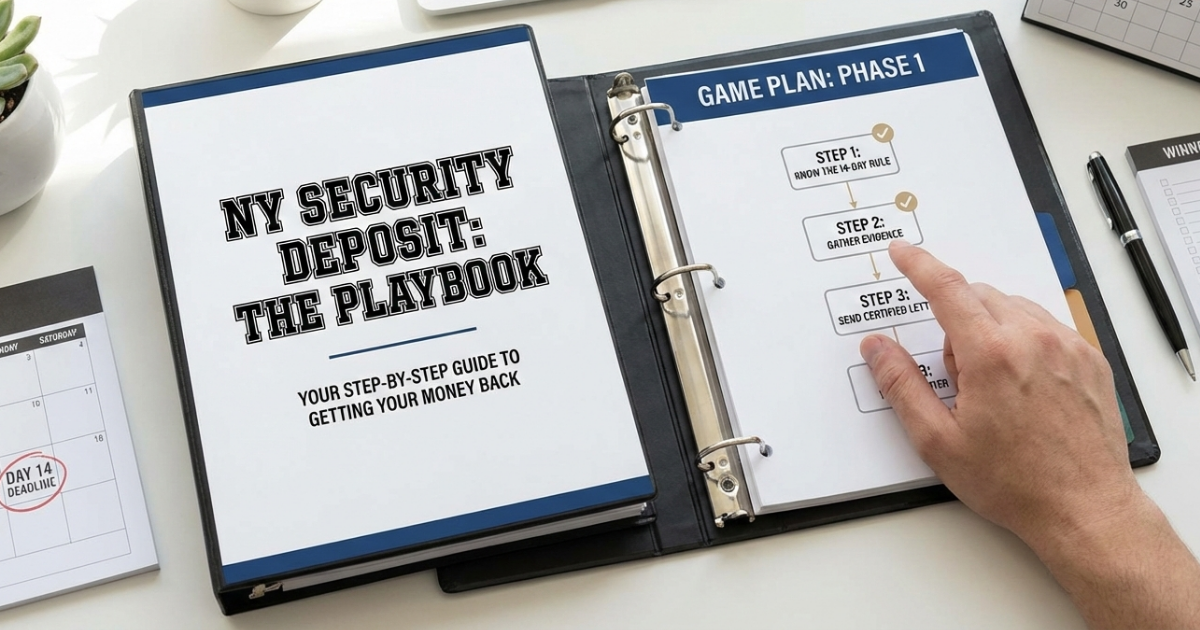
Here's the truth most tenants never discover: getting your security deposit back in New York follows a simple, repeatable playbook that requires no legal expertise, no lawyer (in most cases), and no insider knowledge of court systems. The steps are straightforward. Templates exist. The process is designed for regular people to navigate themselves. You just need to know the sequence.
This is that sequence—the complete step-by-step playbook from "my landlord kept my deposit" to "I got my money back."
The paralysis of not knowing where to start isn't about lack of intelligence or capability. It's about lack of a clear starting point and defined next steps.
When you think about "fighting for your deposit," your brain conjures a nebulous, overwhelming process:
Every element feels uncertain and high-stakes. "What if I file the wrong form? What if I say the wrong thing? What if I miss a deadline? What if I accidentally waive my rights?"
This uncertainty creates decision paralysis. When every possible action feels risky because you don't know if it's the right action, doing nothing feels safer than doing something wrong.
But here's what breaks the paralysis: a clear, numbered sequence of specific actions with templates and examples showing exactly what to do at each step. Not vague advice like "you should send a demand letter"—but precise instructions like "here's the exact text of the demand letter you send, here's where you send it, here's how you send it."
That's what this playbook provides.
Before diving into detailed steps, here's the high-level sequence so you can see where you're going:
Phase 1: Gather & Calculate (30 minutes)
Phase 2: Demand (1 hour)
Phase 3: Decide & File (2-3 hours)
Phase 4: Prepare & Appear (3-4 hours prep, half-day for court)
Total time investment if it goes all the way to court: about 8-10 hours spread over 4-8 weeks. Total cost if you do it yourself: $15-30 filing fee plus certified mail costs.
That's it. Not months of research. Not thousands in lawyer fees. Not endless bureaucratic mazes. A manageable process with clear stages.
Now let's walk through each step in detail.
Start by collecting the basic facts and documents you need. You probably have most of this already.
You need to establish exactly when you vacated the apartment and returned keys, because that's Day 1 for calculating the 14-day deadline.
If you remember the date clearly: Write it down. That's your move-out date.
If you're not certain of the exact date: Check:
Write down: "I moved out on [Month/Day/Year] and returned all keys on [same date or next day]."
From your move-out date, count forward exactly 14 days. Use a calendar or online date calculator.
Example:
Your landlord had until March 15 to either:
Write down: "The 14-day deadline was [Month/Day/Year]."
Check your records for any communication from your landlord about your deposit:
Did you receive any letter, email, or text?
Did they send an itemized list of deductions?
Did they return any money?
Write down: "I received [itemized list / partial payment / nothing] on [date] OR I have received no communication as of [today's date]."
Now compare what happened to what the law required:
Did your landlord send itemization by the 14-day deadline?
Write down your assessment: "My landlord [missed the deadline entirely / sent inadequate itemization / complied with timeline but claims are false]."
Collect whatever documentation you have:
Proof you paid a deposit:
Proof of your tenancy dates:
Communications with landlord:
Evidence of apartment condition (if you have any):
Organize these into a folder labeled "Security Deposit - [Your Address]." You'll reference this throughout the process.
TIME CHECK: You should have completed Phase 1 in about 30 minutes. You now know: (1) your timeline, (2) whether your landlord violated the law, (3) what evidence you have. That's everything you need to move forward.
A demand letter is a formal written notice to your landlord that they violated the law and you're demanding return of your full deposit. This serves multiple purposes:
Here's the exact format to use. Fill in your specific information in [brackets]:
[Your Full Name]
[Your Current Address]
[City, State, ZIP]
[Your Phone Number]
[Your Email]
[Today's Date]
[Landlord's Full Name or Management Company Name]
[Landlord's Address]
[City, State, ZIP]
Re: DEMAND FOR RETURN OF SECURITY DEPOSIT
Former Rental Address: [Your Rental Unit Address]
Tenant: [Your Name]
Dear [Landlord Name]:
I am writing to demand immediate return of my security deposit for the property located at [rental address]. I vacated this property on [move-out date] and returned all keys on [date keys returned].
Under New York General Obligations Law § 7-108(1-e), you were required to provide me with an itemized written statement of any deductions from my security deposit and return the remaining balance within 14 days of my move-out date. The statutory deadline was [14-day deadline date].
[Choose the option that matches your situation:]
OPTION A - No communication received: As of today, [current date], I have received no itemized statement and no portion of my security deposit has been returned. It has now been [X] days since I vacated the premises, which is [X] days past the statutory deadline.
OPTION B - Late itemization received: I received your itemized statement on [date received], which is [X] days after the statutory 14-day deadline. This itemization was sent on day [X] instead of by day 14.
OPTION C - Vague itemization received: I received a communication on [date] listing deductions as "[quote the vague categories, e.g., 'Cleaning: $500']" without specific descriptions of work performed, areas affected, or supporting invoices as required by law.
By failing to comply with the 14-day itemization requirement under GOL § 7-108(1-e), you have forfeited the legal right to retain any portion of my security deposit, regardless of any claimed damages or costs. The full deposit of $[amount] must be returned to me immediately.
I demand the following:
If I do not receive full payment by [date 7 days from today], I will file a claim in small claims court seeking:
I have documented all relevant facts including my move-out date, the statutory deadline, and the timing of any communications from you. I have copies of my lease, proof of deposit payment, and photographic evidence of the apartment's condition at move-out.
Please send payment via check or money order to the address listed above. I will accept electronic payment if you prefer (contact me to arrange).
I expect this matter to be resolved immediately. Failure to return my full deposit will result in legal action without further notice.
Sincerely,
[Your Signature]
[Your Typed Name]
[Your Phone Number]
[Your Email]
Fill in all the bracketed information with your specific facts:
Choose the appropriate violation description (Option A, B, or C) that matches what actually happened.
This step is crucial for creating proof of delivery:
Print two copies of your letter - one to send, one to keep.
Go to the post office and send the letter via:
Why certified mail? Because you get:
Keep your receipts: When you send certified mail, you get a receipt with a tracking number. Staple this to your copy of the demand letter. When the green return receipt card comes back signed, staple that to your file too.
Also send a copy via regular mail and email if you have your landlord's email. Multiple delivery methods ensure they receive it and eliminate any "I never got it" excuses.
Count forward 7 days from the date you mailed the letter. Mark that date on your calendar as "Deposit payment deadline."
On that date, if you haven't received payment, you move to Phase 3.
TIME CHECK: Drafting, printing, and mailing your demand letter should take about an hour total. You're now done with Phase 2.
After sending your demand letter, one of three things will happen:
What happens: You receive a check or electronic payment for the full deposit amount within your 7-day deadline (or shortly after).
What you do:
SUCCESS - You're done!
What happens: Your landlord emails or calls with excuses, offers of partial payment, requests for more time, or arguments about why they don't owe the money.
What you do:
If they offer partial payment: Decide if you'll accept it or hold out for the full amount. If accepting partial payment, get the agreement in writing specifying that this is full settlement of all deposit claims.
If they request more time: You can agree to a brief extension (another 7 days) if you want, but get it in writing. Or you can decline and proceed to filing.
If they argue they don't owe it: Send one brief email response: "Under GOL § 7-108(1-e), you forfeited deduction rights by missing the 14-day deadline. The law does not provide exceptions for [whatever excuse they gave]. My demand stands. You have until [date] to pay, or I will file in small claims court."
Don't get drawn into lengthy email arguments about whether damage existed or whether you caused it. The legal issue is the deadline violation, not apartment condition. Stay focused.
If your deadline passes without full payment, move to filing in court.
What happens: Silence. No payment, no communication, no acknowledgment of your demand letter.
What you do: File in small claims court. The lack of response shows your landlord isn't taking your demand seriously and won't pay voluntarily.
If you reached your deadline without receiving full payment, it's time to file. This is not as complicated as you think.
Small claims court is designed for non-lawyers. The process is intentionally simplified so regular people can represent themselves. You don't need to hire an attorney (though you can if you want). Most tenants handle deposit cases themselves successfully.
What happens in small claims:
The whole hearing typically lasts 10-30 minutes. Judges in small claims are used to hearing from non-lawyers and will guide the process.
Small claims courts in New York are called different things depending on location:
In New York City: "Civil Court - Small Claims Part"
Outside NYC: "District Court," "City Court," or "Justice Court" depending on the county
How to find your court:
Write down: "I will file in [Court Name] located at [Address]."
You need two forms to file:
1. Statement of Claim (or Complaint)
This form identifies you (plaintiff), your landlord (defendant), how much you're claiming, and why.
2. Affidavit of Service (or Proof of Service)
This form proves you properly notified your landlord about the case.
Where to get forms:
Option 1 - Download online:
Option 2 - Pick up at courthouse:
Option 3 - Court help centers:
Here's how to complete the standard small claims form:
PLAINTIFF (You) Information:
DEFENDANT (Landlord) Information:
Amount Claimed:
What the Case Is About: Under "Nature of Claim" or "Statement of Claim," write a brief, clear explanation:
Example Statement:
"Defendant landlord is wrongfully withholding my $2,400 security deposit. I rented [address] from [start date] to [end date]. I vacated on [move-out date] and returned all keys.
Under New York General Obligations Law § 7-108(1-e), Defendant was required to provide an itemized statement of deductions and return remaining deposit within 14 days - by [deadline date].
Defendant failed to comply. [I received no communication / I received itemization on [date], which was [X] days late / I received vague itemization not meeting statutory requirements].
By failing to comply with the 14-day requirement, Defendant forfeited the right to retain any portion of my deposit. I demand return of the full $2,400 deposit plus court costs, filing fees, and statutory penalties for bad faith retention."
Keep it factual, concise, and focused on the legal violation (the missed deadline). You'll provide more details at the hearing.
Sign and date the form.
Take your completed forms to the court clerk's office during business hours.
Filing fee: Typically $15-30 depending on the amount you're claiming. Some courts accept cash, others require money order or credit card. Call ahead to confirm accepted payment methods.
What the clerk will do:
Get receipts and copies of everything. The court keeps the originals; you keep copies.
Write down your court date, time, and courtroom immediately. Mark it on every calendar you use. Missing your court date results in dismissal.
New York requires you to formally notify your landlord that you're suing them. This is called "service of process."
Who can serve:
How to serve:
Option 1 - Personal service: Have someone hand-deliver the court papers directly to your landlord (or to an agent authorized to accept service on their behalf, like a property manager).
Option 2 - Certified mail: In some courts, you can serve by certified mail with return receipt requested. Check with your court clerk if this is allowed in your jurisdiction.
Option 3 - Process server: Hire a professional process server (costs $50-100). They handle delivery and provide proof of service. Worth it if your landlord is avoiding service.
What gets served:
Proof of service: The person who served your landlord must complete an Affidavit of Service form swearing under oath that they delivered the papers to the landlord on a specific date. This affidavit gets filed with the court before your hearing.
Important timing: Service must be completed at least 10-20 days before your hearing date (varies by court). Don't wait—serve immediately after filing.
TIME CHECK: Filing your small claims case (including form completion, going to courthouse, and arranging service) takes 2-3 hours total. Once you file, your hearing is scheduled and the process is in motion.
You've filed your case and served your landlord. Now you prepare for your hearing and show up to win.
Create a simple evidence packet with everything clearly labeled:
Exhibit A: Lease Agreement
Your lease showing the rental address, lease term, and security deposit amount.
Exhibit B: Proof of Deposit Payment
Bank statement, Venmo screenshot, money order receipt, or deposit receipt showing you paid the deposit amount you're claiming.
Exhibit C: Timeline Documentation
Exhibit D: Your Demand Letter
Copy of the demand letter you sent, plus certified mail receipt and return receipt showing it was delivered.
Exhibit E: Apartment Condition Evidence (if you have any)
Exhibit F: Landlord's Communications (if any)
Exhibit G: Evidence Contradicting Landlord's Claims (if applicable)
Make three copies of your entire evidence packet:
Put each set in a folder or binder with tabs separating exhibits. Label clearly: "EXHIBIT A: Lease," "EXHIBIT B: Proof of Payment," etc.
Professional organization impresses judges and makes your case easier to understand.
You'll get a few minutes to explain your case to the judge. Prepare a clear, concise opening statement—write it down and practice saying it out loud.
Sample Opening Statement:
"Your Honor, my name is [Your Name]. I'm here to recover my $2,400 security deposit that my landlord is wrongfully withholding.
I rented [address] from [start date] to [end date]. I paid a $2,400 security deposit when I moved in, which I can prove with my bank records (Exhibit B).
I moved out on [move-out date] and returned all keys that same day. Under New York General Obligations Law § 7-108, my landlord had 14 days from that date—until [deadline date]—to either return my deposit or send me an itemized statement of deductions.
My landlord failed to comply with this requirement. [I received nothing / I received an itemized list on [date], which was [X] days late / I received a vague statement that doesn't meet the law's requirements].
Because my landlord missed the statutory deadline, they forfeited the right to keep any portion of my deposit, regardless of any claimed damages.
I sent a demand letter on [date] asking for return of my full deposit (Exhibit D). My landlord [ignored it / refused / offered excuses but didn't pay].
I'm asking the court to order return of my full $2,400 deposit, plus court costs and filing fees. I also request statutory penalties because my landlord's violation was willful—they knew about the deadline and chose not to comply.
I have all my evidence organized in exhibits and I'm ready to answer any questions."
Practice this statement until you can deliver it smoothly. Keep it under 2-3 minutes.
Your landlord will likely make one or more of these arguments. Prepare your responses:
Landlord claims: "Tenant caused $X in damages."
Your response: "Your Honor, whether damage existed is irrelevant. The landlord missed the 14-day deadline to itemize deductions. Under GOL § 7-108, missing that deadline forfeits all deduction rights. The statute doesn't include exceptions for 'but there was real damage.' The law is clear—14 days or you forfeit."
Landlord claims: "I didn't know about the 14-day rule."
Your response: "Ignorance of the law isn't a defense. The statute has been in effect since 2019. Landlords are responsible for knowing their legal obligations."
Landlord claims: "I sent the itemization but tenant didn't receive it."
Your response: "I have no record of receiving any itemization by the deadline. If the landlord sent something, they need to show proof of when it was sent—a postmark, email timestamp, something. Without that proof, they can't establish they met the deadline."
Landlord claims: "The apartment was destroyed."
Your response: "I have photos showing the apartment was clean when I left (Exhibit E). But again, the key issue is the timeline. Even if damage existed, the landlord forfeited their right to deduct for it by missing the 14-day deadline."
Landlord claims: "Tenant didn't provide forwarding address."
Your response: "I provided my current address in my demand letter (Exhibit D). But also, the landlord could have sent itemization to the rental address, which they controlled, or deposited funds with the court if they genuinely didn't know where to send them. Lack of forwarding address doesn't extend the 14-day deadline."
Write down your planned responses to each likely argument. You'll feel more confident if you've already thought through the responses.
Your evidence packet (three copies in folders)
Original documents if you have them (lease, receipts, etc.) - bring originals plus copies
A notepad and pen for taking notes during the hearing
Your timeline summary - a one-page document showing key dates at a glance
Photo ID (court may require it)
Proof of service if you haven't filed it yet
Professional appearance - you don't need a suit, but dress as you would for a job interview. Clean, neat, respectful appearance.
Arrive 30 minutes early. Find the courtroom, check in with the clerk, and settle your nerves.
Here's the typical small claims hearing flow:
1. Check-in: When you arrive, check in with the court clerk. They'll mark you as present and tell you where to sit.
2. Calendar call: The judge (or clerk) calls all the case names. When yours is called, say "Present" or "Ready."
3. Settlement opportunity: In some courts, parties are sent to a separate room to try to settle before the hearing. If your landlord offers full payment, you can accept and end the case. If they offer partial payment or won't pay, you proceed to hearing.
4. Your case is called: When the judge calls your case, you and your landlord approach the bench (or remain seated, depending on court setup).
5. You present first: As the plaintiff, you go first. Give your opening statement, present your exhibits, and explain your timeline.
6. Judge asks you questions: The judge may interrupt to ask clarifying questions. Answer directly and honestly.
7. Landlord presents: Your landlord gives their side and presents any evidence they have.
8. Judge asks landlord questions.
9. You get brief rebuttal: You can respond to your landlord's arguments briefly.
10. Judge makes decision: Some judges decide immediately. Others take the case "under advisement" and mail you a decision within a few weeks.
Speak clearly and calmly. Nervousness is normal, but speak loudly enough for the judge to hear you.
Address the judge as "Your Honor." Be respectful and professional.
Stick to the facts and the law. Don't get emotional or complain about your landlord's character. Focus on: "Here's what the law required, here's what my landlord did, here's why they violated the law."
Reference your exhibits: "Your Honor, Exhibit C shows the 14-day deadline was March 15, and Exhibit F shows my landlord's itemization is postmarked March 25."
Answer only what's asked. If the judge asks a yes/no question, say yes or no first, then briefly explain if needed.
Don't interrupt. Wait for your turn to speak. Let the judge and your landlord finish before you respond.
Stay calm even if your landlord lies. Don't argue with your landlord directly. Address the judge: "Your Honor, that's not accurate. My evidence shows [true facts]."
End strong: "Your Honor, the law is clear. My landlord missed the 14-day deadline and forfeited all deduction rights. I respectfully request return of my full $2,400 deposit plus court costs and statutory penalties."
If you win: The judge will issue a judgment in your favor for the amount awarded (hopefully your full deposit plus costs and penalties).
The court will provide you with a certified copy of the judgment. This is your official document showing you won and your landlord owes you money.
If your landlord pays immediately: Great! You're done.
If your landlord doesn't pay voluntarily: You have several enforcement options:
The court clerk's office can provide information about judgment enforcement procedures, or you can hire a judgment enforcement service.
If you lose: You can appeal within 30 days if you believe the judge made a legal error. Small claims appeals go to a higher court and you might want to consult a lawyer at that stage.
TIME CHECK: Preparing for court (organizing evidence, preparing statement, practicing) takes 3-4 hours. The hearing itself typically lasts 10-30 minutes, but plan for a half-day at the courthouse accounting for check-in, waiting, and possible settlement discussions.
Q: Do I really need a lawyer?
A: For most security deposit cases based on the 14-day deadline violation, no. The law is straightforward, the evidence is simple (timeline), and small claims court is designed for self-representation. If your case involves complex issues beyond the timeline violation, you might consult a lawyer, but for standard deposit disputes, you can do this yourself.
Q: What if I can't afford the filing fee?
A: Most courts allow you to apply for a fee waiver if you can't afford the filing fee. Ask the clerk's office for a "poor person's order" or "fee waiver application." You'll need to show your income and explain why you can't pay the fee.
Q: What if my landlord doesn't show up to court?
A: If you appear and your landlord doesn't, you can ask for a "default judgment"—you automatically win. Make sure you present your evidence to the judge anyway so they understand the case and can issue an appropriate judgment amount.
Q: Can my landlord bring a lawyer?
A: In small claims court, most jurisdictions don't allow lawyers to represent parties—everyone represents themselves. Some courts allow lawyers in certain circumstances. Even if your landlord has a lawyer and you don't, you still have the law on your side. Stick to your timeline argument.
Q: How long does this whole process take?
A: From sending your demand letter to getting a court judgment: typically 8-12 weeks. Timeline: 1 week for landlord to respond to demand, 1-2 weeks to file, 4-8 weeks until hearing date, immediate or 1-2 weeks for judgment.
Q: What if my landlord appeals?
A: Small claims judgments can be appealed, but appeals must be based on legal errors, not just disagreement with the outcome. If your case is straightforward (missed deadline = forfeiture), there's little basis for successful appeal. Even if they appeal, the appeal doesn't erase your judgment—it just delays enforcement while the appeal is pending.
Q: Can I get more than my deposit back?
A: Yes. New York law allows courts to award up to double the security deposit as a penalty when landlords willfully violate the statute. You can also recover your filing fees and court costs. If you hired a lawyer, you might recover attorney fees. Ask for these remedies in your claim.
The playbook above is the standard path: Demand → File → Court → Judgment. But there are variations:
Some tenants prefer to try mediation before filing in court. Mediation is a process where a neutral third party helps you and your landlord negotiate a settlement.
Pros: Less confrontational, faster than court, sometimes results in payment without needing a judgment
Cons: Requires landlord cooperation (many won't agree), mediator has no power to force payment
When to try it: If your landlord is somewhat reasonable and you think they might pay with third-party facilitation
How to access: Community mediation centers, housing court mediation programs, or private mediators
If mediation fails, you can still file in court afterward.
You can file a complaint with the New York Attorney General's office about your landlord's security deposit violation.
Pros: Free, creates official record of landlord's violation, AG might contact your landlord
Cons: AG typically doesn't recover individual deposits—they focus on patterns of violations affecting many tenants
When to do it: In addition to (not instead of) filing in small claims. The AG complaint creates pressure on your landlord and contributes to larger enforcement actions.
How to file: Visit ag.ny.gov and look for consumer complaint forms
Some tenants prefer to hire lawyers to handle the entire process.
Pros: Lawyer does everything, you don't have to learn the process, might result in higher penalties awarded
Cons: Lawyer fees (some work on contingency, taking a percentage if you win, others charge hourly)
When to consider: If your case involves complications beyond a simple timeline violation, if your deposit is large enough to justify legal fees, if you're uncomfortable representing yourself
How to find: Tenant lawyers through legal aid (if you're income-eligible) or through bar association referral services
For most straightforward deposit cases, hiring a lawyer costs more than the deposit is worth. But it's an option if you prefer professional representation.
You now have the complete sequence:
Total active time required: About 8-12 hours spread over 8-12 weeks.
Total out-of-pocket costs: $15-30 filing fee plus $10-15 for certified mail, possibly $50-100 for process server.
Likelihood of success if landlord missed the 14-day deadline: Very high. The law is clear, the violation is provable, courts enforce strictly.
This isn't a mysterious process requiring special knowledge or insider access. It's a straightforward sequence of specific actions that thousands of tenants successfully complete every year.
The difference between tenants who recover their deposits and tenants who don't usually isn't the strength of their case—it's whether they took the first step.
You've read the playbook. You understand the process. The question isn't "where do I start?" anymore. The question is: "Will I actually start?"
Here's your immediate next action:
Set a timer for 30 minutes right now.
Open a document or get a piece of paper.
Write down:
If they didn't comply, move immediately to drafting your demand letter using the template in Step 2.1.
That's it. That's the first step. Thirty minutes from now, you'll have completed Phase 1 and be ready to send your demand letter.
The overwhelming ambiguity that kept you paralyzed? It's gone. You have a specific action to take, a template to use, and clear instructions for every step that follows.
The legal system isn't just for people who already know how it works. It's for everyone, including you. The instructions exist. The templates exist. The process is navigable.
You don't need to know everything before you start. You just need to know the next step. And now you do.