There's a specific moment where tenants lose habitability cases, and it isn't in a courtroom. It's earlier — it's the moment where the conditions are genuinely bad, and the tenant genuinely knows it, and everything they have to say about it comes out as some version of it's gross in there.
"There's mold everywhere." "The place is falling apart." "It's disgusting, you wouldn't believe it." Every word of that might be true. None of it is evidence. And the landlord's answer writes itself: it's an old building, the tenant's exaggerating, she never told me, I fixed that months ago, it's not that bad. Now it's your word against theirs, and you are, at that point, exactly as credible as your documentation — which is to say, not very, because you don't have any.
Here's the thing to understand, and it's the whole premise of this article: the conditions in your apartment and the provability of those conditions are two entirely different assets, and only one of them helps you. A serious hazard nobody can prove is, functionally, a hazard that doesn't exist — not to an inspector, not to an agency, not to a judge. Meanwhile, a moderate problem that's photographed, dated, reported in writing, and tracked through three broken repair promises is a real, actionable claim. The gap between those two situations isn't the severity of the mold. It's the file.
So let's build the file. We'll set up a dedicated evidence folder, take photos that actually prove something rather than just showing something, record video for the problems that only reveal themselves in motion, keep a problem-and-repair-promise log that may end up being your single most valuable document, gather the health and impact records that turn "unpleasant" into "harmful," and back it all up so an ordinary dropped phone can't erase months of work.
None of this requires equipment you don't own or expertise you don't have. It requires knowing what to capture, and capturing it in the specific ways that make it hold up. That's a learnable skill, and by the end of this you'll have it.
Before the how, it's worth being precise about why documentation is decisive, because understanding the mechanism will make you far better at the rest.
A habitability claim generally has to establish several things: that a serious condition existed, that it existed for a meaningful period, that the landlord knew about it, and that they failed to fix it in a reasonable time. Look closely at that list, because it's revealing. Only the first item is about the condition itself. The rest are about time and notice — how long, who knew, when, and what happened after.
This is why so many tenants with genuinely terrible apartments have weak cases while others with lesser problems have strong ones. The tenant who says "there's been mold for two years" has an assertion. The tenant who has a photo of the wall from March, another from July showing it spread, a text reporting it in March, the landlord's reply saying "I'll get someone out next week," and eleven more months of nothing — that tenant has the whole claim, laid out in dates, and hasn't had to argue for any of it.
Notice what did the work there. Not the severity of the mold. The chronology. Every element a claim requires — condition, duration, notice, failure to act — was captured by ordinary documents created in a few minutes each, at the time things happened.
And there's a defensive dimension too, which matters more than tenants expect. Landlords in these disputes reach for a small, predictable set of responses: it's not that bad, you never told me, I fixed it, you caused it. Each one of those is defeated by a specific piece of documentation. "Not that bad" dies against photographs. "You never told me" dies against a dated text. "I fixed it" dies against a photo from after the alleged repair. "You caused it" dies against a move-in photo, or against a pattern showing the condition predates anything you did.
So you're not just proving your case. You're pre-emptively closing every exit the landlord has. That's what a good file does, and it's why the specific forms of documentation in the steps below matter — each one is aimed at a particular thing that would otherwise be arguable.
Start with the container, because a container that exists from the beginning is a container that fills, and one you plan to assemble later is one that never gets assembled.
Make a digital folder and name it clearly: "Unsafe Conditions – [Your Address]." Make a physical envelope or binder too, for the things that arrive on paper — letters from the landlord, agency notices, inspection reports, medical paperwork. Everything goes in one of those two places, and nothing lives anywhere else. No evidence in your camera roll among six thousand other photos. No landlord letters in a pile on the counter. No inspection notice stuck to the fridge.
The naming matters more than it seems. A folder called "Unsafe Conditions – 412 Elm Street, Apt 3B" tells you, and anyone you eventually show it to, exactly what it is and which property it concerns. If you ever move and have a dispute with a previous landlord, that specificity is what keeps things straight.
Inside it, a little structure goes a long way. Subfolders by category work well — photos, videos, communications, medical, agency — or simply by month, if the chronology is the thing you'll want to trace. Either beats one undifferentiated pile. And whatever you choose, be consistent, because the value of the organization compounds: a folder you can navigate in March is a folder you'll still be adding to in September, while a folder that's already chaotic in March is one you'll quietly abandon.
But here's the deeper reason to do this first, and it's not organizational. Creating the folder is a decision. Up to this point you've been a person enduring bad conditions. The moment you make the folder, you're a person documenting bad conditions — and that shift changes what you do with every subsequent bad thing that happens. The leak stops being just a leak you resent and becomes a leak you photograph. The landlord's vague text stops being a frustration you delete and becomes an entry you save. Everything that happens from now on has somewhere to go, which means it stops evaporating.
Set it up before you photograph anything. It takes two minutes and it changes the next six months.
Most tenants take photographs of problems. Far fewer take photographs that prove anything. The difference is technique, and it's easy to learn.
The core principle is wide, then close. For mold or water damage, start with a wide shot showing the whole wall or ceiling, ideally with something recognizable in frame — a door, a window, a fixture — that establishes where in the apartment this is. Then move in for close-ups showing the actual texture and extent of the growth or damage. The reason both are necessary: a close-up alone proves that mold exists somewhere in the world, and could be anywhere. The wide shot is what places it in your bathroom. Together they say this is mold, and it is here.
Apply that same logic to each category. For pests, photograph the droppings, live insects, filled traps, and gnawed areas — the physical evidence, close enough to be unambiguous, with a wide shot establishing location. A trap with six mice in it is powerful precisely because nobody can argue about what it shows. For wiring and safety equipment, photograph the exposed wires, the broken or missing lock, the empty bracket where a smoke detector should be. That last one is worth its own mention: the absence of something is hard to photograph, so shoot the bare mounting plate, or the ceiling where nothing is, and make sure the wide shot shows enough context that it's clearly a place an alarm ought to be.
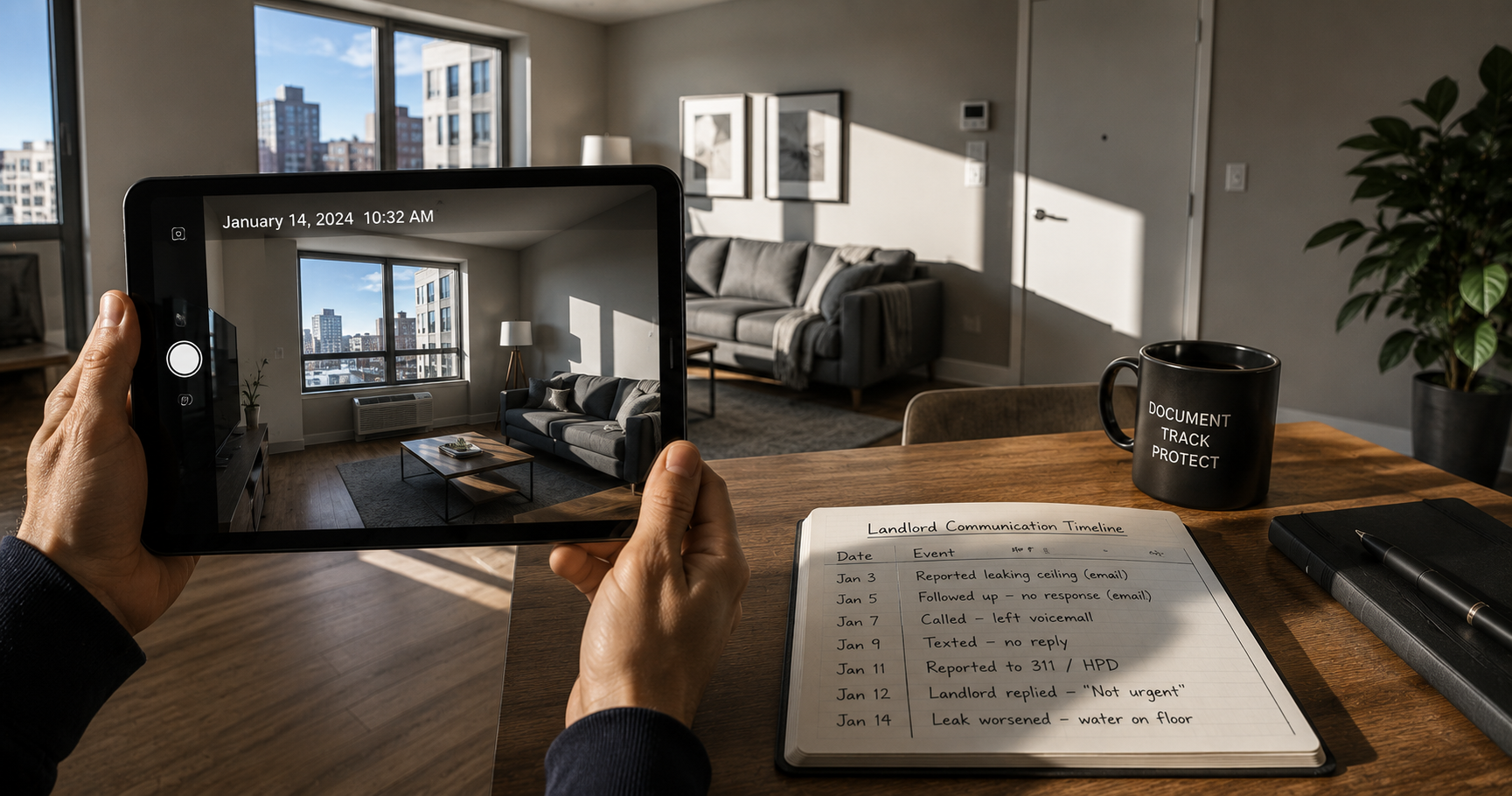
Now, dates. This is what separates a photo that helps from a photo that's merely suggestive, because the entire value of your file is chronological. Use a camera app that stamps the date onto the image, or add dates to your file names — "2026-03-14 bathroom-ceiling-mold-wide.jpg" — or both. Your phone stores capture dates in the file's metadata automatically, which is genuinely useful, but metadata can be stripped by messaging apps and isn't visible to someone looking at a printout. Visible dates survive being printed, emailed, and forwarded. Use them.
Two more techniques worth adopting. First, include something for scale when size matters — a coin, a ruler, your hand next to a crack or a patch of mold. "It's a big crack" is an opinion; a crack photographed beside a quarter is a measurement. Second, and most importantly: photograph the same condition repeatedly over time, from roughly the same angle. A single photo of mold proves mold. Four photos of the same wall taken in November, January, March, and May prove mold that has been there for six months and is spreading — which is a categorically different fact, and it's the one that establishes duration. Put a recurring reminder in your phone. Same spot, same angle, once a month. That series will do more work than any single dramatic image.
Two more shots are worth taking deliberately, because each one kills a specific landlord defense before it's raised.
The first is the baseline. If you have move-in photos — the ones you took for your security deposit, or just the pictures you sent friends when you got the place — go find them and copy them into your folder now. They are enormously valuable, because they establish what the apartment looked like before, and "the tenant caused this" is one of the most common responses to a damage or mold claim. A photo of that ceiling, clean, on the day you moved in, ends that argument permanently. If you don't have move-in photos, take a general set today anyway — of the whole apartment, room by room, including the areas that are currently fine. Today's photos are next year's baseline, and the areas that are fine now are exactly the ones a future dispute may turn on.
The second is the after-repair shot. When a landlord does come and do something, photograph the result — that day, and again a few weeks later. This matters because "I fixed it" is another standard defense, and it's often true in a narrow, useless sense: someone came, painted over the stain, and left the leak above it entirely intact. A photo of fresh paint in April followed by a photo of the same stain bleeding back through in June proves that what happened wasn't a repair. It was a cover-up, and you can show it.
Together these two shots close off the "you caused it" and "I already fixed it" exits, which are, along with "you never told me," the three things a landlord is most likely to say.
Some problems simply don't photograph, because the hazard is the motion. For those, use video.
Flickering or sparking outlets are the clearest case. A photo of an outlet shows an outlet. A five-second video of it sparking shows a fire hazard. Same with active leaks — a photo of a wet floor invites the response that something spilled; a video of water dripping steadily from a ceiling does not. Overflowing trash or sewage in common areas benefits from video because the scale and the ongoing nature come through in a way stills flatten. And for radiators or heaters that aren't working in winter, video lets you show the whole story in one continuous take: the radiator, your hand on it (cold), the thermometer reading, and the window showing it's plainly winter outside — all without cuts, which is precisely what makes it credible.
Video also captures things that aren't visual at all. Sound is evidence: the scratching in the walls at 2 a.m., the banging pipes, the smoke alarm chirping for the fourth month. None of that photographs. Twenty seconds of audio with the date narrated does the job. Same with anything intermittent — a problem that only appears sometimes is exactly the kind a landlord will deny, so when it appears, film it.
Keep each video short. Under a couple of minutes, and honestly, most should be under thirty seconds. There's a real reason for this beyond convenience: a short, focused clip that shows one thing clearly is far more likely to actually be watched, and far more persuasive, than a long meandering tour of your apartment. Nobody — not an inspector, not an advocate, not a judge — is going to watch eleven minutes of you walking around narrating. They will watch fifteen seconds of a dripping ceiling.
Label them clearly, exactly as you do with photos: "2026-03-14 kitchen-outlet-sparking.mp4."
A few techniques that make video hold up. Narrate briefly and factually — state the date, the location, and what you're showing. "March 14th, kitchen outlet, left of the sink." That's it. Resist commentary about how outrageous it is; the clip is stronger without it, and editorializing makes you look like you're performing rather than recording. Hold the shot steady for a few seconds on each thing rather than sweeping around. And when it's relevant, capture continuity in a single unbroken take — the cold radiator and the thermometer in the same shot proves a relationship that two separate clips can't.
One caution: if something is actively dangerous — sparking wires, a gas smell, water near electrical — your safety comes first and the video comes second, or not at all. Document what you can do safely, and report the emergency. No piece of evidence is worth a fire.
This may be the most valuable document you create, and it's the one tenants almost never think of. Photos prove conditions. This log proves notice and failure — which, as we saw earlier, is often where habitability claims are actually decided.
For every serious issue, record: the date you noticed it. The date you reported it. How you reported it — text, email, call. The landlord's response, especially any promise: "I'll have someone out by Friday." And then, critically, add a note when the deadline passes with nothing done.
That last element is what makes this log devastating rather than merely tidy. Consider what a completed entry looks like:
Noticed: Nov 3 — water stain on bedroom ceiling, growing. Reported: Nov 4 by text (saved). Response: Nov 4 — "I'll get the roofer up there next week." Nov 18 — no repair. No contact. Reported again: Nov 20 by email (saved). Response: Nov 21 — "Scheduling it." Dec 15 — no repair. Stain now 3x original size (photo).
Read that back and notice what it establishes without a single word of argument. The condition existed. It was reported — twice, in writing. The landlord acknowledged it, which forecloses any claim they didn't know. They made specific promises. They broke them. Six weeks passed and it got worse. Every element a habitability claim needs is sitting right there, in a log that took perhaps four minutes total to write across six weeks.
Their promises are your evidence. This is the reframe to internalize. When a landlord says "I'll fix it next week," it feels like a resolution — you relax, you cross it off your mental list. It isn't a resolution. It's a dated commitment, and if it's kept, wonderful, nothing lost. If it's broken, it has become one of the most damaging things in your file, because a broken promise proves both knowledge and failure simultaneously. So write down every promise, with its date and its deadline. Root for them to be kept. Record them in case they aren't.
Which points to a practical rule: report in writing, always. If you call, follow up with a text or email — "Just to confirm our call, you said you'd have the plumber out by the 14th." That single sentence converts an unprovable phone call into a written record, creates a document establishing notice, and does it in a tone no one could object to. If the landlord replies at all, they've confirmed it. If they don't, your account stands unchallenged in writing.
Keep the log factual and unemotional. It will be far more powerful for it.
Conditions are one thing. Consequences are another, and they're what elevate a claim from "this apartment is substandard" to "this apartment harmed me."
Save your medical records. Doctor visits, urgent care notes, prescriptions — anything tied to respiratory problems, skin conditions, or stress-related complaints that connect to the apartment. When you go, tell the provider about the conditions at home. This matters for two reasons: it's medically relevant information they need, and it means the connection appears in a contemporaneous medical record created by a professional, which is dramatically stronger than the same claim in your own diary.
That single act — mentioning the apartment at the appointment — is probably the highest-leverage thing in this entire step, and it costs one sentence. "I want to mention that there's been mold in my bathroom since the fall, and I'm wondering if it's related." Whatever the doctor concludes, the fact that you reported the conditions on that date, to a medical professional, now exists in a record you didn't write. Months later, when a landlord suggests you invented the connection after the fact, that chart note says otherwise. Most tenants never think to say it, and it's free.
Save the impact records too. Screenshots of missed work or school. The email to your manager saying you couldn't come in. The text to your kid's teacher. The day you spent at urgent care instead of at your job. These are the ways an unsafe apartment reaches beyond the apartment, and they're evidence that what you've been dealing with is harm rather than inconvenience. Keep the pharmacy receipts and prescription records too — an inhaler prescription dated in the same month as your mold photos is a quiet, powerful piece of corroboration.
That distinction is the whole point of this step. There's a version of your situation that reads as unpleasant — bad apartment, tenant unhappy — and a version that reads as harmful: bad apartment, tenant's asthma worse, three urgent care visits, four missed shifts, prescriptions dated across the same months as the mold photos. The conditions are identical in both versions. The second one has the consequences documented, and the second one is the one that gets taken seriously, because it establishes that real people were really hurt by this.
A note on honesty, because it protects you: don't claim a connection you don't have. If you have a cough and don't know whether it's the apartment, the honest record is "cough, uncertain cause" — and honest records are what make your file trustworthy as a whole. Let the doctor make medical judgments. Let the pattern speak for itself. A file that overreaches on one item invites doubt about all the others, while a file that carefully distinguishes what's known from what's suspected earns belief on every line.
And if the conditions are affecting a child — a kid with worsening asthma, missed school, pediatrician visits — document that with particular care. Harm to children in a dwelling tends to be taken extremely seriously by every body that touches these cases.
The last step protects everything else, and it's the one people skip because it feels like housekeeping rather than evidence.
Keep local copies and a cloud backup. Your phone plus a drive, or a drive plus email — the specific tools matter less than the principle, which is that your evidence should survive the loss of any single device. Photograph or scan the paper items so they exist digitally too.
Understand what real redundancy means, because a common mistake defeats the purpose: two copies on the same phone is not a backup, it's one copy in two folders. The copies have to be able to survive different disasters — a lost phone, a locked account, a fire, a theft. Pair something local with something remote. Emailing key items to yourself is an underrated move here: it puts a timestamped copy on a server you don't maintain, retrievable from any device, and the email's own date helps establish when the file existed.
And back up as you go, not at the end. The temptation is to treat backup as a final task once the file is "done," but files are never done, and the dropped phone won't wait for you to finish. Add each new photo, video, and log entry to both locations as you create it. Seconds each time; total protection.
While you're at it, name things so the backup is actually usable rather than merely present. A cloud folder containing four hundred files called IMG_4471.jpg is a backup in the technical sense and useless in every practical one. "2026-03-14 bedroom-ceiling-stain-wide.jpg" tells you and anyone else exactly what it is and when, without opening it — and it means that when an advocate asks whether you have anything showing the ceiling in the fall, you can answer in ten seconds instead of scrolling for twenty minutes. Sort by date and the whole chronology assembles itself, which is precisely the story you need to tell.
Consider keeping a short index too — a plain text file listing what's in the folder and what each item shows. It takes five minutes and it's the difference between handing someone a pile and handing them a case.
Here's what's at stake, stated plainly. Tenants spend months building genuinely excellent documentation — the monthly photo series, the log, the medical records — and then lose all of it because a phone went into a sink, or got stolen on a train, or simply died. Everything gone, and it cannot be reconstructed, because the whole value was in the dated, contemporaneous nature of it. You cannot go back and take November's photo in March.
Solid documentation is often the single thing that turns an ignored complaint into a claim a landlord has to answer. It's worth ten seconds a day to make sure it can't vanish.
Everything so far is documentation you create yourself, which is genuinely powerful — but there's a category that's stronger still, because it doesn't depend on your credibility at all: records made by someone other than you.
The most accessible of these is a housing inspection. If you call 311 in New York City, or your local housing agency elsewhere, an inspector may come out and record what they find. If they issue a violation, that violation is an official government record stating that a hazardous condition existed at your address on a specific date — created by a neutral party with no stake in your dispute. Nothing you photograph carries quite that weight, because the landlord can always suggest you staged or exaggerated your own evidence. They cannot say that about an inspector's findings.
It's worth knowing how these are graded, because the classification tells you how seriously the city regards your condition. New York City's HPD sorts violations into three classes: Class A is non-hazardous, with a 90-day window to fix. Class B is hazardous, with 30 days. Class C is immediately hazardous — things like no heat, no hot water, lead paint, or a serious vermin infestation — and carries a 24-hour cure period. If an inspector issues a Class C at your apartment, an agency of the City of New York has formally recorded that your living conditions are immediately hazardous. That is a fact about your situation that exists independently of anything you say, and it is worth a great deal.
Get the violation numbers and any inspection reports into your folder. And here's a step most tenants never take: look up your own building. HPD Online — hpdonline.nyc.gov — is free and searchable by address, and it shows violations with their class, the date reported, and a description of the condition. Search your address. You may discover open violations you never knew about, including ones in your own unit, and you may discover a pattern across the building. A landlord with a long trail of open violations across many apartments is a landlord whose "it's not that bad, she's exaggerating" carries very little weight. That history is public, it's free, and it took you ninety seconds to find.
Other third-party records work the same way. The pediatrician's note. The exterminator's report, if one was ever sent. An email from a neighbor confirming the hallway has no working smoke detector either. A contractor's assessment, if you ever had one out. Each of these is evidence that doesn't rest on you being believed.
None of this replaces your own documentation — your monthly photos and your log are the spine of the file, and often the only things that establish duration and notice. But third-party records anchor the whole thing, because they convert "the tenant says there's mold" into "the city inspected and found mold." When you can get them, get them.
One more thing worth knowing, because it's the fear that stops people from calling 311 in the first place: retaliating against a tenant for making a good-faith complaint to a housing agency is unlawful. If your landlord responds to an inspection by moving against you — a non-renewal, a sudden rent increase, new "violations" of your lease — that reprisal is itself a separate legal problem for them, and your dated complaint is what proves the timing. Report the conditions. The law anticipated exactly this situation.
Let's watch the difference play out.
Imagine a tenant with a bedroom ceiling that started staining in the fall. By spring it's a spreading brown patch, the room smells musty, and her daughter's asthma has gotten noticeably worse. She's mentioned it to the landlord repeatedly — she's certain of that — and he's said he'd deal with it, and he hasn't.
Run it without documentation. In March she finally calls a tenant hotline, furious, and describes a ceiling that's "disgusting" and a landlord who "never does anything." The advocate asks reasonable questions. When did it start? Around the fall, she thinks — maybe October? When did you report it? She's told him lots of times, mostly when she catches him in the hall. Do you have anything in writing? Not really. Photos? A couple on her phone somewhere, undated, she'd have to look. Any medical records connecting your daughter's asthma? She's been to the pediatrician, but she never mentioned the apartment.
Everything she said is true. None of it is provable. The landlord will say he was never properly told, that he fixed a leak last year, that the stain is old and cosmetic, and that a kid having asthma in New York proves nothing. She has no answer to any of it — not because she's wrong, but because she's undocumented.
Now run it with the file. She sets up the folder in October, the day she notices the stain. She photographs it: wide shot showing the ceiling and the window for context, then close-ups, then a shot with her hand for scale. She texts the landlord that day — in writing, deliberately — and screenshots his reply: "I'll get the roofer up next week."
Next week comes and goes. She notes it in her log. She re-photographs the ceiling from the same angle on the first of every month; by January the stain has visibly doubled and the growth is undeniable across four images. In December she catches him in the hall and he promises again; she goes upstairs and sends a follow-up text — "just confirming, you said the roofer would come before the holidays" — and he thumbs-ups it, which is now a dated acknowledgment. When the ceiling starts actively dripping in February she takes a fifteen-second video: the date narrated, the drip, the bucket.
She takes her daughter to the pediatrician and this time mentions the apartment: the mold smell, the stain, the timeline. It goes in the chart. She saves the two emails to her employer about the mornings she missed for urgent care.
In February she also calls 311. An inspector comes out, finds the condition, and issues a violation — an official city record, created by someone with no stake in her dispute, stating that a hazardous condition existed at her address on that date. She looks up her building on HPD Online while she's at it and finds four other open violations across the building, none of which she'd known about. All of it goes in the folder.
In March she calls the same hotline. When did it start? October 3rd — here's the first photo. When did you report it? October 3rd, by text, here it is, and here's his reply promising a roofer. Then again on December 18th, here's that one. Did he ever fix it? No — and here's the same ceiling photographed monthly from October to March, and here's video of it dripping in February, and here's the city's violation from the inspection. Any medical connection? Here's the pediatrician's note referencing the home conditions, and two missed workdays.
Same ceiling. Same landlord. Same daughter, same asthma. In one version, a woman with a legitimate grievance is helpless against a landlord's denials. In the other, every denial he could offer is already dead on arrival — and the file that did it consists of a monthly photo, a handful of texts she was sending anyway, a log of four lines, and one sentence to a pediatrician.
Step back and look at what a complete file contains. A named folder holding everything. Photographs taken wide-then-close, dated, with scale, repeated over months so duration is visible. Video of the problems that only exist in motion. A log recording every report, every promise, and every deadline that passed. Medical and impact records tying the conditions to actual harm. And all of it backed up so an ordinary accident can't erase it.
Here's the reframe to carry with you. It feels like the strength of your case should track the badness of your apartment — that if the conditions are severe enough, surely that will be recognized. It doesn't work that way, and the sooner you accept it, the better you'll do. Your case tracks what you can show. Severity you can't prove is worth nothing; a moderate condition, thoroughly documented across time with notice established and promises broken, is worth a great deal.
That sounds cold, and in a sense it is. But look at what it actually means for you: the part that determines your outcome is the part that's entirely within your control. You can't make the landlord fix the ceiling. You can't make the mold stop growing. You can photograph it monthly from the same angle, text instead of calling, write down what he promised and when, and mention the apartment to your doctor. Those things cost you almost nothing and they are, in the end, what decides this.
So build the file. Make the folder today. Photograph what's wrong — wide, then close, dated, with something for scale. Video the drip and the sparking outlet. Report in writing, always, and write down what they promise. Save the medical records and mention the apartment when you go. Back it up twice.
You've been carrying the knowledge that your apartment isn't safe. That knowledge, alone in your head, has done nothing for you. Written down, photographed, dated, and organized, it becomes something else entirely — a claim that a landlord has to answer, an agency can act on, and a court can see. The conditions were always real. Now make them provable. Find out where you stand.