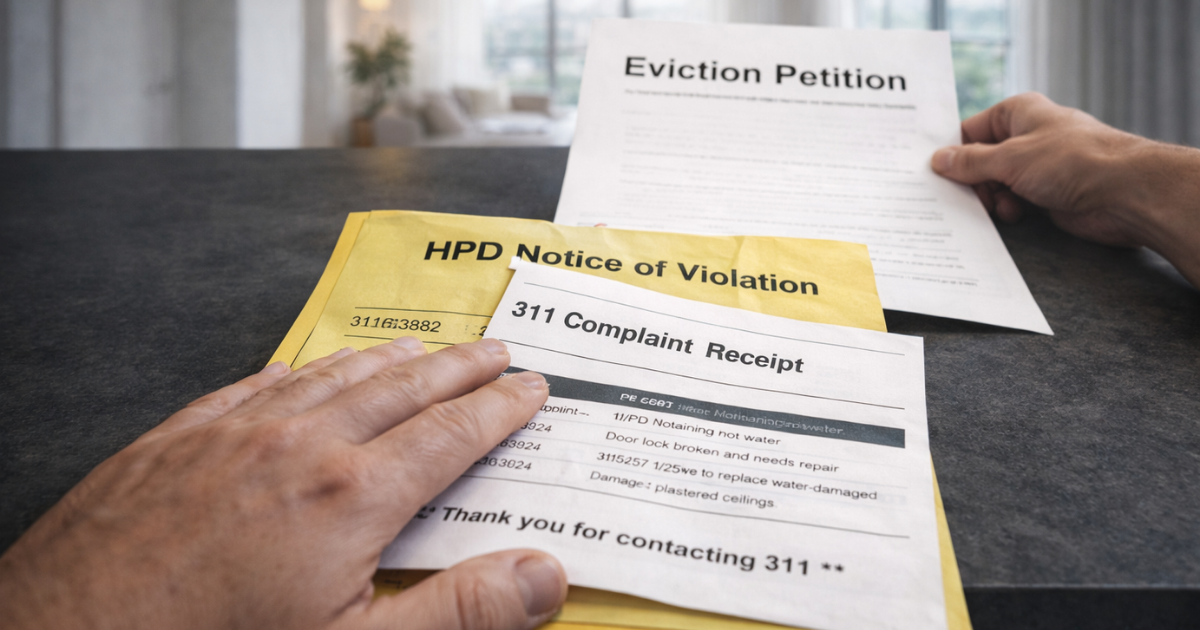
You finally did it. After living with broken heat all winter, or mold spreading across your ceiling, or mice running through your kitchen, you called 311 and reported your landlord to HPD. The inspector came, confirmed the violations, and issued citations. You felt relieved—finally, someone official acknowledged that your apartment is uninhabitable and your landlord has to fix it.
Then, two weeks later, you get a notice. Your landlord is not renewing your lease. Or they're filing eviction claiming you violated some obscure lease term you've never heard them mention before. Or suddenly they're raising your rent by an amount that makes staying impossible. The timing is too obvious to be coincidence. You think: "They're punishing me for reporting them. Can they do this? Is this legal? Do I have any protection, or did reporting violations just cost me my home?"
This fear—that exercising your legal right to report unsafe conditions will result in losing your home—keeps thousands of New York tenants living in dangerous, uninhabitable apartments rather than calling the city for help.
Here's the truth: It is absolutely illegal for your landlord to evict you, refuse to renew your lease, or otherwise retaliate against you because you reported code violations. New York law specifically prohibits retaliatory eviction and creates powerful legal protections for tenants who report violations or assert their rights.
Not only is retaliation illegal, but the law presumes retaliation when landlords take action against you within six months of your complaint—meaning your landlord has to prove they're NOT retaliating. The burden of proof is on them, not you.
Let me show you exactly what the law says, how the retaliation presumption works, what defenses you have, and how to protect yourself when you report violations.
This fear isn't paranoia—it's based on real power dynamics and experiences:
When you report violations:
You think: "Landlord will figure out I called 311. They'll know I'm the one who reported them. They'll retaliate."
This fear is realistic: Landlords often do know who reported them, especially in smaller buildings.
But here's what you don't know: The law specifically protects you BECAUSE landlords know who reported them. Retaliation is illegal precisely because lawmakers recognized this power dynamic.
You worry:
This fear reflects understanding of how retaliation often works: Landlords rarely say explicitly "I'm evicting you for calling HPD." They create pretextual reasons.
But here's what you don't know: The law accounts for this. The timing-based presumption of retaliation is designed specifically to catch pretextual evictions.
You think:
This fear reflects real inequality in access to legal resources.
But here's what you don't know:
You worry:
This fear reflects understanding that retaliation can take many forms beyond eviction.
But here's what you don't know:
Let's establish the legal framework that protects you:
New York Real Property Law § 223-b makes it illegal for landlords to:
Evict you, OR Refuse to renew your lease, OR Substantially change lease terms (like massive rent increases), OR Otherwise penalize you
In retaliation for:
Making good-faith complaints about housing conditions or code violations to government agencies (HPD, 311, Department of Buildings, health department, etc.)
Joining a tenants' organization or association
Asserting your legal rights as a tenant in good faith
Testifying in court or administrative proceedings about housing conditions
Any other exercise of your legal tenant rights
Retaliation is when landlord takes adverse action against you (eviction, non-renewal, rent increase, service reduction) BECAUSE you exercised protected rights.
The key element is motive: Is the landlord acting to punish you for reporting violations or asserting rights?
Retaliation can be:
Direct and obvious: Landlord says "You called HPD on me, so I'm not renewing your lease."
Pretextual and disguised: Landlord files eviction claiming lease violation that was never enforced before, or claiming nonpayment when you actually paid rent, or refusing renewal claiming they need apartment for family (but they don't actually need it—it's an excuse).
The law protects against both forms. You don't need landlord to admit retaliation. Circumstantial evidence (especially timing) can prove it.
This is the most powerful protection in the law:
If landlord takes adverse action against you within approximately six months after you made a protected complaint or took protected action, New York courts presume the action is retaliatory.
What this means in practice:
Timeline:
Legal presumption: Because landlord's action (eviction/non-renewal) occurred within 6 months of your HPD complaint, the law presumes it's retaliation.
Burden shifts to landlord: Landlord must prove they have a legitimate, non-retaliatory reason for the eviction/non-renewal.
You don't have to prove retaliation: The timing alone creates the presumption. Landlord has to disprove it.
In normal eviction cases:
In retaliation cases within 6-month window:
This burden-shifting is huge: It changes the entire dynamic. Instead of you proving landlord's bad motive, landlord has to prove good motive.
Landlords often can't meet this burden because:
Let's apply the law to specific situations:
What happens:
Your timeline:
Retaliation analysis:
Protected activity: ✓ You made good-faith complaint to government agency (HPD via 311)
Adverse action: ✓ Landlord filed eviction
Timing: ✓ Eviction filed less than one month after HPD violations—well within 6-month presumption window
Presumption applies: ✓ Court presumes eviction is retaliatory
What this means in court:
Your defense: "I filed HPD complaint on January 10. Landlord filed this eviction on February 5, less than a month later. Under RPL § 223-b, this creates a presumption of retaliation. Landlord must prove this eviction is not retaliation for my HPD complaint."
Landlord must prove: That the eviction is based on legitimate grounds unrelated to your complaint.
Landlord's challenge: If the claimed lease violation (pet, noise, etc.) either:
...then landlord can't overcome the retaliation presumption and the eviction gets dismissed.
Likely outcome: Strong chance of dismissal, especially if landlord's claimed violation is weak or timing is very close to complaint.
What happens:
Your timeline:
Retaliation analysis:
Protected activity: ✓ HPD complaint about lead paint
Adverse action: ✓ Non-renewal of lease
Timing: ✓ Non-renewal notice sent one month after HPD complaint—within 6-month window
Presumption applies: ✓ Court presumes non-renewal is retaliatory
What this means:
In month-to-month or non-stabilized buildings: Landlords normally have broad discretion not to renew. BUT retaliation law overrides that discretion. They can't use non-renewal to retaliate even if they could normally choose not to renew for any reason.
In rent-stabilized or Good Cause buildings: Non-renewal already requires good cause. Retaliation isn't good cause. Landlord must prove legitimate good cause AND that it's not retaliation.
Your defense: "Landlord refused to renew my lease one month after I reported lead paint violations to HPD. The timing creates a presumption of retaliation under RPL § 223-b."
Landlord must prove: Legitimate non-retaliatory reason for non-renewal (owner occupancy, substantial renovation, etc.) AND that reason isn't pretextual.
Likely outcome: If landlord can't produce strong evidence of legitimate need (like actual owner occupancy plans with documentation), non-renewal is blocked as retaliatory.
What happens:
Your timeline:
Retaliation analysis:
Protected activity: ✓ HPD complaint
Adverse action: ✓ Substantial increase in rent (substantial change to lease terms)
Timing: ✓ Increase offered 6 weeks after HPD complaint—within 6-month window
Presumption applies: ✓ Court presumes rent increase is retaliatory
What this means:
RPL § 223-b prohibits "substantially changing lease terms" in retaliation. A 47% rent increase after years of modest increases is a substantial change, especially right after HPD complaint.
Your defense: "My rent increased an average of $50-$75 annually for 2 years. Six weeks after I reported HPD violations, landlord demanded a $700/month increase (47%). This substantial change in lease terms immediately after my complaint is presumed retaliatory."
Landlord must prove: The increase is based on legitimate market factors, not retaliation, AND explain why suddenly after your complaint the rent needed to jump 47% when previous increases were under 5%.
Likely outcome: Very difficult for landlord to overcome presumption given the dramatic change in pattern immediately following complaint. Increase likely deemed retaliatory and unenforceable.
What happens:
Your timeline:
Retaliation analysis:
Protected activity: ✓ HPD complaint
Adverse action: ✓ Eviction filing
Timing: ✓ Eviction filed 2.5 months after HPD complaint—within 6-month window
Presumption applies: ✓ Court presumes eviction is retaliatory
But landlord claims nonpayment—a seemingly legitimate reason:
Your defense: "I've paid rent on time for 18 months. I paid June and July rent after my HPD complaint. Landlord's claim that I owe $4,500 is false. I have bank records proving payment. This eviction filed shortly after my HPD complaint is retaliatory."
Key evidence: Bank statements showing rent checks clearing, or online payment confirmations, or receipts from landlord.
What happens in court:
Landlord must prove: (1) You actually owe the money, AND (2) The eviction isn't retaliation
You present: Payment records disproving landlord's claim
Analysis: Landlord's "legitimate reason" (nonpayment) is proven false. This strengthens retaliation finding—landlord is fabricating grounds to evict you after your complaint.
Likely outcome: Eviction dismissed. Landlord may face sanctions for filing baseless case. Retaliation is especially clear when landlord fabricates the non-retaliatory reason.
Retaliation protection doesn't make you eviction-proof. Here's the line:
Legitimate non-retaliatory grounds that can overcome the presumption:
If you actually owe rent and landlord can prove it:
Even within 6-month window after complaint, landlord can evict for genuine nonpayment IF they can prove:
Example of legitimate nonpayment:
Analysis: Nonpayment is real and documented. Landlord can probably overcome retaliation presumption by showing genuine financial grounds for eviction.
Example of retaliatory nonpayment claim:
Analysis: Nonpayment claim is false. This actually strengthens retaliation finding—fabricated grounds prove retaliatory motive.
If you're actually violating lease in substantial ways:
Landlord may be able to evict even within 6-month window IF they can prove:
Example of legitimate lease violation:
Analysis: Serious safety violation unrelated to complaint. Landlord can probably overcome presumption.
Example of retaliatory lease violation claim:
Analysis: Pretextual enforcement. Landlord tolerated same conduct before complaint, now using it as excuse to evict after complaint. Retaliation is clear.
In some situations, landlords can reclaim apartments for owner or immediate family occupancy:
Landlord might overcome presumption IF they can prove:
Example that might overcome presumption:
Analysis: Timing shows decision predated complaint. If documentation is strong, might overcome presumption.
Example that won't overcome presumption:
Analysis: Timing and lack of documentation suggest pretext. Retaliation presumption stands.
"Would landlord be taking this action if tenant had never reported violations?"
If the answer is "probably not" or "unclear," retaliation presumption wins and eviction/non-renewal is blocked.
If the answer is "yes, clearly," and landlord has strong documentation proving it, landlord might overcome presumption.
If you're planning to report violations, or already have and are worried about retaliation:
Document your protected activity:
Save proof of your complaint:
Save inspection and violation records:
Save landlord's response (or non-response):
Why this matters: This documentation proves the protected activity (HPD complaint) and establishes the timeline. When landlord later takes adverse action, you can show exact dates proving it followed your complaint.
Create a detailed timeline document:
Format:
Example timeline:
December 2023-February 2024: No heat in apartment multiple times
January 15, 2024: Emailed landlord requesting heat repair
January 20, 2024: Landlord responded "will look into it"
February 1, 2024: Heat still broken, called 311, complaint #123456789
February 10, 2024: HPD inspector came, found heat violations
February 15, 2024: HPD issued violations to landlord
February 28, 2024: Landlord sent email mentioning "lease renewal discussion"
March 5, 2024: Landlord delivered non-renewal notice
Why this timeline matters: It visually shows the sequence: complaint → violations → adverse action. This makes retaliation obvious to anyone reviewing your case.
Document that you were a "good tenant" before the complaint:
Payment history:
Lease compliance history:
Renewal history (if applicable):
Why this matters: Shows landlord's action represents a sudden change in treatment immediately following complaint, which suggests retaliatory motive.
If landlord takes action after your complaint, document everything:
For eviction notices/petitions:
For non-renewal:
For substantial lease changes:
For harassment or other retaliation:
CRITICAL: You must respond to legal notices even if you believe they're retaliatory.
If you receive eviction petition:
If you receive non-renewal notice:
Why you can't ignore it:
Contact legal services as soon as you receive adverse action:
NYC:
Outside NYC:
Tell intake: "My landlord is trying to evict me [or refused to renew my lease] right after I reported housing violations to HPD. I believe this is retaliation. I need help raising a retaliation defense under RPL § 223-b."
What lawyers will do:
Understanding the court process helps you prepare:
Your Answer includes:
General denial of landlord's allegations (if they're false or exaggerated)
Affirmative defense of retaliation:
Request for relief:
Once you've established:
The burden shifts to landlord to prove legitimate non-retaliatory grounds.
Landlord must present evidence showing:
Legitimate grounds exist (nonpayment, substantial lease violation, owner occupancy)
Grounds are real, not fabricated (documentation, witnesses, records)
Decision would have been made regardless of complaint (timing, previous enforcement patterns, documentation)
Your lawyer presents evidence showing:
Timing is suspicious (action taken shortly after complaint)
Claimed grounds are false (you paid rent landlord claims you didn't, violation landlord claims didn't actually occur)
Claimed grounds are pretextual (landlord tolerated same conduct before complaint, selective enforcement, sudden standards change)
Landlord's explanation doesn't hold up (owner occupancy claim without documentation, nonpayment claim contradicted by your bank records)
Judge weighs:
If landlord can't overcome presumption:
If landlord overcomes presumption (rare, requires very strong evidence):
Facts:
Tenant's defense:
Landlord's attempt to overcome presumption:
Court's analysis:
Outcome: Eviction dismissed as retaliatory. Tenant awarded attorney fees.
Here's what you need to know:
Retaliation is explicitly illegal. It's not a gray area. RPL § 223-b directly prohibits evicting or refusing to renew in retaliation for reporting violations.
The six-month presumption is powerful. It shifts the burden to landlord, making your case much easier to win. Timing alone creates the presumption.
Landlords often can't overcome the presumption because their stated reasons are pretextual, their timing is suspicious, and evidence shows selective enforcement.
You have the right to report violations without fear of losing your home. This right is legally protected specifically because lawmakers understood the power imbalance and the fear you're experiencing.
Free legal representation is available for eviction defense, including retaliation defenses. You won't fight alone.
Taking action sends a critical message to your landlord that you know your rights and will enforce them.
If you don't report violations because you fear retaliation, you're living in unsafe conditions AND your landlord gets away with breaking the law. Retaliation protection exists to break this dynamic.
Report the violations. Document everything. If landlord retaliates, raise the defense. Win your case.
Your right to safe, habitable housing is legally protected. Your right to report violations is legally protected. Your right to stay in your home after reporting is legally protected.
Use these protections. They exist for you.