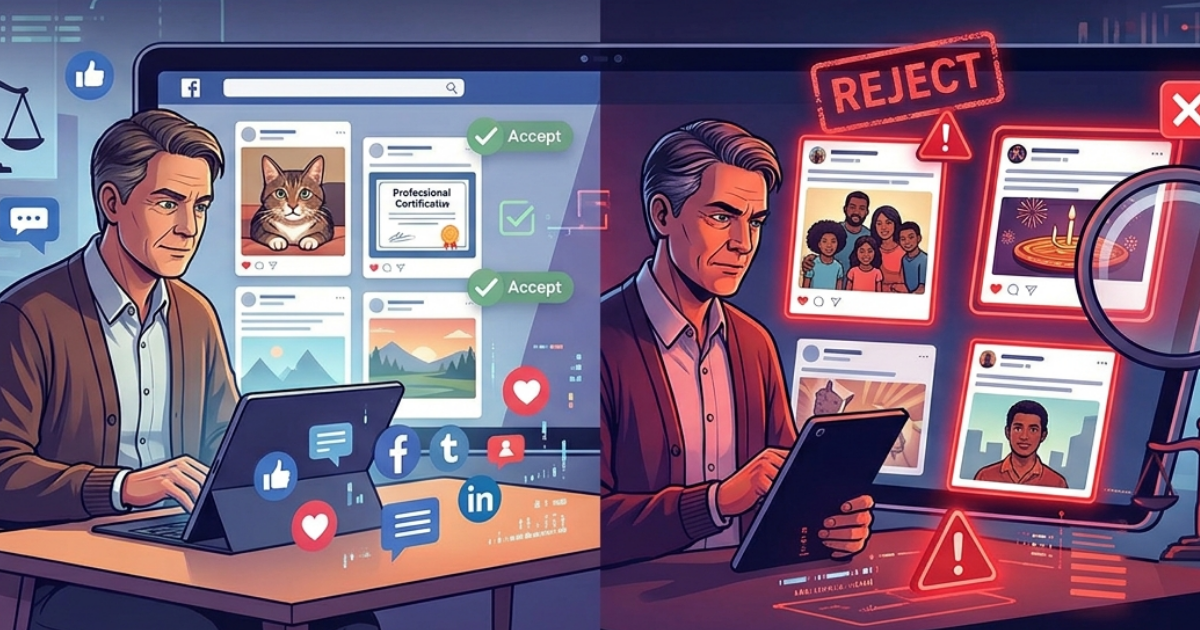
You're apartment hunting, and during your conversation with a potential landlord, they mention they "looked you up online." Your stomach drops. Your Instagram has photos of you at your mosque. Your Facebook profile mentions you're a single parent. Your Twitter shows you're politically active. Your LinkedIn reveals you're much older than the landlord probably assumed from your voice. Or maybe your TikTok makes your disability visible, or your posts mention receiving housing assistance.
You wonder if this online deep dive is even legal. You think about all the personal information visible on your social media—your race obvious in photos, your religion clear from the church or temple you post about attending, your family status evident from kid photos, your political views on display, your disability documented in advocacy posts, your LGBTQ+ identity celebrated openly. You've always been proud to share your authentic life online, but now you're worried this information will be used against you in the rental process.
You think: "Can landlords legally look at my social media to screen me? Do I have any privacy rights here? What if they reject me because they don't like what they see—is that discrimination? If they decide I'm 'not a good fit' based on my religion, politics, disability, or family status visible online, is there anything I can do? How would I even know if my social media was the real reason they rejected me?"
Here's the truth: Landlords in New York can view your public social media as part of their applicant research, but they absolutely cannot use what they discover to treat you differently based on protected characteristics like race, religion, disability, family status, national origin, sexual orientation, source of income, or any other trait protected by fair housing law. When social media screening reveals protected characteristics and landlords use that information to discriminate, they're violating the same fair housing laws that prohibit discrimination in traditional screening—it doesn't matter whether they learned about your religion from your application or from your Facebook posts; discrimination is still illegal.
Let me show you exactly what landlords can and cannot legally do with social media screening, when online vetting crosses into illegal discrimination, what red flags reveal discriminatory use of social media, how to recognize and document this increasingly common form of discrimination, and what legal protections apply.
Before identifying illegal discrimination, understand the baseline of what's permissible in New York regarding landlord use of social media for tenant screening.
New York has no blanket prohibition on landlords viewing applicants' publicly available social media profiles. Just as landlords can Google your name to see if you appear in news articles, court records, or business listings, they can view social media content you've chosen to make public. This is treated similarly to other publicly accessible information—if you've posted something publicly on Facebook, Instagram, Twitter, LinkedIn, TikTok, or any other platform, landlords are generally not prohibited from viewing it.
This permissibility stems from the public nature of the information. When you set your social media to "public" rather than "private," you're making a choice to share that content with anyone who looks, including potential landlords. The law distinguishes between information you've voluntarily made public versus private information that requires special access or permission.
The logic is similar to other public information landlords routinely access. They can drive by the property to see you in person (observing your race, approximate age, whether you use mobility aids). They can look at publicly filed court records. They can search for news mentions. Social media viewing fits into this category of publicly accessible information that landlords encounter through ordinary research.
However—and this is critical—just because landlords can view public social media doesn't mean they can use what they see in discriminatory ways. Access to information and legal use of that information are entirely separate questions.
Understanding the boundaries becomes clearer when you look at related New York law regarding social media and employment screening. New York has laws restricting employers from demanding access to private social media accounts—specifically, employers cannot require job applicants or employees to provide passwords, friend or follow them, disable privacy settings, or otherwise grant access to private content.
These employment-focused laws establish an important principle: while employers (and by extension, landlords) can see what you make public, they cannot force you to reveal private content. The law recognizes a boundary between public posts (fair game for viewing) and private accounts or posts (protected from forced disclosure).
Although these specific statutes target employment rather than housing, they illuminate the general principle New York law embraces: there's a distinction between viewing what someone voluntarily makes public versus compelling access to private information. Landlords operating under this framework can look at your public profile but cannot demand you friend them, provide your password, change privacy settings to give them access, or unlock private posts for their review.
This distinction matters because it establishes your right to maintain privacy on social media. You can have a private Instagram that landlords cannot access, or you can use privacy settings to restrict who sees certain posts. Landlords must accept these boundaries and cannot pressure you to remove privacy protections as a condition of renting.
When landlords engage in social media screening, they're usually doing basic public profile viewing—searching your name on Facebook, Instagram, LinkedIn, or Twitter to see what comes up, scrolling through publicly visible posts and photos, and noting information that might relate to tenant screening (employment status, lifestyle indicators, anything suggesting responsibility or irresponsibility).
Some landlords do this casually and informally—just a quick Google search and glance at the first few posts. Others are more systematic, treating social media as another data point in comprehensive background screening. Some property management companies even use third-party screening services that include social media searches as part of packaged tenant screening reports.
The practice has become increasingly common as social media has become ubiquitous. Landlords rationalize it as "getting to know" applicants beyond the formal application, trying to assess whether you'll be a responsible tenant, a "good fit" for the building community, or likely to cause problems. But this informal character assessment is exactly where discrimination creeps in.
The line between permissible social media viewing and illegal discrimination is defined by fair housing law: landlords cannot use social media to discriminate based on protected characteristics.
The most fundamental violation occurs when landlords use social media to discover protected characteristics and then base rental decisions on those characteristics. Just because information is publicly available doesn't mean using it as a decision-making factor is legal.
Race and national origin discrimination through social media happens when landlords view photos that reveal your race or national origin and allow that to influence their decision. If your profile picture shows you're Black, Latinx, Asian, or any other race, and the landlord rejects you based on racial bias (even if unstated), that's illegal race discrimination—whether they learned your race from seeing you in person, from your photo on an application, or from your social media profile photo.
Similarly, posts revealing national origin—photos from cultural celebrations, posts in languages other than English, pictures at ethnic restaurants or cultural centers, mentions of being an immigrant or having family in another country—can trigger national origin discrimination if landlords use this information to reject you based on prejudice against your country of origin or cultural background. The fact that you voluntarily shared these posts doesn't give landlords permission to discriminate based on the national origin they reveal.
Religion discrimination via social media is particularly common because people frequently post about religious life online. Photos at your church, mosque, synagogue, or temple; posts about religious holidays or observances; religious symbols or text in your profile; mentions of being a member of a faith community—all of these can reveal your religion to a landlord viewing your social media. If the landlord then rejects you because they don't want to rent to Muslims, Jews, Christians, Sikhs, Hindus, or members of any other faith (or because they prefer tenants who share their religion), that's illegal religious discrimination under federal and state fair housing law.
The fact that you chose to publicly express your faith doesn't waive your protection from religious discrimination. Just as wearing religious garments to an in-person apartment viewing doesn't make it legal for a landlord to reject you for being religious, posting about your faith on social media doesn't authorize religious discrimination.
Disability discrimination revealed through social media occurs when posts or photos show your disability or allow the landlord to infer you have a disability, and they use that information to reject you based on disability bias or stereotypes. Perhaps your Instagram has photos showing you using a wheelchair, or mentions physical therapy appointments, or discusses your chronic illness or mental health condition, or shows your service animal, or celebrates disability pride. If a landlord sees these indicators of disability and rejects you because of assumptions about disability (that you'll require accommodations, cause problems, be unreliable, etc.), that's illegal disability discrimination under the Fair Housing Act and state law.
Even if the landlord doesn't explicitly acknowledge the disability as a factor, using social media to screen out people whose online presence reveals disability violates fair housing protections. The landlord cannot claim they were simply "getting to know" you and concluded you weren't a "good fit"—if the actual basis is disability bias triggered by social media content, that's discrimination.
Familial status discrimination through social media happens when landlords see posts revealing you're pregnant or have children and use that information to reject you based on anti-family bias. Your Facebook might be filled with kid photos and posts about parenting. Your Instagram might announce your pregnancy. Your posts might discuss childcare, schools, or family activities. If a landlord views this content and decides they don't want to rent to families (preferring "quiet" tenants or "adult" buildings), they're engaging in illegal familial status discrimination.
This occurs even when the landlord frames it differently—claiming they're concerned about "noise" or "wear and tear" or that the apartment "isn't suitable for children." If the real motivation visible in their decision-making process is bias against families revealed through social media, that's prohibited discrimination.
Sexual orientation and gender identity discrimination increasingly manifests through social media screening. Your posts might mention your same-sex partner, show you at Pride events, include LGBTQ+ advocacy content, discuss your gender identity or transition, or otherwise make your sexual orientation or gender identity visible. If a landlord views this content and rejects you based on anti-LGBTQ+ bias—because they don't want to rent to gay, lesbian, bisexual, transgender, or queer tenants—that's illegal discrimination under New York State and New York City human rights law (and increasingly under federal sex discrimination interpretations).
The fact that you're open about your identity online doesn't give landlords permission to discriminate. Your right to authentically express yourself on social media and your right to fair housing free from sexual orientation and gender identity discrimination coexist—you shouldn't have to choose between the two.
Source of income discrimination via social media is particularly relevant in New York, where state and city law prohibit discrimination based on lawful source of income, including government housing assistance. If your social media posts mention receiving Section 8, HASA, CityFHEPS, SSI, SSDI, or other assistance—maybe you posted celebrating finally getting your voucher approved, or you shared resources about housing programs, or you mentioned your benefits in discussing housing search challenges—and a landlord sees these posts and rejects you because you're a voucher holder, that's illegal source of income discrimination.
This is true even though source of income isn't visible in the same way as race or disability. If the landlord uses social media to discover your source of income and then discriminates based on that information, they've violated New York's strong source of income protections. The medium of discovery (social media vs. formal application) doesn't change the illegality of the discrimination.
Discrimination also occurs when landlords apply social media screening unevenly—thoroughly vetting some applicants while not researching others, with the distinction falling along protected characteristic lines.
Imagine a landlord who routinely Googles applicants and checks Facebook, but only does deep social media dives on applicants with foreign-sounding names—spending extra time trying to determine their immigration status, national origin, or religion. Or a landlord who carefully scrutinizes social media only for applicants who disclose disabilities on applications, looking for evidence to justify rejection. Or screening social media only for applicants who mention children, searching for "evidence" of parenting styles or family chaos.
This selective application of social media screening is discriminatory even if what the landlord ultimately finds is theoretically the same for all applicants. The problem is the disparate intensity of scrutiny applied based on protected characteristics. Some applicants get cursory or no social media review; others get intensive background research—and the distinction tracks race, disability, family status, national origin, or another protected trait.
Fair housing law prohibits this kind of disparate treatment. Screening tools and processes must be applied consistently across all applicants, not selectively intensified for protected groups. If social media screening happens at all, it should happen equally for everyone, not just for people whose protected characteristics trigger the landlord's bias or curiosity.
One of the most insidious forms of social media discrimination occurs when landlords use online content to make subjective judgments about whether you're the "right kind" of tenant based on stereotypes, cultural biases, or political preferences that correlate with protected characteristics.
A landlord views your social media and sees you post frequently about racial justice activism, and decides you're "too political" or "likely to cause trouble"—this often masks race discrimination, as racial justice advocacy is disproportionately engaged in by people of color and those perceived as such. The landlord isn't explicitly saying "I won't rent to Black people," but using political content as a proxy for race-based rejection.
Or a landlord sees your Instagram is filled with drag performance photos and LGBTQ+ nightlife, and concludes you're "too flamboyant" or "not a good cultural fit for the building"—this is sexual orientation and gender identity discrimination disguised as cultural preference. The landlord is using your expression of queer identity as a basis for rejection while claiming it's about "fit" or "lifestyle compatibility."
Or a landlord views posts showing you're deeply religious—frequent church attendance, faith-based community involvement, posts about religious values—and decides you're "too religious" or "probably judgmental of other tenants"—this is religious discrimination masked as concern about interpersonal dynamics.
Fair housing agencies and courts recognize these subjective "fit" assessments as often being pretexts for discrimination. When a landlord can't point to objective qualification failures (income, credit, rental history) and instead relies on vague social media-informed judgments about personality, lifestyle, values, or compatibility, those judgments often reflect bias against protected characteristics visible online.
The term "good fit" or "right fit for our community" is a particular red flag, because it suggests the landlord is selecting tenants based on social, cultural, or demographic characteristics rather than ability to pay rent and comply with lease terms. When social media is the source of information feeding "fit" assessments, discrimination is very likely occurring.
Given New York City's particularly aggressive enforcement of source of income discrimination protections, it's worth emphasizing how these apply to social media screening specifically.
NYC law makes it illegal to discriminate based on lawful source of income, explicitly including Section 8 vouchers, CityFHEPS, HASA, SSI, SSDI, and other forms of government assistance or benefits. If your social media posts reveal you receive any of these forms of assistance—whether through direct mentions, posts in housing assistance groups, sharing of resources about vouchers, celebration of getting approved for assistance, or advocacy for voucher holders—and a landlord views these posts and rejects you because they don't want to accept vouchers or rent to benefit recipients, that's per se illegal under NYC law.
The NYC Commission on Human Rights has made clear that source of income discrimination is illegal regardless of how the landlord learned about your source of income. Discovering you have a voucher through social media rather than through a formal application doesn't make the subsequent discrimination any less illegal. The Commission has pursued cases where landlords found out about vouchers through informal channels (including social media) and then discriminated, treating these cases no differently than discrimination based on vouchers disclosed on applications.
This is particularly important because voucher holders often connect online, sharing resources and support in Facebook groups, posting about housing search challenges, or celebrating housing victories. These posts are part of valuable community building, but they can also reveal voucher status to landlords who look at social media. NYC law ensures that this revelation cannot legally be used as a basis for rejection.
New York City's Fair Chance for Housing Act creates specific limitations on how landlords can use information about criminal history, and these limitations apply to information discovered through social media just as they apply to formal background checks.
The Fair Chance for Housing Act prohibits most NYC landlords from inquiring about or considering criminal history until after making a conditional offer of housing based on non-criminal criteria. The law then limits which convictions can be considered, requires individualized assessment, and mandates notice and opportunity to respond.
These requirements don't include an exception for "information discovered on social media." If a landlord cannot legally ask about criminal history on an application form before conditional approval, they also cannot legally use social media or Google searches to dig up criminal history information before that stage and use it as a screening factor.
Pre-conditional offer social media searches for criminal history violate Fair Chance when a landlord, before making any conditional offer, Googles your name or searches social media to find arrest records, mugshots, news articles about past convictions, or posts you've made mentioning criminal justice involvement—and then uses that information to reject you. This circumvents Fair Chance's "ban the box" requirement by obtaining criminal history information through an alternative channel before the legally permitted time.
Even if the information is publicly available (news articles, court records, your own posts), using it to screen you out before conditional approval violates Fair Chance's sequencing requirement. The landlord must first evaluate income, credit, and rental history, make a conditional offer if you're qualified on those grounds, and only then move to criminal history assessment.
Using impermissible criminal history discovered on social media also violates Fair Chance even if discovered at the proper time. Remember, Fair Chance limits which convictions landlords can consider: generally only recent felonies (within 5 years) and recent misdemeanors (within 3 years), with arrests that didn't result in convictions off-limits entirely.
If a landlord discovers through social media an old conviction from 10 years ago, an arrest that never resulted in conviction, or a sealed/expunged record, and uses that information to reject you, they're violating Fair Chance even if they followed the timing requirements. The law restricts not just when criminal history can be considered but which criminal history can be considered, regardless of source.
Posts about criminal justice involvement are sometimes made by people advocating for criminal justice reform, sharing their personal stories of incarceration and reentry, or discussing their experiences with the system. These posts might reveal criminal history information that, if discovered through a formal background check, would be either impermissible to consider (too old, arrest without conviction) or would require individualized assessment and notice procedures.
When landlords use social media to discover this information and make snap judgments about your application without following Fair Chance procedures, they're violating the law. The fact that you voluntarily shared your story doesn't waive your Fair Chance protections.
Beyond Fair Chance violations, using social media to screen for criminal history raises fair housing concerns because criminal history screening has well-documented disparate impact on people of color. People of color are disproportionately arrested, prosecuted, and incarcerated due to systemic racism in the criminal legal system. When landlords use criminal history (discovered through any means, including social media) to reject applicants, this disproportionately excludes people of color, creating potential race discrimination through disparate impact.
If a landlord is using social media searches to find and act on criminal history information in ways that systematically exclude Black, Latinx, and other people of color, that practice may violate fair housing law's prohibition on policies with discriminatory disparate impact, even if applied to all applicants. The key question becomes: is this screening practice necessary for a legitimate business purpose, or is it simply perpetuating housing exclusion along racial lines?
Because social media discrimination often happens invisibly (landlords don't announce "I looked at your Instagram and don't like what I saw"), you need to watch for circumstantial indicators.
The most powerful indicator of social media discrimination is timing—a change in the landlord's interest, responsiveness, or decision-making that correlates with social media interaction or research.
Sudden withdrawal after friending, following, or sharing handles is a major red flag. Perhaps the landlord seemed very interested in renting to you, and you had positive exchanges about the apartment. Then during conversation, you mentioned your Instagram handle or Facebook profile, or the landlord asked for your social media to "get to know you better," or you sent a friend request thinking it would be nice to connect. Immediately after they view your profile—which prominently features your religion, disability, children, LGBTQ+ identity, or other protected characteristic—the landlord stops responding, claims the apartment is suddenly "no longer available," or becomes cold and discouraging.
This timing strongly suggests they saw something on your social media revealing a protected characteristic and discriminated based on what they learned. The correlation between social media access and changed behavior is circumstantial evidence of discrimination.
Obvious research followed by rejection creates similar inference. If you can tell the landlord looked you up—perhaps they reference something specific from your social media ("I saw you went to [college]" when you never mentioned that in conversation, or "I noticed you have kids" when children weren't discussed), and shortly after demonstrating this research, they reject you—the timing suggests the social media content influenced their decision.
Different treatment before and after in-person meeting or video call can also implicate social media. Sometimes landlords conduct initial screening remotely, then look up applicants on social media before or after an in-person showing. If you notice a landlord was friendly during phone/email exchanges (when they hadn't seen your race, approximate age, or other visible characteristics), then after an in-person meeting or video call (after which they likely Googled you or found your social media), their demeanor shifts and they reject you, this suggests they discovered protected characteristics through research and discriminated.
Sometimes landlords make the mistake of revealing their social media research or the reasoning it triggered.
Direct mentions of social media content are smoking gun evidence. If a landlord says "I saw on your Facebook you have three kids—that's a lot for this apartment" or "Your Instagram shows you're pretty religious, and I'm not sure you'd fit in here" or "I noticed you post about getting Section 8—we don't work with vouchers" or "Your Twitter is very political—we want low-key tenants," they've explicitly admitted to social media screening and revealed discriminatory reasoning.
Save these statements meticulously. Screenshot texts or emails containing them. If said verbally, make contemporaneous notes documenting exact words, date, time, and witnesses. These statements are direct evidence of discrimination.
Coded language referencing "fit" or "lifestyle" often reflects social media-informed bias even when less explicit. Comments like "After looking into your background, I don't think you'd be a good fit for our building community" or "Your lifestyle seems very different from our typical residents" or "I want someone who will blend in smoothly, and I'm not sure that's you" often indicate the landlord formed judgments based on social media content revealing protected characteristics.
When these vague "fit" assessments follow social media research (even if the landlord doesn't explicitly say they looked at your profiles), it's reasonable to infer the assessment is based on protected characteristics visible online.
Questions or comments revealing stereotypes connected to what's visible on social media also signal discrimination. If your posts show you're a single parent and the landlord asks "How will you handle rent with all those kids to support?" (familial status stereotype), or your posts show disability and they ask "Will you be able to keep up with stairs?" (disability stereotype), or posts show your religion and they ask "Will you have lots of people coming over for religious events?" (religious stereotype), these questions reveal the landlord is making assumptions based on protected characteristics discovered through social media.
While harder to obtain, evidence that the landlord treated similarly qualified applicants differently based on what's visible on social media is powerful proof of discrimination.
If you can show—through testing, talking to other applicants, or investigating—that the landlord approved applicants with comparable income, credit, and rental history but whose social media doesn't reveal the protected characteristics yours does (perhaps their profiles are private, don't show religion, don't mention children, don't reveal disability), this comparative evidence suggests your protected characteristic visible on social media was the differentiating factor.
Fair housing organizations sometimes conduct testing where matched pairs of applicants—identical qualifications, different protected characteristics visible on social media—apply to the same landlord to document disparate treatment. If testing reveals landlords treat applicants with "mainstream" or less revealing social media better than those whose social media shows protected characteristics, that's strong evidence of social media-based discrimination.
Because social media screening happens behind the scenes, documentation requires strategic thinking.
Before landlords potentially use claims about your social media as justification, preserve evidence of what was actually posted.
Screenshot your public profiles as they existed when the landlord would have viewed them. Capture your profile pictures, cover photos, recent posts, About sections, and any other content a landlord scrolling your profile would have seen. This prevents the landlord from later mischaracterizing what was on your social media ("Their page was full of inflammatory content" when it wasn't, or claiming you posted things you didn't).
Document privacy settings showing what was public versus private at the time. If the landlord later claims they saw something that was actually private (suggesting they somehow accessed private content improperly), evidence of your privacy settings refutes this.
Save any posts specifically about housing search, vouchers, or housing assistance that might have revealed source of income, as these are directly relevant if source of income discrimination is alleged.
When possible, document that the landlord researched you online and when they did so.
If they send you a friend request or follow you, screenshot the request/follow notification showing date and time. This proves they accessed your social media and establishes a timeline.
If they mention specific social media content in conversation, document what they said and when. Their knowledge of content not shared in your application or conversations proves they looked at your social media.
If you notice sudden profile views from unfamiliar accounts shortly after submitting an application (some platforms notify you of profile views), screenshot these notifications. They may indicate the landlord or their staff researching you.
Create the same type of timeline documentation used in other discrimination cases:
This timeline shows correlation between social media research and discriminatory treatment.
Save all communications showing the progression from interest to rejection, especially messages before and after suspected social media research.
Document your qualifications thoroughly, showing you met all stated criteria, eliminating the landlord's ability to claim legitimate reasons for rejection.
If you have evidence landlords used social media to discriminate against you, the same fair housing remedies available for other discrimination apply.
File complaints with appropriate agencies: New York State Division of Human Rights, NYC Commission on Human Rights (if in NYC), HUD, or the Attorney General. In your complaint, explain: "The landlord appeared interested until they viewed my social media, which shows [protected characteristic]. After viewing my profiles, they rejected me, citing [vague reason or no reason]. I believe they discriminated based on [race/religion/disability/family status/source of income/etc.] they discovered through social media."
Include all evidence: Screenshots of your social media showing protected characteristics, timeline of communications and research, statements by landlord revealing social media use, documentation of qualifications.
Contact fair housing organizations like Fair Housing Justice Center, which may conduct testing to prove landlords systematically discriminate based on social media content revealing protected characteristics.
Consider legal representation for strong cases, particularly where landlord's social media-based discrimination is well-documented or part of a pattern.
The fact that discrimination occurred through social media screening rather than traditional application screening doesn't make it any less illegal or actionable.
Landlords can look at your public social media, but they cannot use what they see to discriminate against you based on protected characteristics. Access to information doesn't equal permission to discriminate.
Your right to express your identity, religion, family life, disability, political views, and authentic self on social media doesn't waive your fair housing rights. You shouldn't have to choose between online authenticity and fair access to housing.
Social media discrimination is real and increasing as landlords adopt informal online research as standard practice. Be alert to red flags.
Document everything: preserve your social media content, track timing of landlord research and changed treatment, save discriminatory statements, build your timeline.
Know that "good fit" and "lifestyle" judgments based on social media often mask illegal discrimination based on protected characteristics visible online.
Use privacy settings strategically if you're concerned, but know you have the right to fair housing regardless of what you choose to share publicly.
Hold landlords accountable when they use social media to discriminate. File complaints, work with advocates, assert your rights.
Your authentic online presence and your right to fair housing can and should coexist.