Security deposits are perfectly legal throughout New York—but what most tenants don't realize is that nearly half of all landlords violate the strict rules governing them, creating instant legal liability that tenants can exploit to get their full deposit back plus penalties.
The difference between knowing "deposits are legal" and knowing the specific regulations landlords must follow is the difference between accepting whatever your landlord decides to return and forcing them to comply with laws that, when violated, can cost them double what they tried to keep.
New York's Security Deposit Framework
The law allows deposits but heavily regulates how much landlords can charge, how they must handle the money, and what they can do with it.
The One-Month Maximum Rule
Since 2019, New York law caps security deposits:
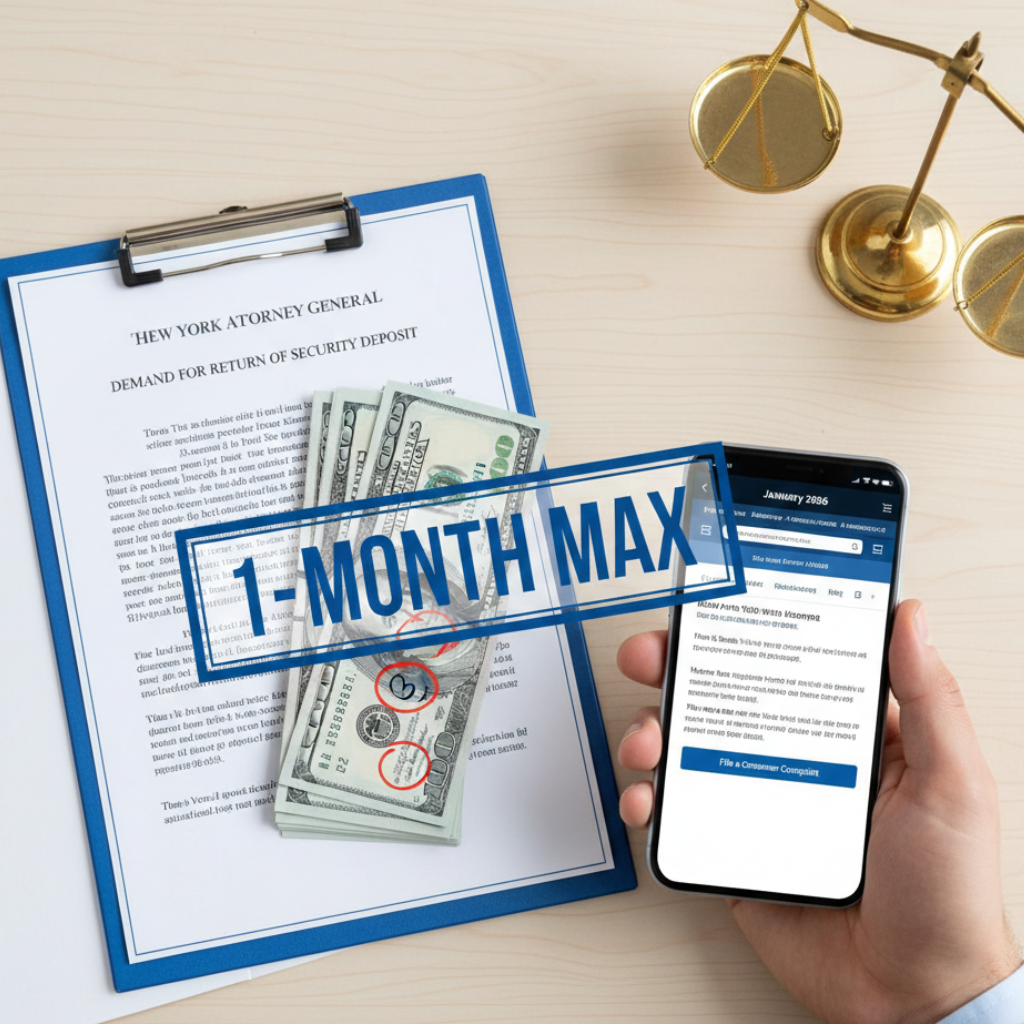
Under General Obligations Law § 7-108 (amended by the Housing Stability and Tenant Protection Act), landlords can charge no more than one month's rent as a security deposit for residential rentals.
What this means in practice:
Rent is $1,500/month → Maximum deposit is $1,500 Rent is $2,200/month → Maximum deposit is $2,200 Rent is $3,000/month → Maximum deposit is $3,000
No exceptions for:
- "High-risk" tenants
- Pet deposits (can't exceed one month total even with pets)
- Prior damage history
- Landlord's preference
- Poor credit
If your landlord charged more than one month's rent as deposit, they violated the law the day they collected it.
When the Law Changed
Timeline matters:
Before June 14, 2019:
- No statewide cap on security deposits
- Landlords could charge 2-3 months' rent
- Many did, especially in competitive markets
June 14, 2019 and after:
- One-month cap applies to all new leases
- Existing leases with higher deposits were grandfathered
- Upon renewal, landlord must reduce to one month
What this means for you:
If you signed lease AFTER June 14, 2019: Deposit over one month is automatically illegal
If you signed lease BEFORE June 14, 2019:
- Original deposit amount was legal at signing
- But upon renewal after June 2019, landlord should have returned excess
- If they renewed you with same high deposit, that's a violation
Example:
- Signed lease May 2018 with $4,500 deposit ($1,500/month rent)
- Renewed lease July 2020
- Landlord should have returned $3,000 at renewal
- Keeping full $4,500 = illegal retention of $3,000
Where the Money Must Be Kept
Separate account requirement:
Landlords cannot treat your deposit as their money. The law requires specific handling:
All residential deposits:
- Must be held in New York bank account
- Must be separate from landlord's personal/operating accounts
- Cannot be commingled with landlord's own funds
- Account must be clearly designated as security deposit account
Buildings with 6+ units (additional requirements):
- Must be interest-bearing account
- Tenant entitled to interest earned
- Landlord can deduct up to 1% annual administrative fee
- Interest paid annually or at move-out
Why this matters:
Many landlords—especially smaller "mom and pop" landlords—violate this by:
- Depositing your security deposit into their personal checking
- Using deposits to pay building expenses
- Treating deposits as income
- Never opening separate account
If landlord commingled funds, that's an independent violation giving you leverage.
Interest on Deposits (6+ Unit Buildings)
How interest works:
Buildings with 6 or more units:
- Security deposits must earn interest
- Rate set by prevailing savings account rates
- Landlord must pay you interest annually or at lease end
- Landlord can deduct up to 1% admin fee
Example calculation:
- $2,000 deposit
- 2% annual interest rate
- Year 1 interest: $40
- Landlord's 1% admin fee: $20
- You receive: $20
Over 5 years: Interest accumulates (if compounded) to $100-200 depending on rates
Buildings with fewer than 6 units:
- Interest not required
- But still must be in separate account
Why landlords violate this:
Many landlords in 6+ unit buildings:
- Never open interest-bearing accounts
- Never track interest owed
- Never pay interest annually
- Forget about it entirely
When you move out and they owe you 5 years of interest, this becomes additional money they're illegally withholding.
The 14-Day Return Rule (Applies to All Deposits)
Regardless of building size or deposit amount, all landlords face the same strict deadline.
What Must Happen Within 14 Days
After you move out, landlord has exactly 14 calendar days to:
Option 1: Return full deposit
- Send check for entire amount
- To your forwarding address
- No explanations needed
Option 2: Send itemized statement + remaining balance
- Detailed list of each deduction
- Specific dollar amount for each item
- Description of what was damaged/unpaid
- Return any money not deducted
That's it. No other options exist.
What Landlords Can Actually Deduct
Only three categories of deductions are legal:
1. Unpaid rent:
- Rent you actually owed and didn't pay
- Through your actual move-out date
- Not speculative future rent
2. Unpaid charges under the lease:
- Utilities if lease says you pay them to landlord
- Late fees if properly charged
- Other fees specifically in lease and actually owed
3. Damage beyond normal wear and tear:
- Physical damage YOU caused
- Beyond what normal living creates
- Proven with evidence
- Reasonably priced repairs
Cannot deduct for:
- Normal wear and tear (faded paint, minor scuffs, small nail holes)
- Damage from prior tenants
- Upgrades or improvements
- Routine maintenance landlord must do anyway
- Cleaning that ordinary wiping/sweeping would handle
- Damage you didn't cause
- Speculative or inflated repair costs
What Counts as "Normal Wear and Tear"
This distinction is critical:
Normal wear and tear (CANNOT charge you):
- Paint fading over time
- Minor scratches on floors from furniture
- Small nail holes from hanging pictures (under 1/4 inch)
- Carpet wear in traffic patterns
- Slightly worn countertops
- Cabinet hinges showing age
- Light switch plates with wear
- Blinds/curtains showing age (if provided)
- Minor caulking around tub/sink
- Worn weather stripping
- Dirty walls/floors that ordinary cleaning addresses
Damage beyond normal wear (CAN charge you):
- Large holes in walls
- Broken windows
- Deep scratches or gouges in floors
- Carpet stains that don't clean out
- Broken appliances from misuse
- Cracked tiles or countertops
- Pet damage (scratched doors, urine stains)
- Deliberately painted walls (if prohibited)
- Broken door locks
- Missing fixtures you removed
The test: Did this result from ordinary living, or from negligence/carelessness/abuse?
Time matters: Lived there 5 years? Even moderately worn carpet is normal. Lived there 6 months? Same wear might be your responsibility.
How Landlords Illegally Withhold Deposits
Understanding common violations helps you identify when your landlord broke the law.
Violation #1: Charging More Than One Month
Most common in competitive rental markets:
Landlords who got away with 2-3 month deposits pre-2019 sometimes still try it, either:
- Not knowing law changed
- Hoping tenant doesn't know
- For leases signed after June 2019
- For renewals after June 2019 without refunding excess
Example of violation:
- Rent: $1,800/month
- Landlord charged: $3,600 deposit (2 months)
- Lease signed: August 2020
- Illegal from day one
- Tenant entitled to immediate refund of $1,800 excess
Even if you signed lease agreeing to excessive deposit, it's still illegal. Can't waive statutory protection.
Violation #2: Commingling Funds
Landlords who treat deposits as their own money:
What commingling looks like:
- Deposit goes into landlord's personal checking
- Used to pay building expenses
- Mixed with rent payments
- No separate account exists
- Landlord spends it and plans to "replace it later"
Why this is illegal:
- Deposits are tenant's money, held in trust
- Must remain separate and accessible
- Can't be used for landlord's purposes
- Violates fiduciary duty
How you prove it:
- Demand bank statements showing separate account
- If landlord can't produce them, violation is proven
- Many landlords will admit they don't have separate account
This violation exists from day one until landlord returns deposit, meaning it's ongoing illegal conduct throughout your tenancy.
Violation #3: Missing the 14-Day Deadline
Single most common violation:
Landlords who:
- Don't respond within 14 days
- Send something on day 16, 20, 30
- "Forget" about it
- Claim they needed more time
- Were waiting for estimates
- Didn't have forwarding address
The penalty is automatic: Landlord forfeits ALL withholding rights, must return full deposit regardless of any actual damage.
No excuses exempt them:
- Didn't know the rule
- Was on vacation
- Waiting for contractors
- Mail was slow
- Tenant didn't respond to their questions
Deadline is absolute. Miss it by even one day = total forfeiture.
Violation #4: Improper Deductions
Landlords who send itemization but include illegal charges:
Common improper deductions:
"Painting entire apartment" - $800
- If you lived there multiple years, repainting is normal maintenance
- Can only charge if you damaged walls beyond normal wear
- Even then, only for damaged areas, not whole apartment
"Carpet replacement" - $1,500
- Carpet has useful life (5-10 years)
- Normal wear is expected
- Can only charge for damage (stains, burns, tears)
- Must depreciate based on age
"Cleaning" - $400
- Too vague without specifics
- Must itemize what needed cleaning
- Can't charge for ordinary dirt
- Must be excessive filth beyond normal
"General repairs" - $600
- Not itemized at all
- Doesn't specify what was repaired
- Doesn't meet legal requirement
Pre-existing damage
- Cracked window you noted at move-in
- Stained carpet from prior tenant
- Broken appliance that never worked
- Your move-in photos prove these
Inflated costs
- Charging $500 to paint room (market rate $150-200)
- $1,000 for cleaning (market rate $200-300)
- Not providing receipts or proof of costs
Violation #5: Not Paying Required Interest
For 6+ unit buildings:
Landlords who:
- Never opened interest-bearing account
- Never tracked interest
- Never paid annual interest
- Kept all interest for themselves
Example:
- $2,500 deposit
- 5-year tenancy
- Average 2% interest minus 1% admin fee = 1% net
- Simple interest: $125 owed
- Landlord never paid it
- At move-out, landlord owes deposit PLUS interest
This adds to the amount illegally withheld.
Violation #6: Keeping Deposit for Wrong Reasons
Illegal reasons landlords withhold:
"You broke the lease early"
- Breaking lease may mean owing unpaid rent
- But not a blanket authorization to keep deposit
- Must still itemize actual costs
- Must follow 14-day rule
- Can't just keep entire deposit
"You didn't give 30 days' notice"
- May owe rent for notice period
- But must itemize that specifically
- Can't characterize entire deposit as "payment for notice"
- Rest of deposit must be returned
"Administrative fee for processing"
- No such fee exists in law
- Can't charge "fee" for returning your own money
- Only exception: 1% admin fee on interest (6+ units)
"Finder's fee to re-rent apartment"
- Not your responsibility
- Landlord's business cost
- Can't be deducted from deposit
Your Remedies When Deposit Is Illegally Withheld
New York gives you multiple paths to collect money your landlord illegally keeps.
Step 1: Send Demand Letter
Always start here—it works surprisingly often.
Why demand letters are effective:
- Creates official record
- Shows you know the law
- Demonstrates you're serious
- Many landlords pay rather than face court
- Required before court filing in some jurisdictions
What your demand letter must state:
[Your Name]
[Your Current Address]
[Date]
[Landlord Name]
[Landlord Address]
RE: ILLEGAL WITHHOLDING OF SECURITY DEPOSIT
[Old Apartment Address]
Dear [Landlord]:
I am writing to demand immediate return of my illegally withheld security deposit in the amount of $[amount] for the apartment at [address].
VIOLATIONS OF NEW YORK LAW:
You have violated New York General Obligations Law § 7-108 in the following ways:
[Choose applicable violations:]
1. EXCESSIVE DEPOSIT: You charged $[amount] as security deposit when my monthly rent was $[amount]. The maximum legal deposit is one month's rent ($[amount]). You collected an illegal excess of $[excess amount].
2. COMMINGLING OF FUNDS: You failed to maintain my deposit in a separate bank account as required by law. You [admitted / cannot prove] that deposits are held separately from your personal/operating funds.
3. FAILURE TO RETURN WITHIN 14 DAYS: I moved out on [date]. Under GOL § 7-108, you had until [date 14 days later] to either return my deposit or provide itemized statement of deductions. As of today ([current date]), you have done neither, a delay of [X] days. This failure results in forfeiture of any right to withhold any amount.
4. IMPROPER DEDUCTIONS: Your itemization includes illegal charges for [list: normal wear and tear, excessive costs, vague charges, pre-existing damage, etc.].
5. FAILURE TO PAY INTEREST: The building has [number] units. You were required to hold my deposit in interest-bearing account and pay me accumulated interest. You failed to do so. Interest owed is approximately $[amount].
LEGAL CONSEQUENCES:
Your violations entitle me to:
1. Return of the full deposit amount: $[amount]
2. Return of excess deposit: $[amount] (if applicable)
3. Interest owed: $[amount] (if applicable)
4. Punitive damages up to twice the deposit for willful violations
5. Attorney fees and court costs
DEMAND FOR PAYMENT:
I demand payment of $[total amount] within 7 days of this letter, payable by check or money order to my current address above.
If you fail to pay within 7 days, I will file in Small Claims Court seeking:
- Full deposit and interest
- Punitive damages up to twice the deposit
- Court costs
- Any other relief available under law
New York courts consistently rule in favor of tenants when landlords violate security deposit laws. Your violations are well-documented and clear.
I have documented the apartment's condition at move-out [and my attempts to contact you / and the timeline of your violations / etc.].
This is your final opportunity to resolve this without court action.
Sincerely,
[Your Signature]
[Your Name]
Enclosures:
- Copy of lease showing deposit amount and rent
- Timeline of violations
- [Any other relevant documents]
How to send:
Certified mail, return receipt requested:
- Post office sends with tracking
- Provides proof of delivery
- Landlord must sign for it
- You get confirmation
Also email same day:
- Creates additional record
- Shows urgency
- Faster delivery
Keep copies:
- Letter for your records
- Postal receipt
- Return receipt when it comes back
- Email confirmation
Step 2: File in Small Claims Court
When landlord ignores demand letter:
Small Claims is perfect for deposit disputes:
- No lawyer needed
- Simple process
- Low cost ($15-35 filing fee)
- Fast resolution (30-60 days typically)
- Judges very familiar with these cases
Jurisdiction limits:
- NYC: $10,000 maximum
- Most NY cities: $5,000 maximum
- Towns/villages: $3,000 maximum
What to sue for:
Base claim: Security deposit amount illegally withheld
Add these if applicable:
- Excess deposit over one-month cap
- Unpaid interest (6+ unit buildings)
- Punitive damages (up to double deposit for willful violations)
- Court filing fees
Example total claim:
- Deposit withheld: $2,400
- Excess collected (charged 2 months when law allows 1): $2,400
- Unpaid interest (5 years): $120
- Punitive damages for willful violation: $4,800
- Filing fee: $25
- Total: $9,745
Where to file:
- Court in county where apartment is located, OR
- Court in county where landlord's office is
How to file:
- Get Small Claims Complaint form at courthouse or online
- Fill in your information and landlord's information
- State amount and basis: "Defendant violated NY GOL § 7-108 by [list violations]. Plaintiff seeks return of deposit, excess charges, interest, and punitive damages."
- File with court clerk and pay fee
- Court sets hearing date and serves landlord
What to bring to hearing:
Essential documents (3 copies—judge, landlord, you):
- Lease showing rent and deposit amounts
- Receipt for deposit payment
- Proof of move-out date
- Timeline showing violations
- Demand letter you sent
- Proof landlord didn't respond within 14 days
- Move-out photos if you have them
- Bank statements showing separate account doesn't exist (if applicable)
Your timeline document:
SECURITY DEPOSIT VIOLATIONS
Lease signed: [date]
Monthly rent: $[amount]
Deposit charged: $[amount]
Legal maximum deposit: $[amount]
Excess charged: $[amount]
Moved out: [date]
Landlord's 14-day deadline: [date]
Days past deadline: [number]
Building has [X] units (interest required: yes/no)
Interest paid: $0 (should be $[amount])
Total illegally withheld: $[amount]
At the hearing:
- Present your case clearly
- Show timeline of violations
- Explain each violation
- Show your evidence
- Judge will likely rule in your favor same day
Step 3: Report to Attorney General
Parallel track that adds pressure:
While pursuing small claims, also file complaint with NY Attorney General.
File online at ag.ny.gov:
- Consumer complaint form
- Upload supporting documents
- Explain violations
What AG can do:
- Investigate landlord
- Contact landlord directly
- Negotiate return of deposit
- Impose fines for violations
- Refer for prosecution if systematic abuse
- Create record for pattern investigations
Benefits:
- Free to file
- Adds serious pressure (landlords fear AG)
- Can result in mediation
- May prompt immediate payment
- Helps other tenants if landlord is repeat offender
Timeline:
- Slower than small claims (weeks to months)
- But powerful additional tool
- Do both simultaneously
Step 4: Housing Court (Alternative to Small Claims)
For larger amounts or complex cases:
If your claim exceeds small claims limits or involves other housing issues:
File in Housing Court:
- No dollar limit
- Can include other claims (harassment, repairs, etc.)
- More formal procedures
- May want attorney (NYC Right to Counsel if eligible)
When to use Housing Court instead:
- Deposit dispute over $10,000
- Multiple violations requiring detailed hearing
- Ongoing tenancy with other issues
- You're income-eligible for free attorney
Housing Court judges:
- Very familiar with security deposit law
- See these violations constantly
- Generally tenant-friendly on clear violations
- Will enforce the law strictly
Proving the Violations
You need evidence. Here's what to gather.
Documents That Prove Your Case
For excessive deposit violation:
- Lease showing monthly rent
- Lease showing deposit amount
- Math: deposit ÷ rent = ratio over 1.0 = illegal
For commingling violation:
- Demand landlord produce bank statements showing separate account
- If they can't, violation is proven
- Landlord's admission they don't have separate account
- Your testimony that you never received interest (6+ units)
For 14-day deadline violation:
- Calendar showing move-out date
- Date 14 days later
- Today's date showing time passed
- Evidence you received nothing (absence of their communication)
- Your texts/emails they never responded to
For improper deductions violation:
- Itemization landlord sent (showing vague charges)
- Move-in photos (showing pre-existing damage)
- Move-out photos (showing good condition)
- Market rate estimates (showing their charges inflated)
For interest violation:
- Lease showing building has 6+ units
- Calculation of interest owed
- Proof they never paid interest
Timeline Document (Most Important)
Create one-page timeline:
SECURITY DEPOSIT TIMELINE & VIOLATIONS
LEASE INFORMATION:
Address: [apartment]
Lease signed: [date]
Monthly rent: $[amount]
Deposit charged: $[amount]
Legal maximum (1 month rent): $[amount]
VIOLATION: Excess of $[amount] collected
ACCOUNT INFORMATION:
Building units: [number]
Interest required: [yes/no]
Interest paid: $0
Interest owed: $[amount]
VIOLATION: Failed to maintain separate/interest-bearing account
MOVE-OUT INFORMATION:
Move-out date: [date]
Keys returned: [date]
Landlord's deadline (14 days): [date]
Days past deadline: [number]
VIOLATION: Failed to return deposit or provide itemization within 14 days
MY ATTEMPTS TO RECOVER:
[Date]: Texted - no response
[Date]: Emailed - no response
[Date]: Sent demand letter
[Date]: Filed AG complaint
[Date]: Filed small claims
TOTAL AMOUNT ILLEGALLY WITHHELD: $[amount]
This document wins cases. It's clear, factual, and shows judge everything at a glance.
Special Situations
You're Still Living There
Can you demand excess deposit back now?
Yes. If landlord charged more than one month's rent, that excess is illegal from day one.
How to handle:
- Send letter demanding refund of excess
- Cite GOL § 7-108 and one-month cap
- Give deadline
- Sue if not returned
Landlord can't retaliate:
- Demanding legally required refund is protected activity
- Retaliation for asserting rights is illegal
- Creates separate cause of action if they try
You Broke Lease Early
Does this change anything?
No. Landlord still must:
- Follow 14-day rule
- Itemize any deductions
- Only deduct actual costs (unpaid rent for notice period)
- Return rest of deposit
Breaking lease ≠ permission to keep entire deposit.
Landlord Sold Building
New owner has your deposit obligation:
Security deposits transfer with property:
- Old owner should transfer deposits to new owner
- New owner inherits obligation to return
- You can sue either or both
Get documentation:
- Ask old landlord for proof of transfer
- Get new owner contact info
- Send demand to both if unsure who has it
Roommate Situation
Deposit held by landlord:
- All roommates on lease have equal rights
- Each entitled to proportional share
- Can sue together or separately
Deposit held by departing roommate:
- That's between you and roommate (not landlord)
- May need to sue roommate separately
You Caused Some Damage
Does this eliminate your rights?
No. Even if you caused some damage:
- Landlord must still itemize within 14 days
- Must only charge reasonable amounts
- Must prove damage beyond normal wear
- If they miss deadline, they forfeit right to deduct even for real damage
The procedure matters as much as the substance.
Why Landlords Keep Getting Away With This
Understanding the system helps you break the pattern.
Landlords Count on Tenant Ignorance
What landlords know:
- Most tenants don't know the one-month cap
- Most tenants don't know about 14-day rule
- Most tenants don't know about separate account requirement
- Most tenants won't sue over $1,500-$3,000
- Most tenants move on with their lives
What landlords do:
- Routinely violate the law
- Return deposits to tenants who push hard
- Keep deposits from tenants who don't
It's a profitable gamble:
- Keep 10 deposits = $20,000
- 2 tenants sue and win = lose $4,000
- Net gain = $16,000
You break this cycle by being the tenant who sues.
Small Dollar Amounts Create Justice Gap
The access-to-justice problem:
Attorneys won't take $2,000 deposit cases because:
- Attorney fees would exceed recovery
- Not economically viable
- Tenants can't afford to hire attorney
This creates enforcement gap:
- Law exists
- Violations are rampant
- No one enforces it
- Landlords face no consequences
Small Claims Court is the solution:
- No lawyer needed
- Low cost
- Designed for exactly this
- Tenants can represent themselves effectively
But most tenants don't use it because:
- Don't know it exists
- Intimidated by court
- Think it's too complicated
- Believe landlord will win
The truth: These cases are simple. Show timeline showing violation. Judge rules in your favor. Done.
Repeat Offender Landlords
Some landlords systematically violate:
- Do this to every tenant
- Standard business practice
- Built into their financial model
- Count on low enforcement rate
How to identify repeat offenders:
- Google landlord's name + "security deposit"
- Check Housing Court records
- Read reviews on tenant forums
- Ask prior tenants
If landlord is repeat offender:
- Even stronger case
- AG more likely to investigate
- May qualify for class action
- Your individual case helps stop pattern
Getting Justice Is Straightforward
When your landlord violates New York's security deposit laws—and the violations are usually multiple and obvious—you have clear enforcement paths that don't require legal expertise or significant money.
Three violations that are nearly automatic wins:
- Charged more than one month's rent: Math proves it instantly
- Missed the 14-day deadline: Calendar proves it instantly
- Can't prove separate account: Their inability to produce records proves it
The process is simple: Send demand letter. If ignored, file small claims. Show timeline at hearing. Win.
The law is on your side because New York intentionally made these rules strict and penalties severe to protect tenants from exactly what your landlord is doing.
Most landlords pay after the demand letter because they know they'll lose in court. Those who don't pay learn that lesson quickly when the judge rules against them and orders them to pay double.
Your deposit is your money. The law requires landlords to follow specific rules to keep any of it. When they don't follow those rules—and they usually don't—you have every legal right and practical tool to take back what's yours.
Find out if you have a case in 30 seconds →