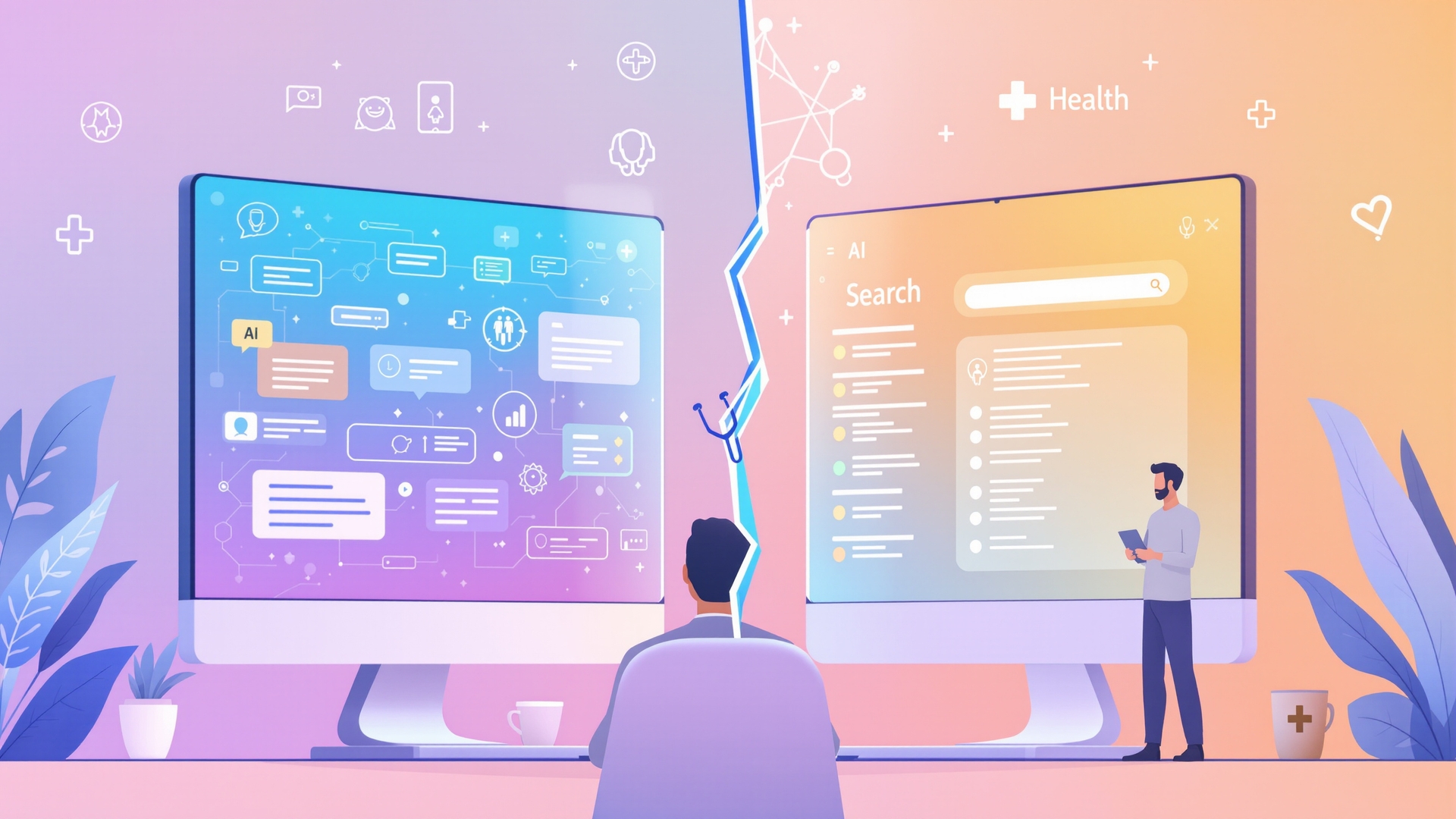
AEO vs SEO: How They Differ—and What It Means for Medical Entrepreneurs
AEO focuses on optimizing content for AI answer engines (chatbots, voice assistants), while SEO optimizes for search engines and ranked pages. AEO targets concise, authoritative answers, structured data, and conversational queries. SEO centers on keywords, backlinks, and on-page UX to win clicks. For medical businesses, AEO drives zero-click visibility; SEO sustains organic traffic.
What you will learn from this blog
- The core difference between AEO and SEO in simple terms
- When to prioritize AEO vs SEO for clinics, medtech, and telehealth
- How to structure patient-friendly content that wins AI answers
- The schema, citations, and author signals machines trust
- KPIs and a 30-day plan to put AEO and SEO to work together
The fork in the road: answer engines vs. results pages
Summary: Think of AEO as winning the conversation; SEO as winning the click.
Details: AI answer engines (Google’s AI Overviews, Bing Copilot, ChatGPT, Perplexity, voice assistants) try to resolve the question right there—no clicking needed. They want short, precise, well-cited answers. Search engines still present lists of pages, where classic SEO—title tags, links, page speed, and UX—compete for the click.
Anecdote: A telehealth startup asked, “Why are we getting mentioned in Perplexity but traffic isn’t exploding?” Because AEO put them in the answer box—great for brand trust and assisted conversions—while SEO still had to win the click for growth. Both matter; the mix depends on your immediate goal: trust vs traffic.
Talk like your patients Google at 2 a.m.
Summary: AEO rewards plain-English, Q&A-style clarity with real evidence behind it.
Details:
- Write the way patients actually ask: “Is semaglutide safe after pregnancy?” “How long does Botox last the first time?” “What’s the recovery for ACL repair at 50?”
- Build “answer-first” pages: lead with a crisp, 2–3 sentence answer, then expand with context, risks, and next steps.
- Use E-E-A-T signals (experience, expertise, authoritativeness, trustworthiness): medical author bios with credentials, clinic address, phone, and a clear medical disclaimer.
- Cite peer-reviewed or government sources (PubMed, NIH, CDC) right under claims. AI answer engines love verifiable sources.
A metaphor: If SEO is putting up a beautiful clinic sign on a busy street, AEO is having a front-desk specialist who answers the exact question before someone steps inside—politely, accurately, and with receipts.
Mini example: A med spa rewrote “Do lip fillers hurt?” to start with a direct, 40-word answer, added a pain-scale visual, cited two studies, and listed aftercare steps. Within a month, the brand started appearing as a cited source in Perplexity and Bing Copilot.
The invisible scaffolding: schema, sources, and signals machines trust
Summary: Structure your data so machines instantly know who you are, who wrote it, and why it’s reliable.
Details:
- Use structured data (schema): LocalBusiness or Organization, Physician profiles, FAQPage, HowTo (for device setup, home-care steps where appropriate), Article/BlogPosting, and Speakable (where supported). Include author, medicalSpecialty, and sameAs links to credible profiles (LinkedIn, PubMed, professional associations).
- Standardize citations: link to PubMed abstracts or authoritative orgs (NIH, WHO). Date your pages, show last medical review, and note credentials.
- Nail your entity basics: consistent name, address, phone (NAP); Google Business Profile; clinic categories; services list; insurance accepted; and rich service descriptions (CPT codes if applicable).
- Avoid over-claiming: don’t promise outcomes. AEO models penalize shaky claims faster than humans do.
Quick checklist (copy/paste this):
1) Pick 25 patient questions per service line.
2) For each, draft a 40–60 word answer-first paragraph.
3) Add two citations.
4) Mark up page with FAQPage and Article schema.
5) Add author credentials and clinic NAP.
6) Publish, interlink, and update your sitemap.
Measure what matters: KPIs that map to appointments
Summary: Track both “we showed up in the answer” and “people booked.”
Details:
- AEO KPIs:
- Inclusion as a cited source in AI Overviews, Bing Copilot, ChatGPT browsing results, and Perplexity. Create a monthly test sheet with 25 target questions; mark “cited/not cited,” engine, and position.
- Share of voice in “zero-click” answers (manual checks + brand mention monitoring).
- Growth in brand queries like “DriplyIQ clinic near me” or “[Your Brand] semaglutide program” (Google Search Console).
- SEO KPIs:
- Organic impressions/clicks (Search Console), Featured Snippets, People Also Ask wins.
- Local pack visibility (map rankings), calls, direction clicks, and appointment conversions from organic sessions.
- Revenue KPIs:
- Call tracking and form submissions tied to organic/AI-sourced sessions.
- Show-up rate and treatment revenue per acquisition channel.
Real-world example: A diagnostics startup tracked 30 AI questions monthly; citations rose from 3 to 14 in eight weeks. Organic traffic only nudged up 9%, but demo requests jumped 22% because clinicians recognized the brand from AI answers they’d already seen.
A 30-day action plan (no fluff, just doable)
Summary: Ship a minimum viable AEO+SEO stack in one month.
Steps:
Week 1
- Interview your front desk and clinicians; harvest the top 50 questions patients actually ask.
- Prioritize 15 questions with high intent (“cost,” “how long,” “near me,” “risks”).
Week 2
- Write 15 answer-first pages (400–800 words each).
- Add two citations per page; publish author bios with credentials and headshots.
Week 3
- Implement FAQPage, Article, and Organization/LocalBusiness schema sitewide.
- Refresh Google Business Profile: services, categories, images, FAQs.
Week 4
- Build an internal “AI answer audit” spreadsheet; test your 15 questions in Google AI Overviews, Bing Copilot, ChatGPT (with browsing), and Perplexity.
- Set up call tracking, form tracking, and conversion goals. Review results, iterate on weak answers.
Conclusion and Contact Us
AEO and SEO aren’t rivals—they’re teammates. AEO earns you trust inside the conversation; SEO turns that trust into steady traffic and booked appointments. Start answering like a clinician, structure like an engineer, and measure like a CFO. If you’d like a hand building this for your clinic or medtech brand, DriplyIQ is ready to roll up our sleeves. Contact Us and let’s map your first 30 days together.