The AI Stack Collapse: Why Tool-First Operators Will Fragment in the Next 180 Days

By Anthony Scott
The AI Stack Collapse: Why Tool-First Operators Will Fragment in the Next 180 Days
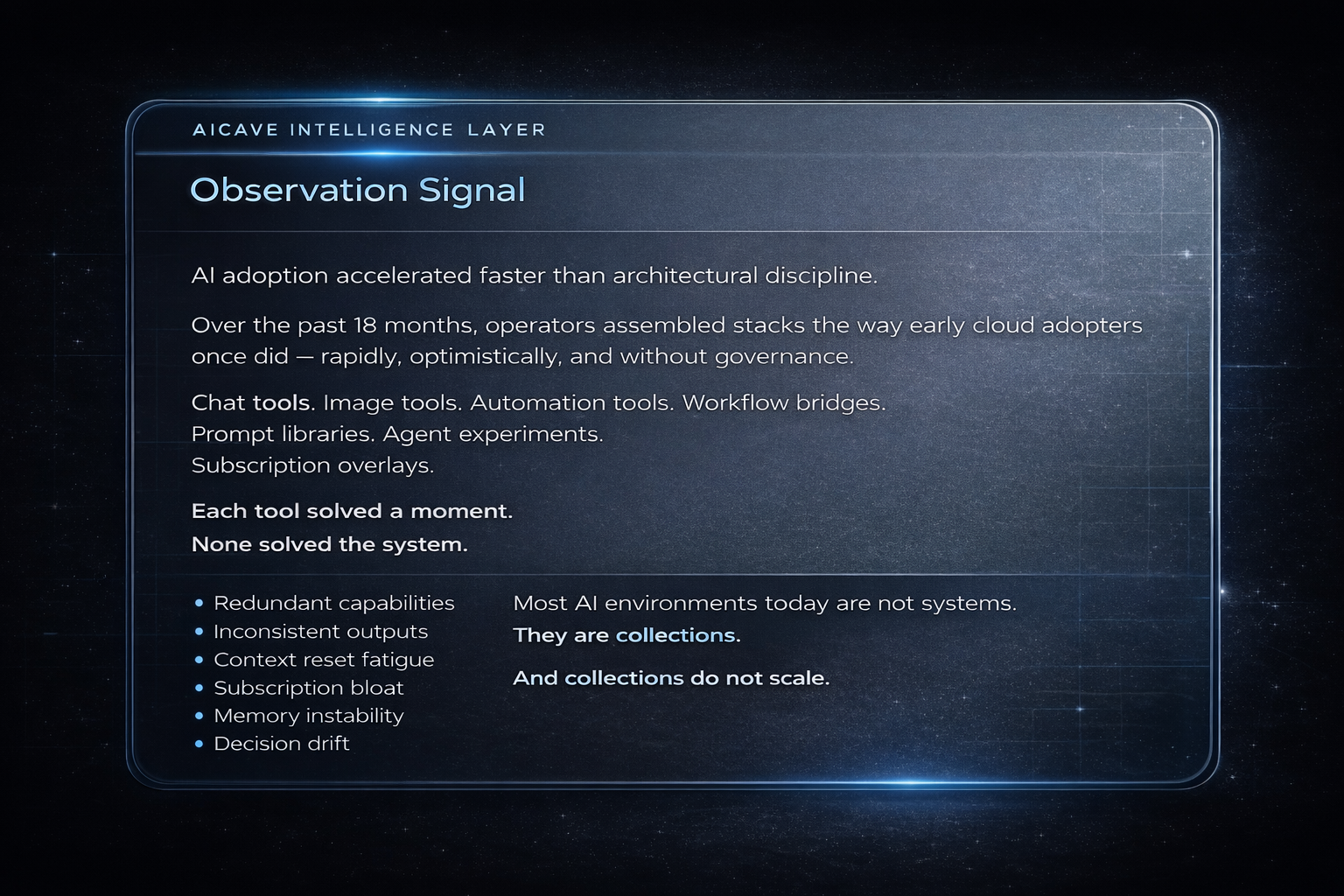
AI adoption accelerated faster than architectural discipline. Over the past 18 months, operators assembled stacks the way early cloud adopters once did — rapidly, optimistically, and without governance. Chat tools.
Image tools.
Automation tools.
Workflow bridges.
Prompt libraries.
Agent experiments.
Subscription overlays. Each tool solved a moment. None solved the system. The result is predictable: • Redundant capabilities
• Inconsistent outputs
• Context reset fatigue
• Subscription bloat
• Memory instability
• Decision drift Most AI environments today are not systems. They are collections. And collections do not scale.
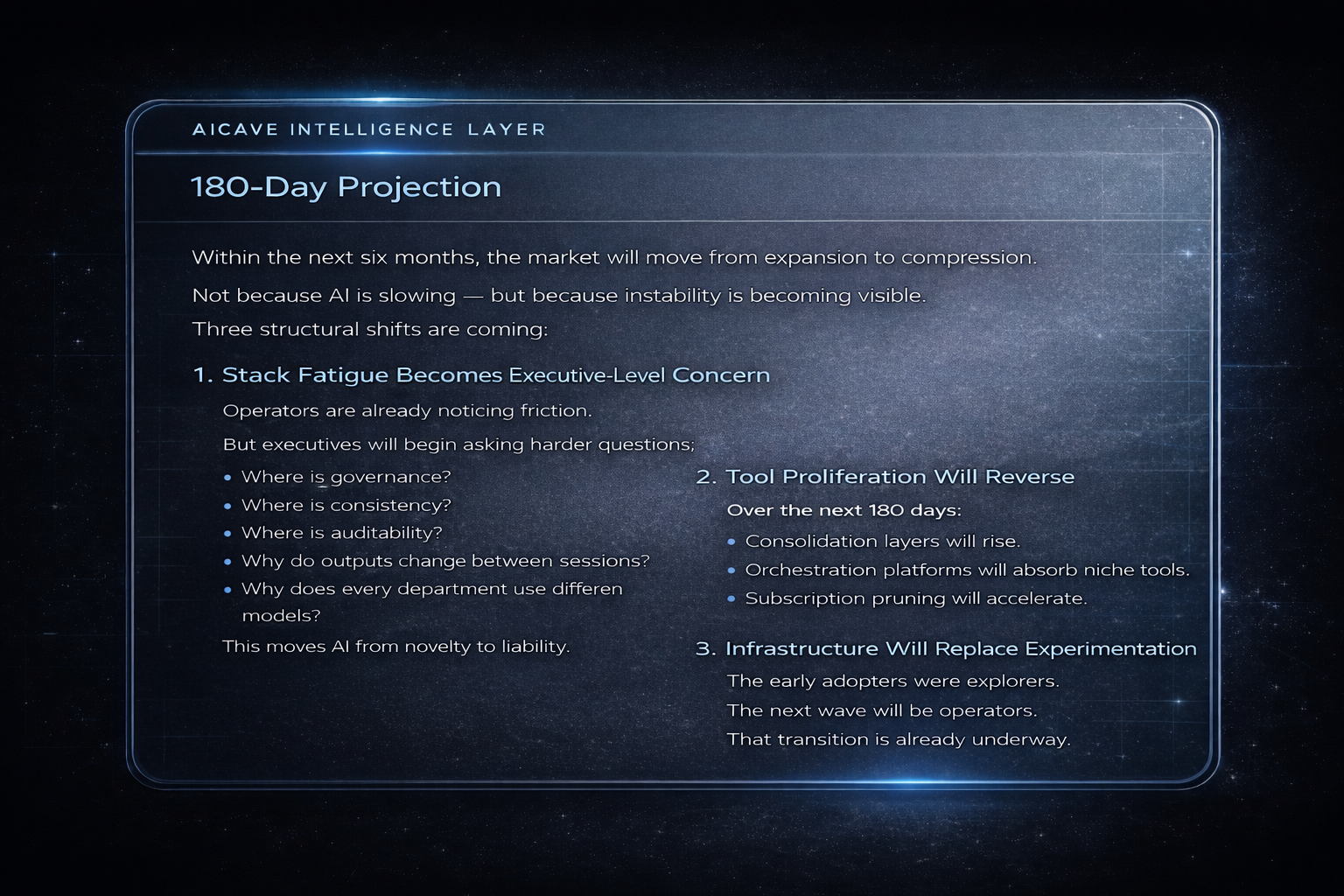
Within the next six months, the market will move from expansion to compression. Not because AI is slowing — but because instability is becoming visible. Three structural shifts are coming: 1. Stack Fatigue Becomes Executive-Level Concern Operators are already noticing friction. But executives will begin asking harder questions: Where is governance?
Where is consistency?
Where is auditability?
Why do outputs change between sessions?
Why does every department use different models? This moves AI from novelty to liability. 2. Tool Proliferation Will Reverse Over the next 180 days: • Consolidation layers will rise.
• Orchestration platforms will absorb niche tools.
• Subscription pruning will accelerate. The question will shift from:
“What AI tools do we use?” To:
“What infrastructure do we operate on?” 3. Infrastructure Will Replace Experimentation The early adopters were explorers. The next wave will be operators. Explorers tolerate chaos.
Operators require stability. That transition is already underway.
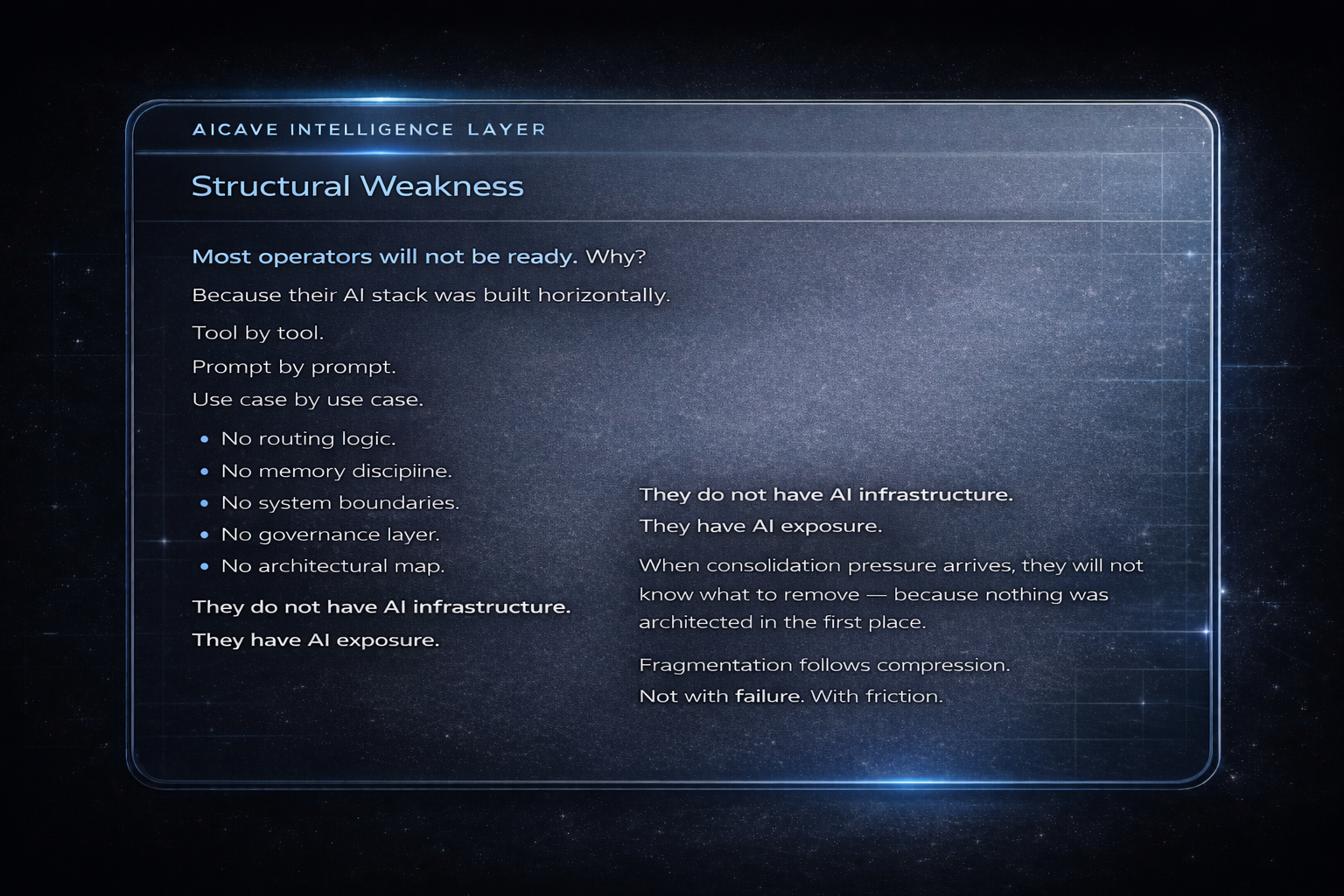
Most operators will not be ready. Why? Because their AI stack was built horizontally. Tool by tool.
Prompt by prompt.
Use case by use case. There is: • No routing logic.
• No memory discipline.
• No system boundaries.
• No governance layer.
• No architectural map. They do not have AI infrastructure. They have AI exposure. When consolidation pressure arrives, they will not know what to remove — because nothing was architected in the first place. Fragmentation follows compression. This is how collapses happen: Not with failure.
With friction.
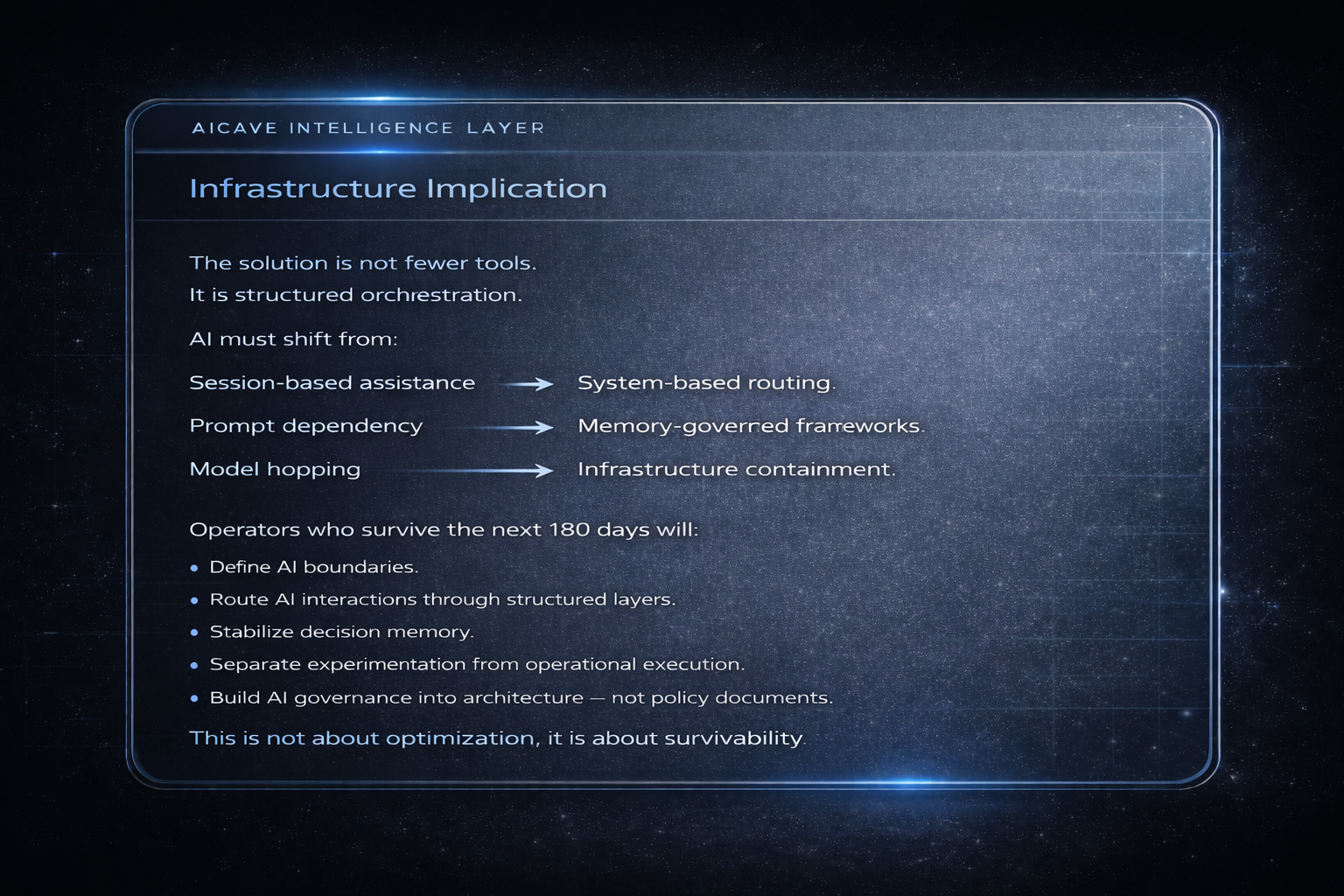
The solution is not fewer tools. It is structured orchestration. AI must shift from: Session-based assistance
→ System-based routing. Prompt dependency
→ Memory-governed frameworks. Model hopping
→ Infrastructure containment. Operators who survive the next 180 days will: • Define AI boundaries.
• Route AI interactions through structured layers.
• Stabilize decision memory.
• Separate experimentation from operational execution.
• Build AI governance into architecture — not policy documents. This is not about optimization. It is about survivability.
The AICAVE Infrastructure Layer was not built for experimentation. It was built for containment. While the market stacked tools, AICAVE focused on: • Layered orchestration
• Session control
• Memory routing
• Governance-aware structure
• Operator-first stabilization This is the difference between using AI and operating AI. If you’re building beyond tools and preparing for the next 180 days, explore AICAVE.