.png)
Introduction: The Quiet Shift Happening in Digital Businesses
For years, agencies, consultants, and service providers built their businesses around expertise. Strategy, execution, and results were the value drivers. Tools were secondary — often invisible to clients and interchangeable behind the scenes.
That model is changing.
In 2026, clients no longer judge value only by outcomes. They judge it by experience, control, and infrastructure. They want portals instead of reports. Dashboards instead of updates. Systems instead of scattered tools.
This is why white-label platforms are no longer a branding tactic.
They are becoming the foundation of modern digital businesses.
What White Label Really Means Today
Traditionally, white label meant taking an existing product and placing your logo on it. The function stayed the same, but the appearance changed. It allowed businesses to look bigger, more professional, and more established without building technology from scratch.
But that definition is outdated.
In 2026, white label is about owning the client experience while outsourcing the complexity of technology. It’s not about hiding the original provider — it’s about presenting a coherent system that feels purpose-built for your clients.
White label today is not cosmetic. It’s structural.
Client expectations have evolved faster than most service models. Businesses now expect automation, AI assistance, personalization, and real-time visibility as a baseline. They don’t want to log into five tools or manage integrations. They want one system that works.
At the same time, competition has increased. Services are easier to replicate, and differentiation is harder to sustain. White label platforms allow businesses to move from “we do this for you” to “we built this for you.”
That shift changes perception instantly. It moves you from provider to platform.
The Limitations of Traditional White Label Solutions
Most white label solutions available today were designed for a different era. They focus on surface-level customization such as logos, colors, and domains — while the underlying experience remains fragmented.
These platforms often white-label a single function: a CRM, a funnel builder, or a chatbot. The result is a branded interface sitting on top of disconnected tools and rigid workflows.
This creates friction. Clients still feel the seams. Operations remain complex. Scalability is limited because every new client increases support, setup, and manual work.
Traditional white label makes businesses look established — but not intelligent.
What’s emerging now is a new category: white-label AI systems.
Instead of rebranding tools, businesses can now rebrand entire ecosystems. These systems don’t just execute tasks — they learn, adapt, and automate across the client lifecycle.
In this model, white label is no longer about resale.
It’s about control, leverage, and scale.
AI becomes the invisible engine powering the branded experience.
🧳 Agencies | 💡 Consultants |
Agencies that want to productize services instead of selling time, turning expertise into scalable, repeatable AI-powered offerings. | Consultants who want leverage without hiring, using AI systems to deliver their frameworks at scale without increasing workload. |
🎓 Educators | 🚀 SaaS Founders |
Educators building ecosystems instead of one-off courses, offering tools, automation, and AI-driven experiences under their own brand. | SaaS founders validating ideas without building from scratch, launching faster by leveraging a ready-made white label AI platform. |
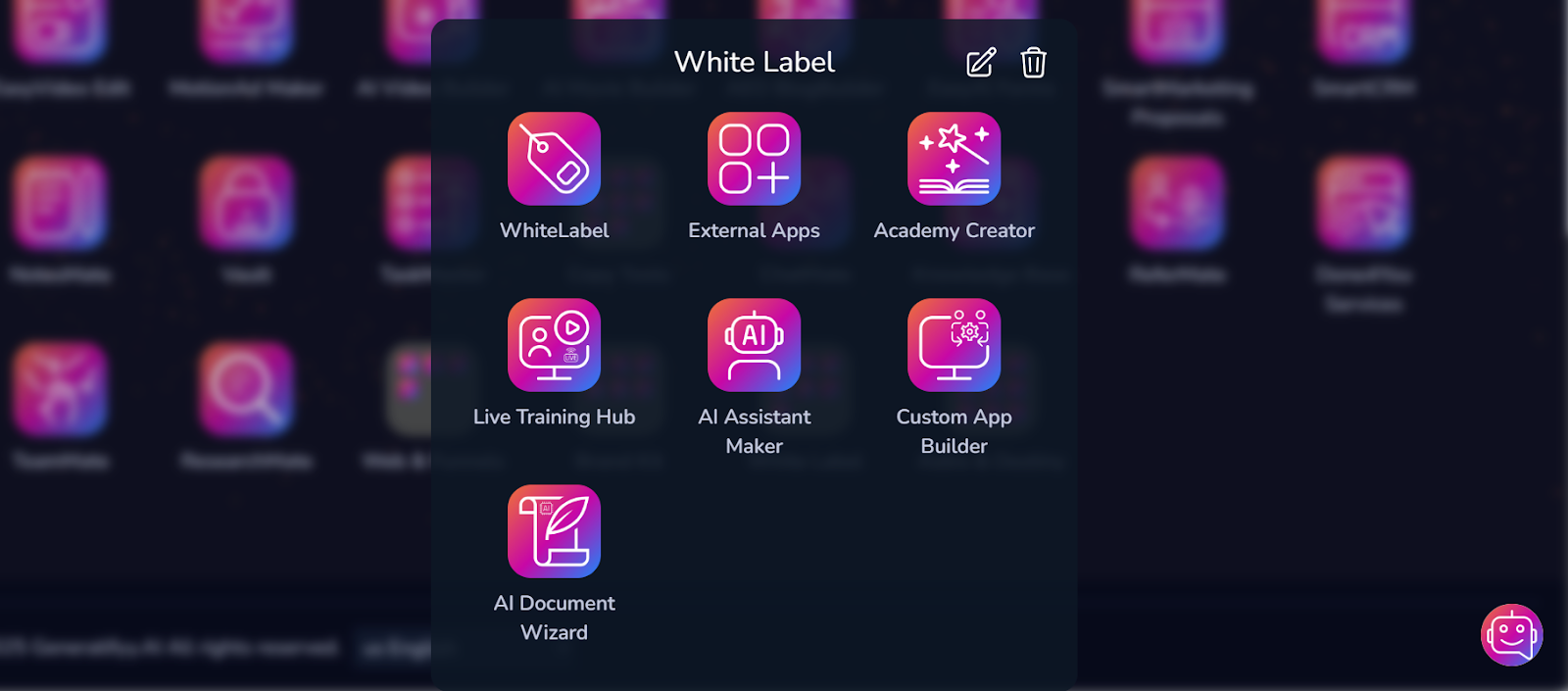
Generatifyy.AI was built with this evolution in mind. Rather than offering white label as an add-on, Generatifyy.AI treats it as a core capability. The platform allows businesses to present a fully branded AI workspace that clients interact with daily — not just a tool they log into occasionally.
Because Generatifyy.AI unifies content creation, funnels, CRM, automation, and AI logic in one environment, the white-label experience feels cohesive. Clients don’t see features. They experience a system designed around outcomes.
Generatifyy.AI White Label suite goes far beyond basic rebranding by giving you a complete, client-ready AI ecosystem under your own brand. Along with full WhiteLabel customization, you can connect External Apps, create and sell courses using the Academy Creator, and onboard clients through the Live Training Hub. The AI Assistant Maker lets you build brand-trained AI assistants, while the Custom App Builder allows you to design tailored AI apps for specific use cases. On top of that, the AI Document Wizard enables automated document creation and intelligence — all delivered inside a single, fully branded platform that feels like proprietary software to your clients.
This is the difference between rebranding software and owning a platform.
The most overlooked benefit of modern white label systems is efficiency — not just for clients, but for the business offering it.
When everything lives inside one platform, onboarding becomes simpler. Training time drops. Support issues decrease. Data flows naturally between features instead of breaking at integration points.
Generatifyy.AI white label system reduces operational drag by design. Businesses don’t need to manage multiple vendors, APIs, or workflows. They deliver one login, one interface, and one experience.
Efficiency at this level isn’t incremental — it’s exponential.
Traditional service businesses scale linearly. More clients require more time, people, and effort. White label AI platforms change that equation.
By offering a branded platform, businesses can shift from project-based pricing to recurring revenue. Access, usage, and value are delivered continuously, not episodically.
Clients stay longer because they rely on the system. Revenue becomes predictable. Growth no longer depends on headcount.
White label turns expertise into infrastructure — and infrastructure scales.
In 2026, the most successful digital businesses won’t be the ones offering the most services. They’ll be the ones offering the best systems.
White label is no longer about hiding someone else’s software.
It’s about presenting a unified, intelligent platform that clients trust, rely on, and grow with.
Generatifyy.AI makes this possible by turning AI into a branded, scalable system — not just a feature.
The future isn’t service-led.
It’s platform-led.
💬 Frequently Asked Questions (FAQ)
Industries such as marketing, consulting, education, SaaS, coaching, real estate, and professional services benefit most from white label AI because they rely on repeatable workflows, automation, and scalable expertise.
2. How long does it take to launch a white label AI platform?
With a modern white label AI platform, businesses can launch in days or even hours. Since the core technology is already built, setup focuses on branding, customization, and go-to-market strategy rather than development.
3. White label AI vs building from scratch: which is better?
For most businesses, white label AI is better than building from scratch because it dramatically reduces development time, cost, and risk. Instead of spending months building software, companies can launch immediately and focus on branding, sales, and growth.
Businesses monetize white label AI by charging monthly subscriptions, offering tiered access, bundling services with platform access, or reselling AI-powered tools to clients. This shifts revenue from one-time projects to predictable, recurring income.
Yes, white label AI significantly improves client retention by providing a system clients use daily. When clients rely on a branded platform for automation, content, or workflows, they are more likely to stay long-term.\
Start our 7-day free trial and build your entire business system in a week
Read Our Blogs here!
