.png)
YouTube is the stronger long-term B2B lead generation platform in 2026 because it combines search intent, long-form trust building, evergreen discoverability, short-form reach, and AI-search value. LinkedIn is still highly valuable for professional authority, thought leadership, and direct access to named decision-makers, but YouTube has the bigger underused opportunity for B2B businesses that want to build trust, educate buyers, and create content that compounds over time.
For more on why video now matters for AI visibility, read Why YouTube Is Now Essential for Business Visibility in the AI Era.
LinkedIn is the answer most B2B marketers give when asked where they generate leads online. It has been that answer for the better part of a decade, and for good reason. LinkedIn’s audience targeting, professional context, and authority signals make it a genuinely powerful platform for B2B marketing.
But it is not the most underused platform available to B2B marketers in 2026.
That is YouTube.
The gap between what YouTube can do for B2B lead generation and what most B2B businesses are actually doing on YouTube is one of the most significant underexploited opportunities in marketing right now.
This is not a contrarian take for the sake of it. It is the conclusion that follows from looking honestly at where B2B buyers spend their attention, where AI search is heading, who owns what, and what the competitive landscape looks like on each platform. The evidence is there. Most people just have not joined the dots yet.
This article does that.
It makes the case for YouTube as the primary B2B lead generation platform in 2026. It also gives LinkedIn the credit it genuinely deserves, because LinkedIn absolutely belongs in the mix, and its role in authority-building and AI visibility is real and growing.
But it is honest about which platform represents the bigger opportunity, and why that is only going to become more pronounced over the next twelve to twenty-four months.
For the wider market context behind this shift, read The State of AI Search in May 2026.
Factor | YouTube | |
| Buyer intent | Strong when users search for answers, tutorials and comparisons | Strong when targeting named professionals or accounts |
| Content lifespan | Months or years through search and recommendations | Usually days, sometimes weeks |
| Trust building | Very strong because buyers see and hear expertise | Strong for written authority and professional credibility |
| Organic compounding | High | Lower |
| Paid reach cost | Often lower than LinkedIn for video reach | Often higher, especially for senior B2B audiences |
| AI search value | Strong because videos create transcripts, metadata and searchable authority | Strong for entity signals and professional validation |
| Best use | Education, trust, discovery, long-term authority and sales enablement | Distribution, founder authority, ABM, relationship building and social proof |
| Main weakness | Requires consistency and confidence on camera | Content disappears quickly and feed competition is heavy |
The conclusion is not “stop using LinkedIn”. That would be silly.
The conclusion is that most B2B businesses have over-relied on LinkedIn and underinvested in YouTube. In 2026, that imbalance is costing them visibility, trust and inbound demand.
The foundational question in any platform debate is not “where do marketers publish?” It is “where do buyers go when they are trying to make a decision?”
For B2B buyers in 2026, the answer is increasingly YouTube, and the research has been pointing in this direction for longer than most marketers have acknowledged.
Google’s own research into B2B purchase journeys found that around 70% of B2B buyers and researchers watch videos throughout their path to purchase. The same research also showed that many B2B researchers watch substantial amounts of video while evaluating business decisions, including 30 minutes or more of B2B-related video content in some cases. Read Google’s B2B video research.
The implication for B2B marketing is significant: your buyer is already on YouTube.
They are searching for solutions to the problems your product or service solves. They are watching competitor content, independent reviews, tutorial videos, product demos and thought leadership from practitioners in your space. In most B2B sectors, the volume of genuinely useful content from actual vendors is still sparse, which leaves the field largely to comparison sites, independent reviewers and a handful of competitors who got there first.
LinkedIn’s audience is real and valuable, but the nature of its usage is different. LinkedIn is where professionals go to be professional, maintain their network, share work updates and signal their expertise.
It is not usually where they go to spend thirty minutes learning something new in depth.
The average LinkedIn session is short. The average YouTube session is longer. For content designed to build genuine understanding, demonstrate expertise in depth and create the kind of trust that converts a cold prospect into a qualified enquiry, that difference matters.
YouTube is often described as the world’s second largest search engine. Whether or not you use that exact phrase, the important point is this: people use YouTube to search for answers.
That includes B2B buyers.
When a procurement manager types “how to evaluate a managed IT service provider”, “what is a forward exchange contract”, or “how to choose a renewable energy installer for commercial premises” into YouTube’s search bar, they are doing the same thing a B2B buyer does on Google. They are looking for the most credible, useful answer to a specific question.
The business whose content appears at the top of that result owns the first impression, the first extended interaction and often the first call.
Most B2B businesses have invested significantly in appearing on Google for these searches. Very few have invested properly in appearing on YouTube for the same searches, despite the fact that the same buyer may be running both searches.
The difference is trust depth.
A Google click might give you a few seconds of attention. A YouTube video can give you five, ten or twenty minutes of buyer attention. That is a completely different relationship with the prospect.
LinkedIn advertising is powerful and precise. It is also expensive.
LinkedIn’s cost per thousand impressions for B2B audiences can regularly run into double figures. Targeting CFOs, IT directors or procurement leads in a specific sector and geography can cost significantly more when the audience is competitive.
YouTube advertising often reaches professional audiences at a lower cost. Skippable in-stream ads targeting B2B decision-makers can deliver longer and more immersive brand exposure when the viewer chooses to engage. Shorts ads and bumper ads also reach a growing professional audience consuming short-form video in moments where long-form content is not realistic.
For organic reach, the gap is even more important.
A well-optimised YouTube video on a specific B2B topic can generate views for years through search and recommendations. The production cost is fixed, and the reach compounds over time. A LinkedIn post usually has a much shorter lifespan before it disappears into the feed.
The economics of YouTube organic content are fundamentally better for any B2B business thinking in terms of return over twelve months rather than immediate visibility over twenty-four hours.
B2B sales cycles are long. The average enterprise purchase involves multiple stakeholders, risk checks, internal conversations and months of decision-making.
Traditional content marketing, including blog posts, white papers and case studies, helps with this. But video accelerates trust in a different way.
A buyer who watches someone from your business explain a problem clearly begins to form an opinion about your competence, character and credibility. They see how you think. They hear how you explain complexity. They get a sense of whether you are confident, useful and honest.
For service businesses and solution providers where the relationship with the team is part of the product being sold, this matters enormously.
A B2B buyer who has watched four YouTube videos from a vendor has already formed a view about the people behind the product or service. By the time that buyer makes contact, some of the trust-building that usually happens across multiple sales calls has already happened.
That is the mechanism that shortens B2B sales cycles for businesses with a strong YouTube presence.
The buyer arrives warmer, more educated and more confident.
YouTube Shorts has become a huge short-form attention channel. YouTube reported that Shorts had reached more than 70 billion daily views by 2024, and more recent industry reporting has suggested that figure has continued to rise. Read YouTube’s Shorts update.
This is not only a Gen Z phenomenon. Professionals consume short-form video between meetings, during commutes, over lunch and in the gaps where longer content is not practical.
For B2B marketers, Shorts represent an entry point into professional attention when the viewer is receptive but time-constrained. A 60-second answer to “what is the difference between contingency and retained recruitment?” or “three things to check when evaluating a cyber security provider” can reach a decision-maker in a different context from a long-form video.
LinkedIn has short-form video too, and it should be used. But YouTube Shorts has scale, discoverability through YouTube Search and a direct relationship with the wider YouTube ecosystem. A Shorts viewer can click through to a full-length video on the same channel, subscribe, revisit and be recommended more of your content later.
That gives YouTube a structural advantage for building an audience over time rather than simply reaching one moment.
The businesses generating the most efficient B2B inbound through content in 2026 tend to share a common trait: they have a consistent YouTube presence built around their buyers’ questions.
HubSpot built one of the strongest B2B YouTube channels in the marketing space, using content that answers real buyer questions, demonstrates product capability and builds a library that compounds over time.
Semrush operates in a competitive B2B SaaS market and uses YouTube to educate users, demonstrate workflows and reach buyers at the point where they are evaluating whether a solution fits their needs.
In professional services, the same pattern is emerging. The first firms in each sector to build a YouTube presence around their buyers’ questions are gaining first-mover advantage in a space many competitors have barely entered.
The accounting firm that explains IR35 clearly on video. The IT support company that demonstrates how it handles ransomware response. The FX broker whose dealer explains forward contracts in plain English. These businesses are not necessarily spending more on marketing. They are creating content that works for years rather than days.
A YouTube channel is not only a discovery channel. It is also a sales enablement asset.
Sales teams can send videos before calls, after calls and during proposal follow-up. A prospect unsure about a technical concept can be sent a clear video answer. A buyer comparing providers can watch your founder explain your approach. A committee member who missed the original sales call can still understand the thinking behind your recommendation.
This matters because most B2B buying decisions are not made by one person. They are made by groups. YouTube gives your message something most sales conversations lack: repeatability.
The same explanation can travel through the buying committee without being diluted.
That is a major advantage.
This is the section that separates a tactical platform comparison from a strategic forecast.
The Google, YouTube and AI search intersection makes YouTube’s advantage for B2B marketing not just a 2026 story, but a 2027 and 2028 story as well.
AI search is changing how buyers research, compare and shortlist businesses. That matters because YouTube is no longer only a video platform. It is becoming part of the evidence layer AI systems can use to understand who knows what, which brands explain topics well and which businesses deserve trust.
Google acquired YouTube in 2006 for $1.65 billion. In the nearly two decades since, YouTube has become one of the most important strategic assets in Google’s content ecosystem, not just as an advertising platform, but as a vast indexed repository of video and transcript content. Read Google’s original YouTube acquisition press release.
Google’s AI ambitions, built around Gemini, sit on top of this broader search, video and data infrastructure. Gemini’s ability to understand, summarise and generate answers about video content is not incidental. It is a strategic advantage Google has at scale.
YouTube transcripts, video metadata, engagement signals and creator authority signals all help Google understand topics, people and businesses.
The practical implication for B2B marketers is simple: YouTube content is not just video content. It is searchable, indexable and increasingly useful for AI-driven discovery.
A YouTube video answering a specific B2B buyer question can become a YouTube search result, a Google search result, a Google AI Overview source, a Gemini-understandable asset and a sales enablement tool.
One asset can work across multiple layers of discovery.
Gartner predicted that traditional search engine volume would decline by 25% by 2026 as AI chatbots and virtual agents take more of the discovery journey. Read Gartner’s search volume prediction.
For B2B businesses, this matters because the buyer journey is becoming more answer-led. Buyers are asking AI tools to summarise options, compare vendors, explain risks and recommend approaches before they ever speak to a salesperson.
That makes content structure and authority signals more important.
A useful YouTube video with a clear title, description, transcript and supporting blog can become part of the source layer AI systems use to understand your expertise.
This is why your YouTube strategy and your GEO strategy are starting to overlap.
To understand the wider AI visibility layer, read What Is GEO in 2026 and How Do You Get Cited in AI Answers?.
This is the mechanism most B2B marketers still underappreciate.
When you upload a video to YouTube, the platform can generate captions and transcripts. Those transcripts become text that can be indexed, searched, repurposed and used as the foundation for related blogs, FAQs, clips and social posts.
A B2B business that publishes a video answering “what should you look for in a managed IT service provider?” is not just producing video content. It is producing a structured explanation that can also become text content, sales content, LinkedIn content, FAQ content and AI-readable topical authority.
That is why video has leverage.
One good YouTube video can become a long-form video, a Shorts clip, a LinkedIn native video, a blog section, a FAQ section, a sales follow-up asset, a newsletter topic, a schema-ready answer and a source of transcript-led topical authority.
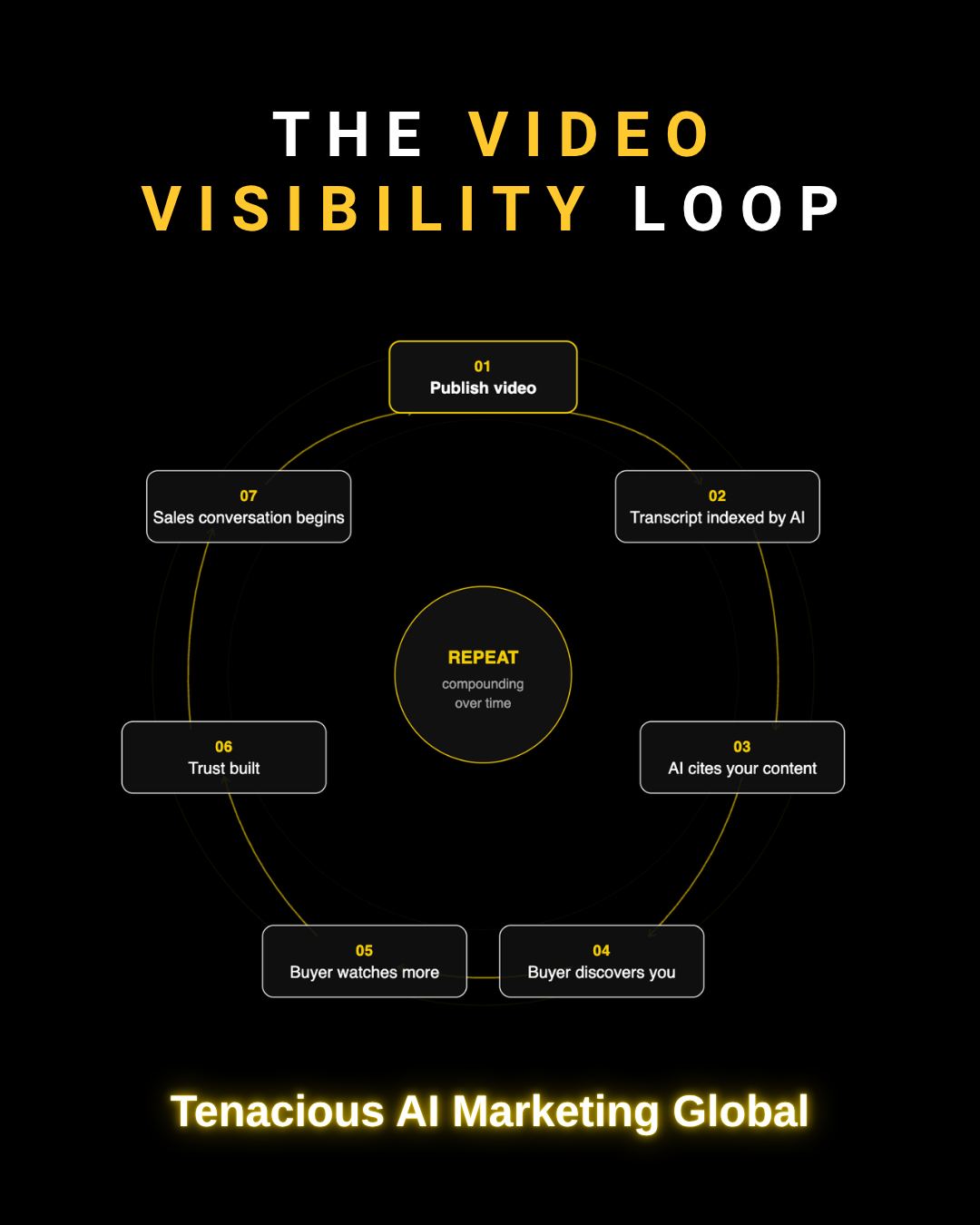
LinkedIn posts rarely have that same compounding structure.
Google’s AI Overviews are increasingly shaping how search results are consumed. Google says AI features in Search can use AI to provide overviews and links that help users explore information, and that AI Mode can use query fan-out across related searches and sources. Read Google’s guidance on AI features in Search.
For B2B visibility, the direction of travel is clear: search is becoming more blended.
Text results, videos, summaries, citations, answer panels and AI-generated recommendations are all starting to affect how buyers discover and validate providers.
A short, well-titled YouTube video that directly answers a specific query is now part of this ecosystem. So is a long-form video with a strong transcript. So is the supporting blog that turns that video into a structured content asset.
Businesses that have invested in YouTube content built around specific buyer questions are creating assets that can work in more places than a standard LinkedIn post.
That is a major strategic advantage.
If YouTube is becoming part of your AI visibility strategy, you need to measure whether that content is actually helping.
That means testing whether AI platforms mention your brand, cite your website, surface your videos, understand your expertise and recommend your business for commercially relevant prompts. It also means checking whether competitors are being recommended instead, and which sources AI systems are using to support those answers.
This is where AEO testing matters.
AEO testing is the process of checking how answer engines and AI platforms understand, describe, cite and recommend your brand. It turns AI visibility from a nice idea into something you can track, improve and report on.
For a practical breakdown, read Beyond the Search Bar: Why AEO Testing Is Now a Business Visibility Metric.
LinkedIn has not become irrelevant. It has become more specifically useful.
Understanding that specificity is what allows a B2B marketer to use it well alongside YouTube rather than treating the platforms as competitors.
For GEO purposes, meaning making sure your business appears in AI-generated answers, LinkedIn is one of the most important platforms available.
AI tools, when assessing whether to recommend a business or professional, look for consistent and credible signals across the web. A well-maintained LinkedIn company page, an active executive presence with genuine thought leadership content and consistent professional profile information all contribute to the entity signals AI systems use to assess legitimacy and authority.
LinkedIn is also one of the strongest public platforms for company information, leadership credentials and professional validation.
A business that appears consistently on LinkedIn with accurate, active and professional content is easier for both humans and machines to verify.
LinkedIn’s targeting capabilities remain extremely valuable for B2B.
If you need to reach CFOs at UK professional services firms with between 50 and 500 employees, LinkedIn can do that with a level of precision most platforms cannot match.
For account-based marketing, LinkedIn’s ability to target named accounts and identified decision-makers makes it a critical component of any enterprise B2B strategy.
YouTube reaches audiences broadly and through intent-led discovery. LinkedIn reaches specific people specifically.
Both capabilities are valuable. They are just not the same capability.
LinkedIn is where professional reputation is built and maintained.
A managing partner, founder or CEO who publishes consistently on LinkedIn, shares genuine expertise and engages meaningfully with their network builds professional authority that compounds over time.
That authority is visible to AI tools. It is visible to peers. It is visible to referral sources. It is often the context in which a potential client first encounters a professional before they look them up elsewhere.
LinkedIn thought leadership and YouTube education are complementary.
The LinkedIn post drives awareness and context. The YouTube video builds deeper trust. The blog adds structure. The website converts. The sales team follows up.
The whole system works better when each asset has a defined role.
Perhaps LinkedIn’s most practical role in a content marketing strategy is as a distribution channel for content produced elsewhere.
A well-edited clip from a YouTube video, shared as a native LinkedIn video with a caption that draws out the key insight, reaches a professional audience that might not have found the full YouTube video through search.
LinkedIn extends YouTube’s reach into professional networks.
YouTube gives LinkedIn substantive content worth distributing.
This is the partnership most B2B businesses should be building.
For more on building authority across several discovery surfaces, read Search Everywhere Optimisation: AI Visibility in 2026.
YouTube is the more powerful underused B2B lead generation platform in 2026.
It wins because of the scale of its audience, the depth of trust its content builds, the economics of organic reach and the structural advantage it carries into an AI search landscape where Google’s ownership of YouTube means video content is increasingly important across discovery.
LinkedIn is still genuinely valuable for the things it is genuinely good at: professional authority signals, named decision-maker targeting, thought leadership credibility and distribution. It is a critical part of a GEO strategy. It is not a substitute for YouTube.
The B2B marketing strategy that wins in the next two to three years is not one that picks a platform and ignores the other.
It is one that uses YouTube as the primary content and trust-building engine: a growing library of specific, helpful, well-optimised videos that answer real buyer questions and compound in reach over time.
Then it uses LinkedIn as the professional context layer that amplifies that content into the right networks and builds the authority signals that AI systems and decision-makers both respond to.
The businesses still treating YouTube as “maybe later” and LinkedIn as their only serious digital play are leaving one of the biggest B2B content opportunities of the current moment on the table.
Later is already now.
Pick the five questions your ideal clients ask most often before they engage you.
Record a clear, straightforward video answering each one. Optimise the titles and descriptions around the natural language your buyer uses. Publish on a consistent schedule.
This is your foundation. Everything else builds on it.
Video Type | Example |
| Problem explainer | “Why your business is not generating enough inbound leads” |
| Comparison video | “LinkedIn vs YouTube for B2B lead generation” |
| Buyer guide | “How to choose a B2B marketing agency in 2026” |
| Mistakes video | “Five mistakes service businesses make with YouTube” |
| Proof video | “How one content asset can support sales, SEO and AI visibility” |
Do not stop.
Clip your YouTube videos into 60 to 90 second formats for LinkedIn native video. Share insights from your longer content as text posts. Use LinkedIn to drive your professional network to your YouTube channel.
Let the two platforms reinforce each other.
The mistake is not using LinkedIn. The mistake is expecting LinkedIn alone to carry all your authority, search, trust and sales enablement.
Test YouTube pre-roll and in-stream ads targeting your B2B audience before scaling LinkedIn spend.
The CPM difference can be significant, the engagement can be longer and the audience may be in a more intent-led research mindset when the targeting is built properly.
LinkedIn should still be part of the media mix, especially for ABM and named-account campaigns. But if your goal is trust, education and scalable reach, YouTube deserves serious budget consideration.
Recognise that your YouTube content is also your AI content.
Every video you publish with a clear title, structured explanation and useful transcript is a potential authority asset for AI systems answering the questions your buyers are asking.
Your YouTube strategy and your GEO strategy are, increasingly, the same strategy.
If you have not checked your AI visibility yet, start with an audit. Read How to Audit Your Website for AI Visibility in 2026.
If you want to understand where your business currently stands in AI search, use Answer Architect to check your AI visibility score and see what needs fixing.
You can also take the Organic Visibility Scorecard or speak to the Tenacious team if you want help building the system properly.
For precision targeting of named decision-makers in specific accounts, yes. LinkedIn’s targeting is unmatched for many B2B use cases.
But YouTube reaches those same decision-makers when they are actively searching for answers to the problems you solve. That is often a higher-intent moment than receiving a LinkedIn ad in their feed.
Both types of reach are valuable. The question for most B2B businesses is which one they are currently underusing. For the vast majority, the answer is YouTube.
Yes. Google’s B2B research has shown that video plays a significant role in the B2B purchase journey, with around 70% of B2B buyers and researchers watching videos during the process. The professional research that once happened mainly through articles, white papers and analyst reports is increasingly supported by video.
YouTube is where much of that video research happens. LinkedIn is where professional conversations happen. Both are part of the B2B buyer’s research journey.
At the enterprise level, highly produced video content can require proper budget. But most B2B businesses do not need to start with a documentary crew.
An iPhone, a decent microphone, a clean background and a clear explanation are enough to begin. The production quality that builds trust in B2B video is the quality of the thinking and the clarity of the explanation, not cinematic polish.
A managing director explaining something complex clearly on camera often builds more trust than a slick brand video that says very little.
Yes, and this is becoming more important. YouTube content can be indexed by Google, surfaced in search results, used in AI-supported discovery and repurposed into transcript-led content that supports AI visibility.
Google’s AI search documentation explains that AI features in Search can surface links and use related searches and sources to help users explore a topic. YouTube content is part of Google’s wider content ecosystem, which makes it strategically important for B2B visibility.
The biggest mistake is treating YouTube like a portfolio instead of a search engine.
Uploading product demos, brand films and award acceptances, then concluding YouTube does not work for B2B, misses the point. The content that works is the content that answers specific questions your buyers are already asking.
It needs to be titled around those questions, described clearly and structured so that the viewer gets a genuinely useful answer.
The businesses that understand this are building compounding inbound that competitors cannot reverse-engineer quickly.
Start with the platform that lets you publish consistently.
If you are comfortable writing, LinkedIn may be the easiest starting point. If you are more comfortable speaking than writing, which many experienced professionals are, YouTube may be the better place to begin.
But the long-term ROI case for YouTube is stronger because YouTube content has search value, trust value, sales value and AI visibility value. The sooner a B2B business builds a body of YouTube content, the longer its compounding advantage over competitors who have not started.
Beyond the Search Bar: Why AEO Testing Is Now a Business Visibility Metric
Why YouTube Is Now Essential for Business Visibility in the AI Era
What Is GEO in 2026 and How Do You Get Cited in AI Answers?
The New Rules of AI Search in 2026
Search Everywhere Optimisation: AI Visibility in 2026
How to Audit Your Website for AI Visibility in 2026
If you want to build a YouTube strategy that does more than collect views, and actually supports B2B lead generation, AI visibility, sales enablement and authority, visit Tenacious AI Marketing.
Or speak to the Tenacious team about launching YouTube as part of your Search Everywhere strategy.