.jpg)
You have the expertise. You have the case studies. You’ve spent years (and a small fortune) on SEO, blog posts, and backlinks. You dominate the keywords for your niche on Google.
But when you ask ChatGPT, "Who is the best provider of [Your Service]?"... silence.
Or worse, it recommends your competitor, the one who started two years after you, has a worse product, but somehow "gets" the new game better than you do.
This isn't a technical glitch. It is a business crisis.
At Tenacious AI Marketing, we call this the "Invisible Entity" problem. You are invisible because you are still playing by the rules of a Search Engine (Google), while your customers have moved on to Answer Engines (ChatGPT, Perplexity, Gemini).
If you are tired of being the industry's "best-kept secret," this guide is for you. We are going to dismantle the old way of thinking and show you exactly how to build a brand that AI models can't ignore.
To understand why you are invisible, you have to understand how the game has changed.
For the last 20 years, we optimized for Retrieval. Google’s job was to be a librarian: you ask a question, and it hands you a list of 10 books (websites) to read yourself. Your goal was simply to be the book on the top shelf.
Today, we are optimizing for Synthesis. AI models like Claude and Perplexity act like professors.
They read the books for the user, synthesize the information, and deliver a single, direct answer.
If the Professor (the AI) doesn't trust the Author (You), they won't include your work in the lecture.
Watch Dean explain why traffic is collapsing and how AI engines decide which businesses survive in the new search economy.
This isn't just a theory. The data proves the landscape is shifting faster than most agencies admit:
According to Gartner, traditional search engine volume is predicted to drop by 25% by 2026 as users shift toward AI chatbots and virtual agents.
If you are banking your entire marketing strategy on "ranking on Google," you are fighting for a shrinking pie. The new traffic isn't on a results page; it's inside the answer.
Why does the AI ignore you? It usually comes down to three specific barriers.
Old SEO was about keywords. If you wrote "Best CRM software" enough times, Google ranked you.
AI doesn't care about keywords. It cares about entities.
An "Entity" is a person, place, or thing that the AI knows exists in the real world. It relies on a Knowledge Graph to verify this. If your digital footprint is messy, if your LinkedIn says one thing, your website says another, and your Crunchbase is empty, the AI treats you as “unverified noise.”
Ensure your professional footprint is AI-ready by following our guide: Is Your LinkedIn Profile Machine-Readable? The 2026 Guide to GEO-Driven LinkedIn Marketing.
The Tenacious Fix:
We use the G.L.O.W. Framework (Generate Light, Open Waves, Gain Leads, Optimise Wins).
The first step, Generate Light, is about clarifying your Entity data.
AI models are incredibly smart, but they are also incredibly lazy. They crave structure.
If your answer to a user's question is buried in the 5th paragraph of a wandering 2,000-word essay, the AI will skip it in favor of a competitor who used a bulleted list. This is the core of Generative Engine Optimisation (GEO).
A 2024 study by SparkToro revealed that 58.5% of Google searches in the US now end without a click (Zero-Click searches).
This means nearly 60% of users are getting their answer on the results page or via an AI snippet and leaving. If your content isn't formatted to be that snippet, you get zero visibility.
The Tenacious Fix:
AI models are designed to minimize hallucinations. To do this, they look for consensus. If you say you are the best, the AI ignores you. If Forbes, TechCrunch, and 50 industry podcasts say you are the best, the AI believes it.
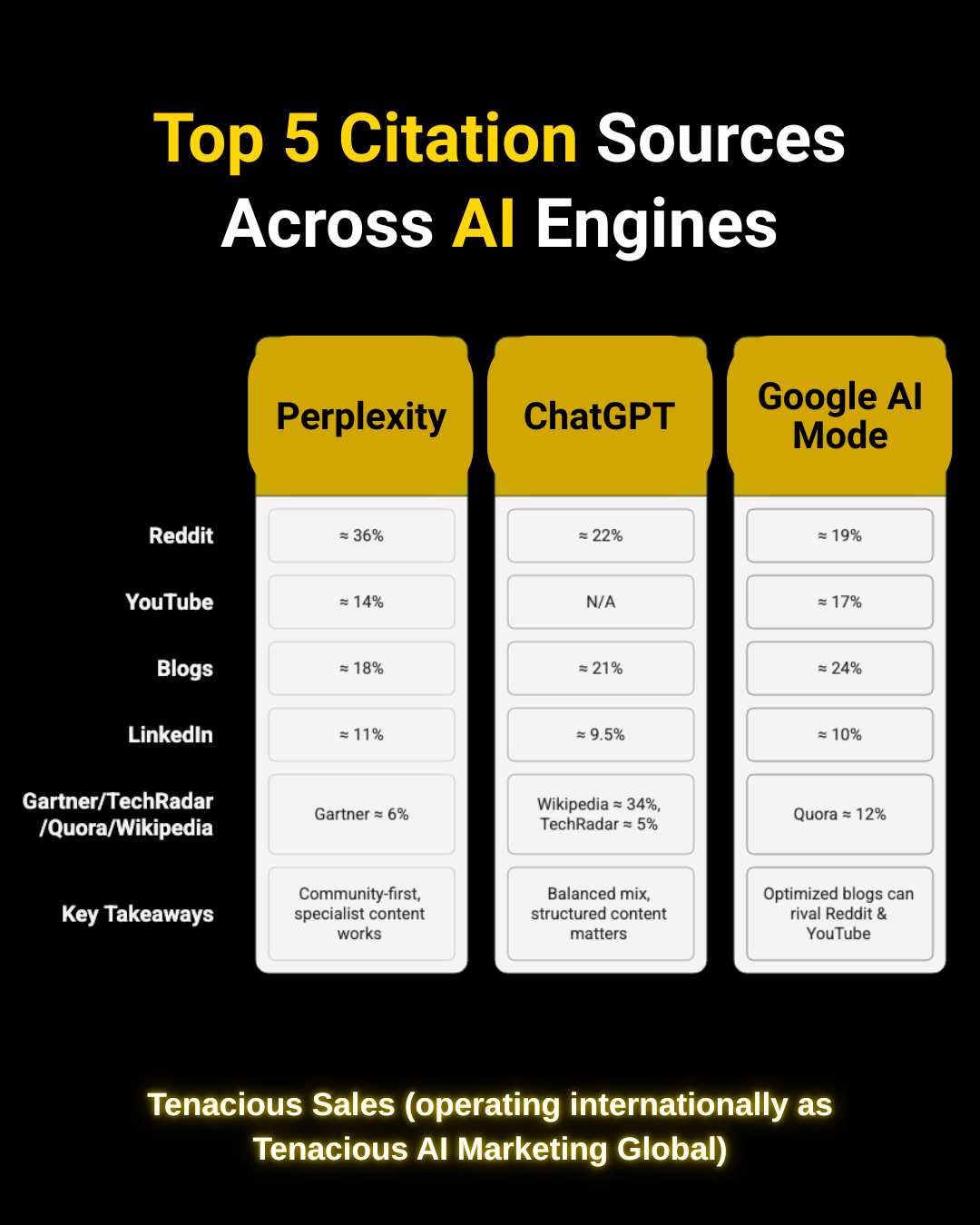
Perplexity AI has seen explosive growth, processing over 230 million queries per month as of mid-2024, proving that users are actively seeking sourced, cited answers over blue links.
Learn how to build this authority in our article: Search Everywhere Optimisation: How to Be Cited by AI and Trusted by People.
Most founders ask us, "What kind of content should I write?" The answer is rarely "more blog posts." It’s about writing the right kind of content.
AI models are trained on massive datasets, but they have a preference for Information Density.
They hate fluff. If you are writing 500 words of intro before getting to the point, you are training the AI to ignore you.
Here is the "Content Diet" we prescribe at Tenacious AI Marketing:
| Avoid This (The Fluff Diet) | Embrace This (The GEO Diet) |
| Long Anecdotes: "When I was a boy..." | Direct Definitions: "GEO is defined as..." |
| Vague Headers: "Thoughts on success" | Question-Based Headers: "How do I fix X?" |
| Walls of Text: 10-sentence paragraphs | Bullet Points & Lists: Numbered steps |
| Opinions: "I think this is good." | Data & Sources: "According to Gartner..." |
| PDFs: Locked inside downloadable files | HTML Tables: Open data directly on the page |
The Strategy:
Go back to your top 5 performing articles. Look at them through the eyes of a lazy robot. Can you extract the answer in 3 seconds? If not, rewrite the intro. Add a "Key Takeaways" box at the top.
This simple tweak can double your visibility in AI summaries.
Sometimes, the problem isn't your content, it's your plumbing.
We often see brands inadvertently blocking AI crawlers in a misguided attempt to "protect" their content. While you don't want your content stolen, you do want it read by the engines that drive traffic.
If you are blocking GPTBot or CCBot (Common Crawl), you are telling ChatGPT and its cousins to stay away. You cannot be the "answer" if you refuse to be read.
AI models prioritize content that loads fast and renders clean HTML. If your site is heavy with Javascript that hides text until a user clicks a button, the AI might miss it entirely.
“How long does this take?”
This is the most common question we get. Unlike Google SEO, which is a slow grind of link building, GEO is about verification. Once the AI verifies you are a trusted entity, your visibility can spike rapidly.
Here is the typical Tenacious Roadmap for our clients:
At Tenacious AI Marketing, we don't just "fix SEO." We build Systems. We use our VITAL Framework to take you from invisible to irreplaceable.
Here is how we apply it to solve the AI visibility crisis:
We don't want you to just "rank." We want you to be the Source of Truth for your industry.
The world isn't waiting for you to catch up. Your competitors are already adapting to the AI era.
They are structuring their content, building their personal brands, and ensuring they are the "answer" users find.
You have a choice:
Don't let your expertise go to waste. Let's make sure that when the world asks, "Who is the best?", the answer is You.
Ready to see how invisible you really are? Start with a Free Brand Audit and let's get to work.
Stay Tenacious.
Why does ChatGPT not mention my brand?
ChatGPT likely views your brand as "unverified" because it lacks a consistent presence in the Knowledge Graph. This usually stems from inconsistent business information across the web, a lack of Wikipedia or Wikidata presence, or insufficient third-party citations (backlinks from news sites) that confirm your authority.
What is the difference between SEO and GEO?
SEO (Search Engine Optimization) is the process of optimizing content to rank links on a search engine results page (SERP). GEO (Generative Engine Optimization) is the process of optimizing content to be the single, direct answer provided by AI models (like Perplexity or Gemini) by focusing on structure, authority, and entity verification.
How can I check if my content is visible to AI?
You can manually check by asking specific questions about your brand or industry to models like ChatGPT, Claude, and Perplexity (e.g., "Who is the best X provider?"). For a data-driven approach consult with an GEO agency like Tenacious AI Marketing to audit your “Entity Status.”
Does Schema Markup actually help with AI rankings?
Yes. Schema Markup (structured data) is the primary language of AI crawlers. By wrapping your content in Schema (like Organization, FAQPage, or Article), you explicitly tell the AI what your content means, drastically reducing the chance of the AI "hallucinating" or ignoring your data.
How long does it take to start showing up in AI answers?
Unlike traditional SEO which can take 6-12 months, GEO results can be faster (3-6 months) because it relies on data verification rather than domain age. Once an AI model "verifies" your Entity and citations through a strategy like the VITAL Framework, your visibility can spike across multiple platforms simultaneously.