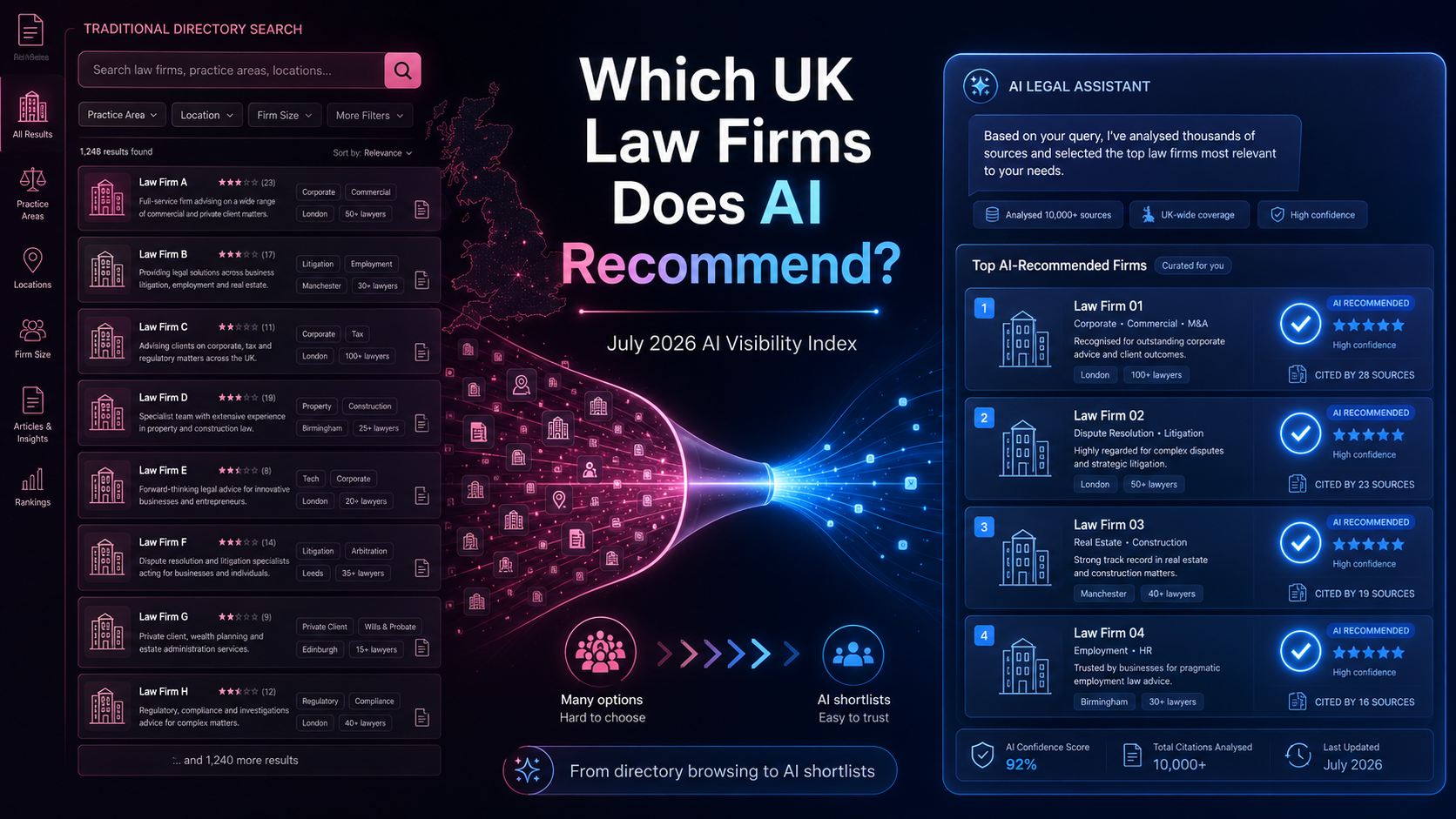
When a business owner, in-house counsel or private client asks AI for legal recommendations, they're rarely asking for a list of every law firm in the country.
They're asking for a shortlist.
The firms that appear in that shortlist increasingly become the firms that make it into the next stage of consideration.
That is why we created the Tenacious AI Visibility Index.
Each month, we ask leading AI platforms the same buyer questions across multiple industries and record every company they recommend. By repeating the process monthly, we can see how AI recommendations evolve, which firms are gaining visibility, which are losing ground and where new opportunities are emerging.
This report covers UK law firms.
July 2026 marks the second month of the Index and reveals some significant shifts compared to June. New firms have entered the rankings, established names have dropped out, and the group of firms achieving consensus across AI models has changed substantially.
July's legal sector data shows one of the most significant reshuffles across the entire AI Visibility Index.
In June, firms such as DLA Piper, Freshfields, Clifford Chance and Norton Rose Fulbright dominated AI recommendations.
In July, the picture changes dramatically.
Osborne Clarke becomes the most visible law firm in the dataset, while CMS climbs into second place. Withers and Macfarlanes also enter the leading group.
Only one firm that achieved full consensus in June remains in the full-consensus group in July: Linklaters.
The broader story is that AI recommendations appear to be expanding beyond traditional Magic Circle and global law firms towards a wider mix of commercial, sector-focused and specialist legal brands.
For law firms, that creates both opportunity and risk.
| Metric | June 2026 | July 2026 |
| AI models analysed | 3 | 4 |
| Buyer questions | 10 | 10 |
| Unique law firms detected | 85 | 95 |
| Full-consensus firms | 6 | 5 |
| Most visible firm | DLA Piper | Osborne Clarke |
| New Top 10 entrants | - | Osborne Clarke, CMS, Withers, Macfarlanes |
| Largest shift | DLA Piper #1 → Outside Top 10 | Osborne Clarke Outside Top 10 → #1 |
The July dataset includes more firms than June, reflecting a broader recommendation landscape and greater diversity across AI responses.
The standout performer in July is Osborne Clarke. After not appearing in the June Top 10, the firm rises to become the most visible law firm in the entire July dataset.
More importantly, Osborne Clarke achieves four-model consensus, meaning ChatGPT, Claude, Gemini and Perplexity all recommend the firm.
That level of agreement remains relatively rare.
CMS records one of the largest jumps in the Index. The firm moves from outside the June Top 10 into second place overall in July.
Like Osborne Clarke, CMS appears across all four AI models.
Withers becomes one of the strongest-performing specialist firms in the July data. Rather than relying on visibility within a single model, the firm appears consistently across all four.
Macfarlanes follows a similar pattern, securing four-model agreement and joining the July leadership group.
Four firms enter the July Top 10 after not appearing in the June Top 10:
Each achieved full four-model consensus.
That matters because model agreement is often a stronger signal than raw mention volume.
A firm recommended by all four models is generally more resilient than a firm heavily dependent on a single platform.
Several firms that performed strongly in June are no longer present in the July Top 10.
These include:
Importantly, dropping out of the Top 10 does not necessarily mean these firms disappeared from AI recommendations entirely.
It simply means other firms gained greater visibility across the July dataset.
| Rank | Law Firm | Total Mentions | Models Agree |
| 1 | Osborne Clarke | 23 | 4/4 |
| 2 | CMS | 22 | 4/4 |
| 3 | Withers | 18 | 4/4 |
| 4 | Macfarlanes | 16 | 4/4 |
| 5 | Linklaters | 15 | 4/4 |
| 6 | Clifford Chance | 14 | 3/4 |
| 7 | Mishcon de Reya | 13 | 3/4 |
| 8 | Pinsent Masons | 12 | 3/4 |
| 9 | Ashurst | 11 | 3/4 |
| 10 | Shoosmiths | 10 | 3/4 |
| Firm | June Rank | July Rank | Movement |
| Osborne Clarke | Outside Top 10 | 1 | New entrant |
| CMS | Outside Top 10 | 2 | New entrant |
| Withers | Outside Top 10 | 3 | New entrant |
| Macfarlanes | Outside Top 10 | 4 | New entrant |
| Linklaters | 4 | 5 | ▼1 |
| Clifford Chance | 2 | 6 | ▼4 |
| Mishcon de Reya | Outside Top 10 | 7 | New entrant |
| Pinsent Masons | Outside Top 10 | 8 | New entrant |
| Ashurst | Outside Top 10 | 9 | New entrant |
| Shoosmiths | Outside Top 10 | 10 | New entrant |
| DLA Piper | 1 | Outside Top 10 | ▼ Out |
| Freshfields | 3 | Outside Top 10 | ▼ Out |
The key takeaway is not that certain firms became weaker. The key takeaway is that AI recommendation patterns shifted significantly between June and July.
ChatGPT continued to favour larger commercial firms with broad service offerings. Several firms appeared consistently across questions involving corporate transactions, international law and commercial disputes.
Claude produced the highest concentration of recommendations around established advisory-led firms. The model showed stronger clustering around firms with broad commercial reputations.
Gemini surfaced a wider mix of firms than either ChatGPT or Claude. This contributed significantly to the rise of several July entrants.
Perplexity remained the least concentrated model. It introduced a wider variety of firms and helped drive some of the changes seen in overall rankings.
The result is that no single AI platform currently defines legal-sector visibility.
Firms that achieve consensus across multiple models are likely to be the most durable winners.
Three patterns stand out.
First, AI recommendations remain highly fragmented.95 different law firms appeared in July alone.
Second, consensus is difficult to achieve. Only 5 firms were recommended by all four models.
Third, visibility appears to be spreading beyond traditional legal powerhouses.
The July results show a broader range of firms competing successfully for recommendation space.
That suggests AI systems are becoming more nuanced in how they match legal providers to buyer intent.
The legal sector is becoming increasingly competitive inside AI-generated recommendations.
Historically, many firms relied on referrals, reputation and rankings.
Those signals still matter.
But AI systems also depend on what they can understand, verify and confidently reference.
Firms that appear repeatedly tend to have:
Our AI visibility metrics guide explains how these signals can be measured, while our generative engine optimisation guide explores how firms can improve recommendation visibility over time.
The firms winning AI recommendations today are creating an advantage that compounds every month the Index runs.
The July 2026 edition of the Tenacious AI Visibility Index analysed responses from ChatGPT, Claude, Gemini and Perplexity.
Each model was asked the same ten UK-focused buyer questions relating to legal services.
Every law firm explicitly named in a response was recorded and normalised. Mentions were then aggregated to create overall visibility rankings.
The same methodology will be repeated monthly to track how AI recommendations evolve over time.
Disclosure: AI recommendations can change as models, prompts and source data evolve. Results reflect the responses collected during July 2026 and do not constitute endorsements by Tenacious AI Marketing.
Want the Full Legal Sector Dataset?
This report highlights the key findings from the July 2026 edition of the Tenacious AI Visibility Index.
Behind these rankings sits the complete dataset, including:
If you'd like to see the full legal-sector dataset, get in touch, and we'll send it across.
Whether your firm appears frequently, occasionally or not at all, the underlying data provides a much clearer view of how AI currently sees the legal market.
The Tenacious AI Visibility Index is a monthly research project tracking which companies AI platforms recommend across multiple industries. The same buyer questions are repeated every month to identify changes over time.
AI models update regularly, sources change, and recommendation patterns evolve. The Index measures those changes rather than assuming results remain static.
No. The Index records which firms AI models recommend. It is not a ranking based on legal quality, client outcomes or market reputation.
A fall in ranking does not necessarily mean a firm became less visible overall. It often means other firms gained visibility across a wider range of buyer questions.
Law firms that appear consistently tend to have strong authority signals, specialist content, recognised expertise and third-party citations that AI systems can confidently reference.