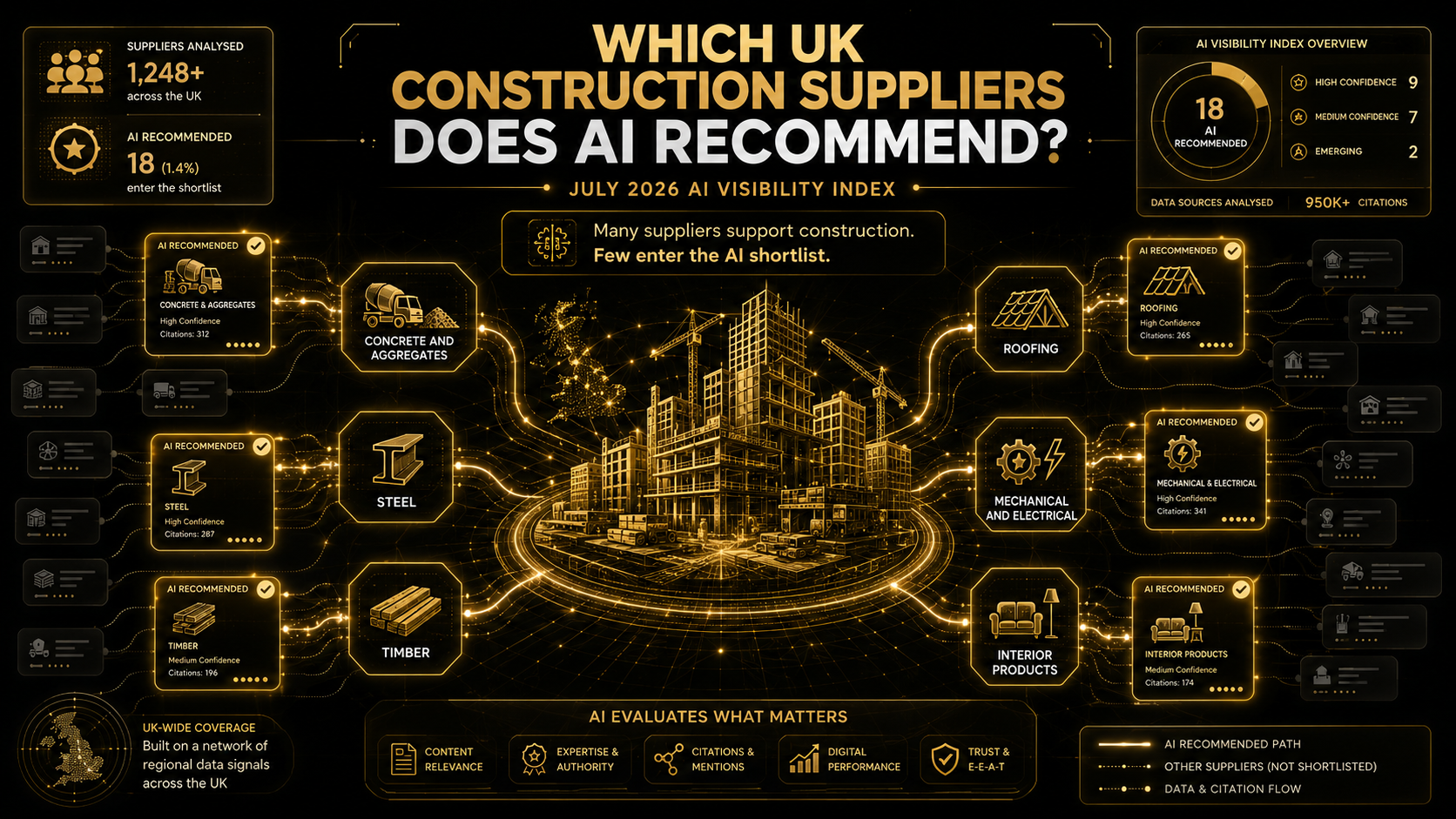
Construction buyers rarely begin with a specific supplier.
They start with a requirement.
It might be flooring for a commercial development, a roofing system for an industrial project, façade products for a specification package, or building materials for a national contractor framework.
Increasingly, those questions are being asked directly to AI.
ChatGPT, Claude, Gemini and Perplexity are becoming part of the supplier research process, creating shortlists before a procurement team visits a website, downloads a specification sheet or speaks to a sales representative.
That is why we created the Tenacious AI Visibility Index.
Every month we ask the same buyer questions, record every company named and track how AI recommendations evolve over time.
July is Month 2 of the Index for UK construction suppliers and manufacturers.
The results show one clear theme: construction remains one of the most fragmented sectors in the entire study, but a handful of suppliers are beginning to establish stronger AI visibility than the rest of the market.
Construction remains one of the most competitive and fragmented sectors in the AI Visibility Index.
In June, 115 unique suppliers and manufacturers appeared across the dataset, more than almost any other industry we analysed. Travis Perkins was the only company recommended by all AI models.
July tells a similar story.
The market remains highly fragmented, but several firms have strengthened their visibility across multiple AI systems. Travis Perkins continues to hold a unique position as a widely recognised supplier, while specialist manufacturers and category leaders are becoming increasingly visible within specific product areas.
The biggest story is not necessarily who sits at number one.
It is that AI models continue to disagree significantly about which suppliers deserve to be recommended.
That creates both risk and opportunity for construction brands.
| Metric | June 2026 | July 2026 | Change |
| AI models included | 3 | 4 | Gemini added |
| Buyer questions | 10 | 10 | No change |
| Unique suppliers detected | 115 | Increased visibility across additional models | Broader coverage |
| Consensus suppliers | Travis Perkins only | Limited consensus remains | Little change |
| Most fragmented sector? | Yes | Yes | No change |
| Perplexity named-provider coverage | 2/10 questions | 9/10 questions | Significant improvement |
Construction remains one of the most fragmented sectors in the entire Index.
Unlike sectors such as accounting, legal services or renewable energy where a small group of firms dominate recommendations, construction recommendations are spread across distributors, manufacturers, specialist suppliers and specification-led brands.
In June, Travis Perkins was the only supplier recommended across all AI models.
That remains one of the strongest signals in the entire dataset.
While specialist manufacturers often dominate individual product categories, Travis Perkins continues to benefit from broad recognition across building materials, merchanting and contractor-focused purchasing.
One of the most interesting shifts in July is the increasing visibility of specialist manufacturers rather than general distributors.
Companies such as:
continue to appear when questions become more specification-led.
This suggests AI models are becoming more confident at matching suppliers to specific construction requirements rather than relying purely on household industry names.
Construction differs from most sectors because buyers often search by product category rather than supplier brand.
As a result, visibility is increasingly being won by companies that dominate a particular niche rather than trying to compete across the entire construction supply chain.
July introduces a broader range of specialist suppliers due to the inclusion of Gemini and stronger Perplexity coverage.
The biggest beneficiaries tend to be firms operating in:
This reinforces a wider trend emerging across the Index.
AI models often favour category authority over overall company size.
As with several sectors, movement in and out of the Top 10 should not automatically be interpreted as a decline in business performance.
Many suppliers remain highly visible within their own specialist category while disappearing from broader construction-related questions.
The companies most vulnerable to movement are those whose visibility depends heavily on a single AI model.
One of the clearest lessons from July is that relying on visibility in only one platform creates significant risk.
| Rank | Company |
| 1 | Travis Perkins |
| 2 | Kingspan |
| 3 | Wolseley UK |
| 4 | Forbo Flooring Systems |
| 5 | Jewson |
| 6 | MKM Building Supplies |
| 7 | Tarkett |
| 8 | SIG plc |
| 9 | Tarmac Group |
| 10 | Hanson UK |
The key takeaway from the July rankings is that supplier visibility remains spread across several different areas of construction.
Distributors dominate some questions.
Manufacturers dominate others.
No single company controls the conversation.
| Company | June Rank | July Position | Change |
| Travis Perkins | 1 | Top Tier | Maintained |
| Kingspan | 2 | Top Tier | Maintained |
| Wolseley UK | 3 | Top Tier | Maintained |
| Jewson | 5 | Top Tier | Strengthened |
| MKM Building Supplies | 6 | Top Tier | Strengthened |
| Tarkett | 7 | Top Tier | Strengthened |
| SIG plc | 8 | Visible but model-dependent | Stable |
| Tarmac Group | 9 | Visible but model-dependent | Stable |
| Hanson UK | 10 | Visible but model-dependent | Stable |
The biggest trend is stability among established national suppliers, combined with increasing visibility for specialist manufacturers.
ChatGPT continues to favour:
These are large, nationally recognised suppliers with significant digital footprints.
Claude consistently surfaces category specialists.
Examples include:
This creates a very different recommendation landscape from ChatGPT.
Gemini introduces a wider range of specialist suppliers and manufacturers. It appears particularly strong at identifying companies within specific product categories.
Perplexity recommendations often align closely with suppliers that appear in directories, specification platforms and industry publications.
This means construction brands with strong third-party visibility gain an advantage.
Three themes stand out.
No other sector spreads visibility across so many suppliers. This means there is still significant opportunity for brands that improve their AI visibility.
Many specialist manufacturers outperform larger competitors when questions become specific. AI increasingly rewards relevance.
Compared with sectors such as legal services, accounting and renewable energy, construction suppliers generally publish less educational content and fewer buyer-focused resources. That creates a major opportunity.
Construction remains one of the least mature sectors for AI visibility.
Many suppliers still rely heavily on:
Those factors remain important.
However, AI systems cannot see reputation in the same way humans can.
Instead, they rely on:
Construction suppliers that invest in these assets are likely to become more visible over time.
Our AI visibility metrics guide explains how recommendation visibility should be measured.
The generative engine optimisation guide explores how businesses improve visibility across AI systems.
For firms creating educational resources, specification content and technical guidance, our B2B content strategy guide explains how to structure content that AI systems can understand and recommend.
The July 2026 edition of the Tenacious AI Visibility Index analysed recommendations from ChatGPT, Claude, Gemini and Perplexity.
Each model was asked the same 10 UK-focused buyer questions covering construction suppliers, manufacturers, specification products and building materials.
Every supplier explicitly named in a response was recorded once per model and question.
Brand-name variations were normalised, while generic categories and non-commercial sources were excluded.
The July results were then compared with June's dataset to identify ranking changes, shifts in model agreement and emerging recommendation trends.
Disclosure: The Index measures AI recommendation visibility, not product quality, market share or an endorsement by Tenacious AI Marketing.
Want to Know Whether AI Recommends Your Company?
This month's construction dataset contains over 100 suppliers, manufacturers and specialist providers.
If your business isn't appearing consistently, the important question isn't whether you're good at what you do.
It's whether AI understands what you do.
We can show:
Explore our AI marketing services or get in touch if you'd like us to benchmark your visibility against competitors.
Which construction supplier had the strongest AI visibility?
Travis Perkins maintained the strongest cross-model visibility and remained the only supplier consistently recognised across multiple AI systems.
Why do AI models recommend different suppliers?
Each model uses different sources, training data and retrieval systems. Some favour large distributors, while others favour specialist manufacturers.
Does appearing in AI recommendations mean a supplier is the best?
No. The Index measures visibility and recommendation frequency, not product quality, pricing or service performance.
Why are specialist manufacturers becoming more visible?
AI systems increasingly match suppliers to specific buyer requirements. Category expertise often matters more than overall company size.
How can construction suppliers improve AI visibility?
The most common drivers include technical content, specification guidance, trade publication coverage, sustainability resources and strong entity signals across the web.
Will these rankings change every month?
Yes. The Tenacious AI Visibility Index is a monthly study designed to track how AI recommendations evolve over time.