.png)
Yes. Service businesses should launch YouTube in 2026 because buyers are already using video to research, compare, and validate experts before they enquire. For accountants, law firms, IT MSPs, FX brokers, cyber security firms, recruiters, and consultants, YouTube builds trust faster than written content alone. It also supports AI visibility because videos create searchable titles, descriptions, captions, and transcripts that help search engines and AI systems understand your expertise.
For a wider breakdown of why YouTube matters to AI visibility, read Why YouTube Is Now Essential for Business Visibility in the AI Era
If you run a professional service business, an accountancy practice, a law firm, an IT support company, an FX brokerage, a cyber security consultancy, a logistics provider or a recruitment firm, there is a very good chance you have considered launching a YouTube channel and talked yourself out of it.
Maybe you thought it was not professional enough for your sector. Maybe you decided you did not have time. Maybe you watched a few channels in your space, decided they were doing it better than you could, and moved on.
Here is what actually happened: you left one of the most powerful trust-building tools available to a service business sitting unused while your competitors continued to rely on the same referral networks, the same conference circuit, and the same LinkedIn posts as everyone else.
People do not buy professional services the way they buy products. They buy the person. They buy the firm. They buy the feeling that whoever they are handing this problem to actually knows what they are talking about and will take care of it properly.
That trust used to take months of relationship-building to establish. A YouTube channel can establish a large part of it in forty minutes, before you have ever spoken to the prospect directly.
This is the complete DIY guide. Not the version that assumes you have a production budget and a marketing team. The real one, for the managing partner who is going to record this themselves on a Thursday afternoon, the finance director who wants to explain forward contracts to nervous business owners, the IT director who knows exactly what question clients keep asking and wants to answer it on camera.
You do not need a studio. You do not need a production company. You need a clear system and the willingness to start.
Most professional service businesses rely on a combination of referrals, industry events, Google searches, partner relationships and occasional LinkedIn activity to generate new business.
These channels work. They are also slow, time-heavy and limited by the size of your existing network.
YouTube works differently. It works while you sleep. It reaches people who have never heard of you through a referral. It lets a prospective client spend time watching you explain things before they have ever met you, building the same kind of trust that a referral and two coffees would build, but with no ceiling on scale.
For a service business specifically, the economics of YouTube are compelling in a way they are not always for product businesses.
You are not trying to sell to millions of people. You need twenty, thirty or fifty genuinely good clients per year. YouTube does not need to produce thousands of leads to justify the investment. It needs to produce a handful of well-qualified, pre-trusting, ready-to-convert prospects per month.
For most professional service businesses, that is achievable within six to twelve months of consistent publishing.
The other reason YouTube matters now is its connection to AI search. When someone asks ChatGPT, Perplexity, Gemini or Google AI Overviews which IT support company, law firm, accountant or FX broker they should consider, AI systems increasingly draw on a wider set of signals than traditional web pages alone.
A well-titled, well-described YouTube video that answers a specific buyer question is searchable, indexable and repurposable. Its transcript can become blog content. Its clips can become LinkedIn content. Its explanation can become FAQ content. Its presence can strengthen your wider GEO strategy.
That makes YouTube more than a social channel.
It is trust infrastructure.
For more on how this connects to wider AI visibility, read What Is GEO in 2026 and How Do You Get Cited in AI Answers?
Before a service business decides YouTube is not for them, there are three objections worth dealing with properly.
Most firms do not avoid YouTube because they have analysed the opportunity and decided against it. They avoid it because they assume nobody will watch, their people will not be good on camera, or the time investment will be too high.
Those are understandable concerns. But they are not strong enough reasons to ignore what may become one of the most important marketing shifts of the next few years.
The first objection is usually: “Why would anyone be interested in what we put out there?”
The answer is that they may not be interested in your company updates, your office news or a polished brand video. But that is not what a good YouTube strategy is built around.
YouTube is one of the largest search engines in the world, and a lot of people prefer to learn while they watch. They watch on the treadmill. They watch on the train. They watch in the gym. They watch while making lunch. They watch because video lets them understand something faster than reading a long article.
So the question is not, “Will people care about us?”
The better question is, “Are we answering something they are already asking?”
If an accountant explains whether a director’s loan account is a problem, people will watch. If a solicitor explains what happens when a supplier breaches a contract, people will watch. If an FX broker explains whether a forward contract protects a business from currency movements, people will watch. If an IT provider explains what actually happens after a ransomware attack, people will watch.
The interest is not in the company.
The interest is in the problem.
As long as you answer what buyers are already asking, YouTube has a role to play.
But there is a second point that matters even more. The reason to launch YouTube is not only because people watch videos today. It is because Google owns YouTube, Google is building Gemini into the search experience, and video content is likely to become an increasingly important part of how AI systems explain, summarise and recommend businesses.
That means the videos you publish now are not just for today’s viewers. They are creating a searchable, transcribed and AI-readable authority library that may matter significantly more in 2027 and 2028.
That is why YouTube should not be seen as a nice-to-have content channel. It is becoming part of the AI visibility infrastructure.
The second objection is: “Our people are not good on camera.”
That may be true at the beginning. But it is also fixable.
Most people are not naturally media polished. They are professionals, not presenters. A solicitor does not need to become a YouTuber. An accountant does not need to perform. An IT director does not need to act like an influencer.
They need to explain useful things clearly.
For short-form content, raw and lightly edited answers can work extremely well. A clear answer to a real client question often performs better than something overproduced, because it feels more human and more useful.
For longer-form content, or for firms where the brand needs to feel more premium, the standard can be raised. This might mean better structure, better preparation, cleaner editing from an internal or external editor, and support from a good speaking and presence coach. A coach can help partners, directors and technical experts become more confident, concise and engaging on camera.
This is like going to the gym.
The first sessions can feel painful. People feel awkward. They overthink their voice, their face, their hands and how they sound. Then they improve. After a few sessions, they become more natural. After a few months, they become genuinely good.
That matters because the firms that build this capability now will have a visible advantage over firms that continue hiding their expertise behind static service pages and occasional LinkedIn posts.
At Tenacious, our belief is that video confidence is going to become a serious business skill. That is why we recommend that businesses take YouTube seriously as part of their wider AI visibility and authority strategy, and where needed, invest in the training that helps their experts become more confident on camera.
The goal is not to turn professionals into influencers.
The goal is to make real expertise easier for buyers and AI systems to see, trust and recommend.
The third objection is: “We do not have time.”
That is the most honest objection of all, because a proper YouTube strategy is not effortless.
A serious service business should expect to invest time. Realistically, between planning, filming, reviewing, editing, publishing and repurposing, YouTube may require 5 to 10 hours a week across the business if it is being treated properly.
That does not mean the founder, partner or senior expert has to do all of that work personally. The highest-value person should usually focus on the part only they can do: sharing the expertise. The rest can be systemised, delegated or supported internally.
But it is still an investment.
The question is whether it is worth it.
If AI visibility becomes one of the major drivers of inbound demand in 2027 and 2028, and if being recommended by AI systems can influence six, seven or even eight-figure opportunities in professional services, then YouTube cannot be viewed as a side project.
It becomes a strategic investment in future visibility.
That is the mindset shift.
Most businesses still treat YouTube as something they might do later if they have spare time. But the businesses that win visibility in the AI era are unlikely to be the ones that waited until the channel felt easy. They will be the ones that built the authority library before the market fully understood the value of it.
At Tenacious, our belief is simple: for many B2B service businesses, YouTube should now be the number one marketing play, not because every video will go viral, but because video builds trust, supports sales, strengthens AI visibility and compounds over time.
For firms serious about future demand generation, allocating around 20% of the marketing budget to YouTube and video authority is no longer aggressive. It may become the sensible baseline.
The businesses that make that shift early will own the answers, the trust and the visibility while competitors are still debating whether anyone would watch.
The shift towards video is not just a creator economy trend. It is a B2B buyer behaviour trend.
Google’s research into the B2B path to purchase found that 70% of B2B buyers and researchers watch video during their purchase journey. The same research found that many B2B researchers watch 30 minutes or more of B2B-related video while evaluating options. Read Google’s B2B video research here.
This matters because professional services are trust-led purchases.
A prospect looking for an accountant, solicitor, IT provider, FX broker or cyber security consultant is not only asking, “Can this firm do the job?” They are also asking, “Do I trust these people with something important?”
Video answers that question faster than almost any other format.
It lets the buyer hear your thinking. It lets them see how you explain complexity. It gives them a sense of your judgement, confidence and care. That is why YouTube can shorten the trust-building process before the first call.
In the UK, video consumption is now mainstream. Ofcom’s Online Nation reporting shows YouTube as one of the dominant online platforms in the UK, making it a natural place for people to search, learn and evaluate. Read Ofcom’s Online Nation work here.
In the US, Pew Research has also consistently reported YouTube as one of the most widely used online platforms among adults. Read Pew’s social media usage research here.
The point is simple: your clients are not “too professional” for YouTube.
They are already there.
For a professional service business, authenticity on camera is not a limitation to work around.
It is your competitive advantage.
When a worried business owner searches for “what to do if I get a legal dispute with a supplier”, they do not want a glossy corporate video produced by a marketing agency. They want to see a real solicitor explain the situation clearly, in plain English, in a way that makes them feel less anxious and more informed.
When a finance director searches for “should my business be hedging currency exposure”, they want to see a real FX specialist explain the options honestly, including the cases where hedging may not be right for them.
Not a promotional video.
A genuine explanation.
The production quality that creates trust is not mostly technical. It is the quality of the thinking, the clarity of the explanation and the presence of a real person with real expertise.
Your expertise, your way of explaining things and your genuine interest in helping the people you work with cannot be outsourced to a production company. They have to come from you.
So when you watch your first video back and think, “I look a bit awkward”, or “my background is not perfect”, or “I fluffed a line in the middle”, remember this:
The accountant who explains tax planning clearly and honestly on a plain background will often outperform the slick corporate explainer video, because the buyer is not mainly evaluating the production.
They are evaluating the person.
Before you record your first video, get these foundations in place. This should take a few hours. Once it is done, it is done.
Area | What to Set Up | Why It Matters |
| Channel | Dedicated YouTube channel for the business or named expert | Gives your authority a home |
| Description | Clear explanation of who you help and what viewers will learn | Helps humans and search systems understand the channel |
| Handle | A consistent @handle across platforms | Supports brand and entity consistency |
| Website link | Add your website in the About section | Connects YouTube to your business entity |
| Profile image | Use a clear professional headshot | People trust people faster than logos |
| Channel banner | Simple banner with name, role and promise | Makes the channel feel intentional |
| Thumbnail template | Consistent Canva template | Helps recognition and click-through |
| Channel trailer | 60 to 90 second introduction | Explains who the channel is for |
For most professional service firms, the best channel is often a personal brand channel built around a named partner, director or founder.
For example, “James Chen, Commercial Solicitor” usually builds trust faster than a faceless firm channel. People connect with people before they connect with logos.
That does not mean the business brand disappears. It means the person becomes the trust layer that leads back to the firm.
This is the section most people overthink.
Here is the honest minimum for a result that looks professional and builds trust.
Your smartphone is fine.
An iPhone from the last few years, a Samsung Galaxy flagship or a Google Pixel can all produce a strong enough image for professional YouTube content. Set it to record at 1080p, place it at eye level and keep the shot stable.
You do not need cinematic production. You need clarity, confidence and consistency.
A basic tripod for £20 to £35 is enough to start.
Spend money here.
Audio quality matters more than video quality for viewer retention and trust. A video that looks slightly soft but sounds crisp will hold attention far better than a beautifully shot video with echoey, distant audio.
Good starter options include a USB microphone for desk-based recording or a simple lapel microphone if you are recording on a phone.
If your audio sounds clean, viewers will forgive a lot.
If your audio sounds bad, they will leave.
Use natural light if you can.
Sit facing a window. Natural light on your face is one of the easiest ways to make a video look professional without buying anything.
If your space does not have good natural light, a basic ring light or softbox solves the problem quickly.
Keep it clean and consistent.
A plain wall, a bookshelf or a tidy office corner is enough. For law firms, accountants, financial services and professional practices, a clean office or bookshelf background often communicates exactly the right signals.
The background should support your credibility, not fight for attention.
For tutorial or walkthrough content, use simple screen recording software.
Loom is easy. OBS is more powerful. Both can record screen and webcam together, which is useful if you are explaining a process, reviewing a document or showing a system.
This is where most professional service businesses get stuck, and where the answer is simpler than almost everyone expects.
You already know what to talk about because your clients tell you every week.
Every question a client has ever asked before signing up is a video idea.
Every mistake you have seen businesses in your sector make is a video idea.
Every piece of advice you find yourself giving repeatedly is a video idea.
Every misconception about your service that you have to correct in the first meeting is a video idea.
Every thing a prospect should ask you, but does not know to ask, is a video idea.
Every regulatory change that affects your clients is a video idea.
That is your content pipeline.
It is specific to you in a way competitors cannot easily replicate.
Pick one concept that clients regularly find confusing and explain it clearly, in plain English, in under ten minutes.
No jargon. No hedging. No unnecessary cleverness.
Just a genuinely clear explanation of something your audience wants to understand.
These videos have long shelf lives because the underlying question often does not change.
Examples by sector:
Sector | Example Video Topics |
| Accountants | What is a director’s loan account and when is it a problem? |
| Law firms | What is a shareholder agreement and why does your business need one? |
| IT MSPs | What does a managed service provider actually do? |
| FX brokers | What is a forward contract and why should my business use one? |
| Cyber security | What is a penetration test and what does it actually tell you? |
| Logistics | What is a 3PL and when does it make sense to use one? |
| Recruitment | Contingency vs retained recruitment, which is right? |
This content works because it gives the buyer a useful answer before asking for anything in return.
Pick the single question clients ask most frequently in your first meeting or introductory call.
Answer it properly on camera.
This format has an almost guaranteed audience because you already know there is demand for it. Your own clients have been asking it.
Examples:
“The question I get asked most as a business accountant: do I need to register for VAT?”
“Every IT client asks me this in the first meeting: how much does managed IT support actually cost?”
“The question every FX client asks before they sign up: is it safe to use a currency broker instead of my bank?”
“What lawyers get asked most: do I really need a written contract for this?”
This is also one of the most efficient formats for collapsing the sales funnel, because the viewer is asking the same question a genuine prospect would ask.
Pick one thing a significant proportion of your potential clients believe that is not true, or is more nuanced than they think.
Address it directly and clearly.
This format works because it positions you as the person willing to tell people what they actually need to hear, not just what they want to hear.
Examples:
“The biggest myth about managed IT support: more expensive means more covered”
“What most businesses get wrong about cyber insurance”
“The misconception costing UK importers money every month”
“The myth that small businesses do not need a shareholder agreement”
This type of content builds authority because it shows judgement.
Explain what it actually looks like to work with you, from first conversation to outcome.
Walk through onboarding, scoping, what the client needs to provide, what you do in the first thirty days and what ongoing service looks like.
This content removes uncertainty.
Many people do not contact a service provider because they do not know what happens next. A clear process walkthrough removes that barrier.
Examples:
“What happens when you hire us as your IT support provider, the first 30 days”
“How we handle a client’s first FX transfer, from enquiry to completion”
“What a law firm engagement actually looks like from first call to resolution”
“How our accountancy onboarding works, what you need, what we do and what you will have at the end”
When something changes in your sector, record a short, clear video explaining what it means for your audience.
This might be a Budget announcement, law change, FCA update, cyber security development, tax deadline, employment law change or market shift.
This content is time-sensitive, but powerful. It shows that you are current, active and paying attention.
It also signals freshness to both humans and search systems.
Examples:
“What the Spring Budget means for small business owners”
“Employment law changes in 2026 every employer needs to know”
“What the latest cyber security rules mean for SMEs”
“What currency movements mean for UK importers this month”
This is the section most YouTube guides skip, and most professionals need.
Reading a script on camera usually produces stiff delivery.
Instead, write four to six bullet points covering the key things you want to say, in order. Then talk naturally from those points.
This produces the conversational clarity that builds trust. You sound like yourself because you are.
Do not try to record the whole video perfectly in one take.
Divide the video into sections. Record each one separately. If you stumble, stop, take a breath and start that section again.
This removes pressure and makes editing easier.
When you look at your own face on the screen, you appear to be looking away from the viewer.
Look at the camera lens instead.
Eye contact on camera is the equivalent of eye contact in a meeting. It communicates confidence and attention.
Leave a two-second pause at the start and end of each take.
This gives you clean edit points and makes the final video feel more professional.
Turn off notifications. Close the door. Tell people you are filming. Avoid fans, traffic noise, air conditioning and background conversations where possible.
Your microphone will hear things you stop noticing.
You will not feel ready.
Nobody does before their first video.
The only way to feel comfortable on camera is to film yourself on camera. That means you have to start before you feel comfortable.
Publish the first few videos even if they are not perfect. The learning curve is steepest at the beginning.
You do not need to become a video editor.
You need to produce a watchable, professional result in the least possible time.
Here is the minimum viable editing workflow.
Step 1: Import and review
Bring your footage into your editing tool. Watch through and mark the sections you want to keep.
Cut everything else.
Step 2: Remove silences and stumbles
Remove long pauses, false starts and filler words that break the rhythm.
Do not try to remove every imperfection. A few natural hesitations make you sound human.
Remove the ones that interrupt understanding.
Step 3: Add captions
Auto-generated captions in CapCut, Descript or YouTube Studio are now accurate enough to use with minor corrections.
Captions increase watchability because many people watch without sound. They also give you transcript material that can be repurposed into blogs, FAQs and social posts.
Step 4: Add a simple intro and outro
A two to three second title card at the start is enough.
At the end, use a simple call to action, such as subscribing, watching a related video or booking a call.
Do not overcomplicate it.
Step 5: Export and upload
Export at 1080p. Upload to YouTube. Fill in the title, description and tags before publishing.
Recommended tools:
Tool | Best For |
| CapCut | Fast simple editing and captions |
| Descript | Editing video by editing text |
| iMovie | Simple Mac-based editing |
| Loom | Screen recording and simple explainers |
| OBS | More advanced screen and camera recording |
Target editing time should be one to two hours per video once your process is familiar.
A good video can still underperform if the title, description and thumbnail are weak.
YouTube is a search and discovery platform. Treat publishing properly.
Use the language your buyer would actually search.
“What is a director’s loan account?” is stronger than “Director’s Loan Account Explained” because it matches the natural phrasing of a real search.
Do not title videos around what you want to say.
Title them around what your buyer wants to know.
The first two or three sentences should summarise what the video covers using natural search phrases.
Then include:
A brief bio
Your website link
Booking link
Related videos
Relevant resources
Contact information
The description is content. It is not an afterthought.
Use TubeBuddy, VidIQ or YouTube search suggestions to find related phrases.
Include the primary search term, related terms and your firm name.
Use your Canva template. Keep the design consistent.
Your thumbnail should show your face, use clear short text and make the topic obvious.
A good thumbnail does not need to be loud. It needs to be clear.
Pick a publishing rhythm you can sustain.
Weekly is great if you can do it. Fortnightly is realistic for many busy professionals.
Consistency matters more than intensity.
A channel that publishes every two weeks for a year will usually beat one that publishes daily for a month and then disappears.
This is the mechanism that makes YouTube worth the investment for a professional service firm.
Traditional service business development works like this:
A prospect hears about you through a referral, event, LinkedIn post or Google search. They make contact. You have a discovery call where you explain what you do and how you can help. Then there is a period of consideration, proposal, follow-up and decision-making.
At every stage, trust is being built from a low base.
The prospect does not know much about you, so the early stages require significant investment from both sides.
YouTube reorders the sequence.
When a prospect has watched four or five of your videos before making contact, the trust-building phase is partly complete before the first call. They know how you explain things. They know your approach. They know enough about your expertise to form a view on whether they want to work with you.
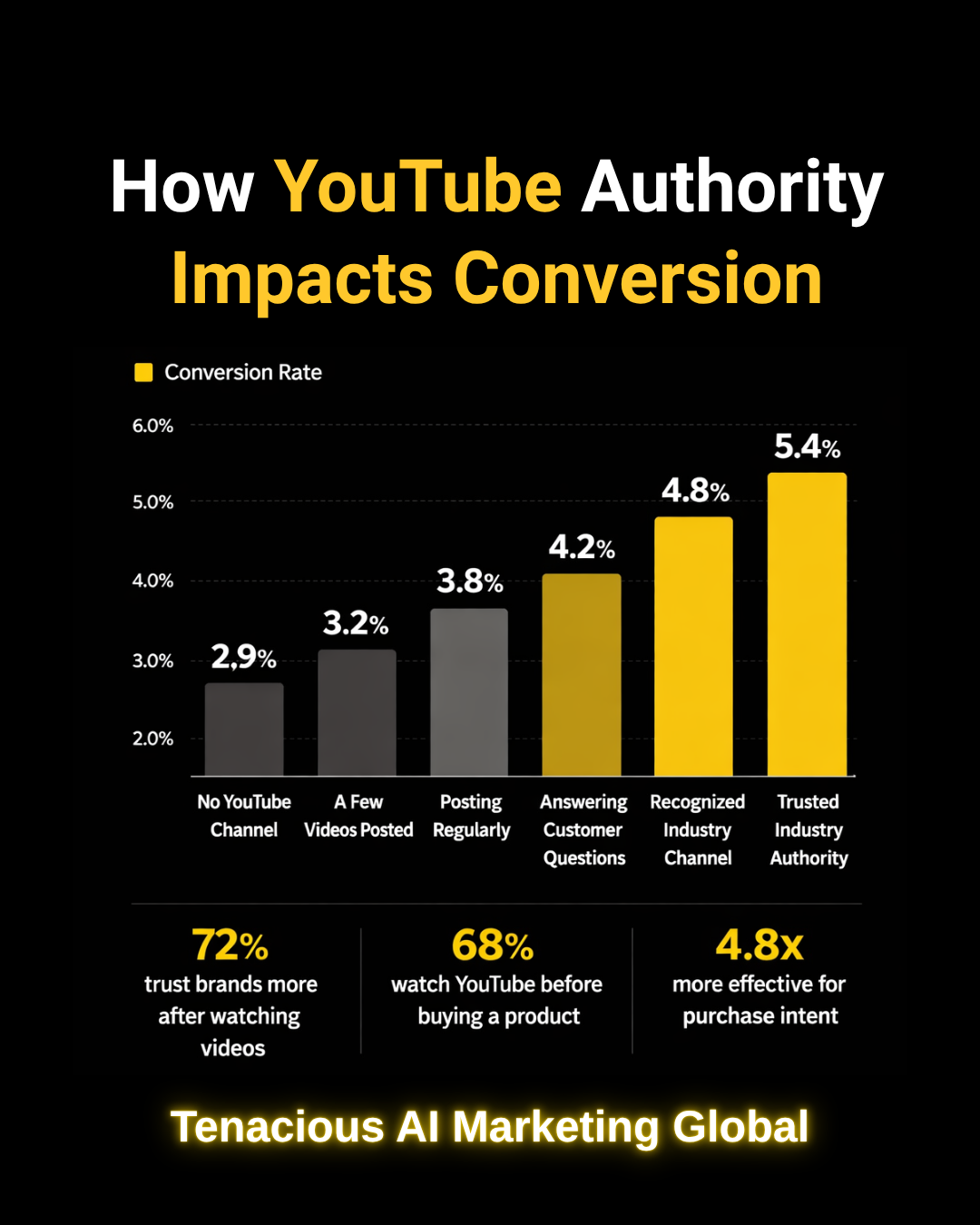
When they book a call, they are not exploring whether you might be a fit.
They are confirming that you are.
The practical effect is significant:
Sales Impact | Why It Happens |
| Shorter discovery calls | Less time explaining fundamentals |
| Higher close rates | Trust is established before enquiry |
| Better-fit clients | Useful content attracts people who value expertise |
| Stronger referrals | Referred prospects can validate your credibility before contact |
| Easier follow-up | Videos answer objections after the call |
To engineer this deliberately, include a clear call to action in every video.
Not vague encouragement to “check out our services”.
Use a direct next step:
“If this is the kind of challenge your business is dealing with, the link to book a conversation is in the description.”
Then make the booking process frictionless.
Add the link in every video description, your channel About section and pinned comments where appropriate.
This section connects your YouTube channel to the broader GEO strategy.
When you upload a video to YouTube, several things happen that can improve visibility in AI-generated answers.
Every video can generate captions or transcripts. Those transcripts can be used to create blogs, FAQs, social posts and schema-ready answer assets.
For example, a video titled “What is a forward contract and how does it help UK businesses manage currency risk?” can become useful source material for a blog, a LinkedIn post, an FAQ and a sales follow-up.
That means one video can support multiple discovery surfaces.
Google owns YouTube. Google acquired YouTube in 2006 for $1.65 billion, and YouTube has since become a major part of Google’s search and content ecosystem. Read the original acquisition press release here.
Google’s own documentation explains that AI features in Search can help users explore information with AI-generated responses and links to useful sources. Read Google’s guidance on AI features in Search here
For service businesses, the practical point is simple.
A video answering a real buyer question is not just a video. It is an AI visibility asset, a search asset and a trust asset.
AI systems assess how consistently and authoritatively a business appears across the web.
A YouTube channel with regular, well-structured content on your specialist topics is an entity signal. It shows that your business is active, expert and producing useful information around a topic.
For accountants, law firms, IT firms, FX brokers, cyber security companies, recruiters and consultants, this matters because many competitors still have little or no YouTube presence.
Launching early creates a visibility advantage.
AI systems and search engines increasingly connect expertise to people.
A named accountant who has produced twenty videos about tax planning for growing businesses becomes associated with tax planning expertise. A solicitor who consistently explains shareholder agreements, commercial disputes and employment law builds topical association around those legal areas.
This is one reason founder-led and expert-led video matters.
People become the proof layer behind the brand.
For more on measuring whether AI systems understand and cite your business, read Beyond the Search Bar: Why AEO Testing Is Now a Business Visibility Metric.
Use this as your launch runway. These ten videos establish your channel, demonstrate your expertise and begin creating useful assets that can support search, sales and AI visibility.
Video | Topic | Purpose |
| 1 | Who I Am and Who This Channel Is For | Introduces the expert and audience |
| 2 | The Question I Get Asked Most | Captures proven demand from real prospects |
| 3 | Plain-English Explainer of Your Core Service | Explains what you do without selling |
| 4 | Common Mistake or Misconception | Builds authority through useful correction |
| 5 | Process Walkthrough | Reduces uncertainty before enquiry |
| 6 | Specific Technical Explainer | Demonstrates depth of expertise |
| 7 | Real Scenario or Case Study | Shows proof and practical application |
| 8 | What to Ask Your Provider About X | Positions you as buyer-friendly and trusted |
| 9 | Regulatory or Industry Development | Shows freshness and current expertise |
| 10 | What I Wish More Business Owners Knew About X | Creates personal, memorable authority |
Start with questions around tax, VAT, cash flow, director loans, payroll, Making Tax Digital and business structure.
Suggested videos:
“What is a director’s loan account?”
“When should a small business register for VAT?”
“Limited company vs sole trader: what should you choose?”
“What does a good accountant actually do for a growing business?”
Start with practical, plain-English answers around contracts, disputes, employment law, shareholder agreements and commercial property.
Suggested videos:
“What is a shareholder agreement and why does it matter?”
“What should you do if a supplier breaches a contract?”
“How does a commercial lease review work?”
“What questions should you ask before hiring a solicitor?”
For more on GEO for law firms, read “Why UK Law Firms Should Invest in Generative Engine Optimisation and How to Start”
Start with managed IT, cyber security, backup, ransomware, Cyber Essentials and response planning.
Suggested videos:
“What does a managed service provider actually do?”
“What is Cyber Essentials and does your business need it?”
“What should happen after a ransomware attack?”
“Cloud backup vs disaster recovery: what is the difference?”
Start with trust, safety, forward contracts, spot rates, international payments and property transfers.
Suggested videos:
“What is a forward contract?”
“Is it safe to use a currency broker instead of a bank?”
“Spot rate vs forward rate: which should your business use?”
“How do you transfer money safely for an overseas property purchase?”
For more on GEO for FX brokers, read Why UK Foreign Exchange and Currency Brokers Need GEO Before a CFO Chooses a Competitor They Found on ChatGPT
Start with hiring mistakes, salary expectations, retained vs contingency recruitment and interview process.
Suggested videos:
“Contingency vs retained recruitment: what is the difference?”
“Why your job description is attracting the wrong candidates”
“How to choose a recruitment partner”
“What does a good executive search process look like?”
One of the biggest mistakes service businesses make is treating YouTube as isolated content.
A good video should feed the rest of your marketing system.
Source Asset | Repurposed Assets |
| 10-minute YouTube video | Blog post |
| Video transcript | FAQ section |
| Key explanation | LinkedIn post |
| Strong quote | Short-form clip |
| Process section | Sales follow-up asset |
| Common question | Email newsletter |
| Main answer | Schema-ready Q&A |
| Video description | Internal link hub |
This is why YouTube matters for Search Everywhere Optimisation.
One expert explanation can create content for Google, YouTube, LinkedIn, AI answers, email, sales and your website.
For more on this wider system, read Search Everywhere Optimisation: AI Visibility in 2026
Your audience does not wake up wanting to watch your company update.
They want answers to their problems.
Make the channel about what they need to understand, not what you want to announce.
Professional does not mean cinematic.
It means clear, useful, audible and trustworthy.
If you wait for perfect lighting, perfect confidence and perfect editing, you will never publish.
A YouTube channel needs structure.
Your videos should cluster around the services you offer, the questions buyers ask and the problems your best clients have.
Random content creates weak authority.
Clusters create topical strength.
And don’t forget to make your titles and descriptions aimed at what people actually search for and get that data first, remember it’s not about you it’s about meeting the searches with the right intent. And you might be thinking that contradicts doing YouTube for AI visibility but no it doesn’t because Ai always still wants to give the very best answer for the human search so it comes back to search intent at the end of the day.
Every video should tell the viewer what to do next.
Watch another video. Download a guide. Book a call. Visit the website. Take an audit.
Do not make them guess.
If your YouTube videos are not connected to blog posts, FAQs, internal links, schema and AI visibility tracking, you are leaving value on the table.
A video should not just live on YouTube.
It should support your entire visibility system.
Do not judge YouTube only by views.
For a service business, a video with 300 views can be commercially valuable if 20 of those viewers are exactly the right buyers. Or if the sales team are using the videos as part of the sales process and thus the videos collapse the sales funnel and that equals higher conversions which equals massively improved revenues for your business.
Track:
Metric | Why It Matters |
| Views | Shows reach |
| Average view duration | Shows whether people stay |
| Subscriber growth | Shows audience building |
| Comments and questions | Shows buyer engagement |
| Clicks to website | Shows commercial movement |
| Enquiries mentioning YouTube | Shows direct business impact |
| Sales team usage | Shows sales enablement value |
| AI mentions and citations | Shows GEO impact |
You can track AI visibility manually by testing prompts in ChatGPT, Perplexity, Gemini and Google AI Overviews.
Or use Answer Architect to check how visible your business is in AI search
You can also take the Organic Visibility Scorecard here
YouTube is not instant.
But it compounds.
In the first month, the main win is confidence and process. You learn how to film, edit, upload and talk naturally on camera.
By months two and three, you start to build a small library of videos answering real buyer questions.
By months four to six, you may begin seeing early commercial signals, such as prospects mentioning videos, longer website sessions, better sales calls and more branded search.
By months six to twelve, the channel becomes more useful as a trust and sales asset because prospects can watch multiple videos before contacting you.
This is where the real advantage begins.
Your competitors cannot easily copy twelve months of visible expertise.
It is a common worry, but rarely a real problem in practice.
Clients usually respond positively to professionals who share expertise publicly because it reinforces trust. Competitors seeing your content is unavoidable, but the benefit of reaching the right audience far outweighs the risk of competitors watching.
The firms that stay invisible to avoid competitor scrutiny are often the ones that lose ground to firms willing to be visibly expert.
You can catch mistakes in editing or correct them later in the description or pinned comment.
For regulated sectors, such as law, financial services and accountancy, keep content educational and informational rather than personalised advice. Use standard disclaimers where appropriate.
This does not reduce the value of the content. In fact, educational clarity is usually exactly what buyers and AI systems both respond to.
For professional service content, eight to fifteen minutes is a strong range for most explainers and process videos.
Tutorials or walkthroughs can run longer if the content justifies it. Quick answers can be five to eight minutes.
Do not pad videos to hit a length target. End when you have answered the question properly.
Weekly is useful, but fortnightly is more realistic for many busy professionals.
One video every two weeks is enough to build a serious content library over twelve months.
Consistency is more important than intensity.
Regulated sectors can still use YouTube effectively.
The safest and most useful content is usually educational. Explain concepts, processes, risks and common questions. Avoid personalised advice unless the correct regulatory process has been followed.
This type of content is often easier to approve because it informs rather than promises.
Use hypothetical scenarios based on real problems your ideal clients face.
For example:
“Imagine a business has just received a legal letter from a supplier. Here is what they should think about first.”
This demonstrates expertise without needing client permission.
Test prompts related to your services in ChatGPT, Gemini, Perplexity and Google AI Overviews.
Check whether your brand appears, whether your content is cited, whether your competitors are mentioned and whether AI systems describe your expertise accurately.
For a deeper framework, read Beyond the Search Bar: Why AEO Testing Is Now a Business Visibility Metric
Related Content
To go deeper into how AI visibility and GEO work for service businesses, these guides are useful next reads:
The State of AI Search in May 2026
Beyond the Search Bar: Why AEO Testing Is Now a Business Visibility Metric
Why YouTube Is Now Essential for Business Visibility in the AI Era
What Is GEO in 2026, and How Do You Get Cited in AI Answers?
The New Rules of AI Search in 2026
Search Everywhere Optimisation: AI Visibility in 2026
How to Audit Your Website for AI Visibility in 2026
Why UK Law Firms Should Invest in Generative Engine Optimisation and How to Start
A YouTube channel is not a vanity project.
For a professional service business, it is one of the most efficient trust-building investments available. It compounds over time, works while you are with other clients and creates a pipeline of prospects who arrive at discovery calls already more educated and more confident.
The barrier to starting is lower than almost everyone assumes.
You have the equipment in your pocket. You have the expertise in your head. You have the questions from clients arriving in your inbox every week.
What you need is a system for capturing that expertise on camera and distributing it to the people who need it.
This guide is that system.
The next step is pressing record.
For wider context on how YouTube compares with LinkedIn for B2B lead generation, read YouTube vs LinkedIn for B2B Lead Generation in 2026.
If you want help launching a YouTube strategy that supports trust, AI visibility and inbound lead generation, visit Tenacious AI Marketing.
Or speak to the team here.