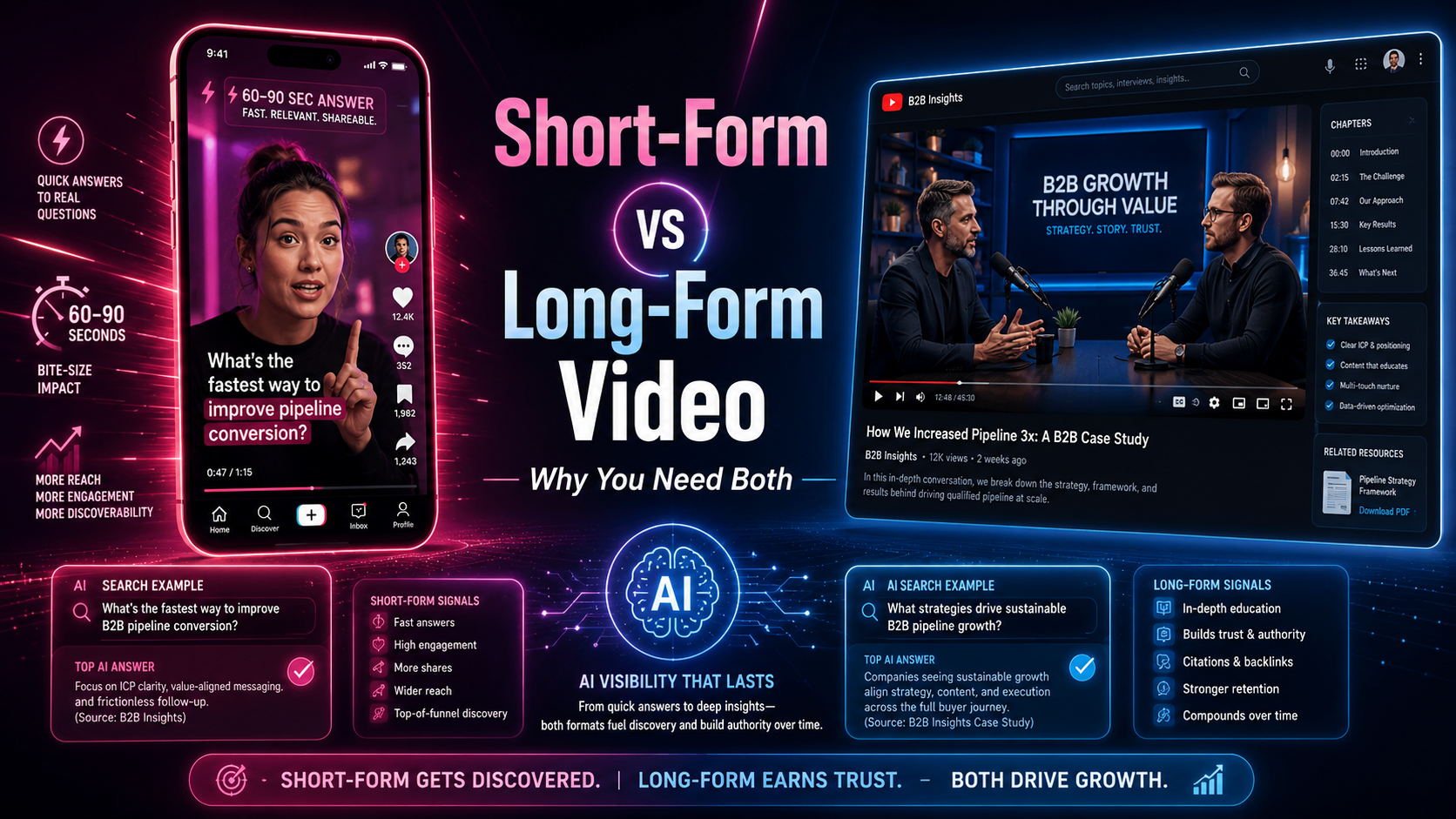
Yes. B2B businesses need both short-form and long-form video because they do different jobs.
Short-form video should answer specific buyer questions quickly, usually in 60 to 90 seconds. It gives your audience clear, useful answers in the format they already consume on LinkedIn, Instagram Reels, TikTok and YouTube Shorts.
Long-form video builds deeper trust. It gives buyers proof, context, expertise and confidence before they speak to your sales team. It also creates transcripts, topic depth and authority signals that can support AI visibility and citation potential over time.
Short-form helps you answer more questions at speed. Long-form helps people and AI systems understand why you are credible.
Most businesses that start doing video pick a format and stick to it. Usually short-form, because it feels more manageable. Then they spend six months posting Reels and wonder why nobody is calling them.
The format choice is not the problem. The misunderstanding of what each format is actually for is the problem.
Short-form video and long-form video are not competing options. They are different tools inside the same visibility system. Short-form helps you answer specific buyer questions quickly. Long-form helps you build trust, proof and depth around the things your audience needs to understand before they choose you.
This is where many businesses get video wrong. They think short-form means trying to go viral. They think long-form means trying to become a YouTuber. Neither is the point.
The point is value. The data supports that. Wyzowl’s 2026 video marketing research found that 93% of video marketers say video has helped increase user understanding of their product or service, while 93% also say it has helped increase brand awareness. That is why video should not be treated as decoration. It is one of the clearest ways to explain what you do and why buyers should care
If AI serves up the best answer, and if buyers increasingly use AI, YouTube, Google, LinkedIn and social platforms to research before they contact a business, then your job is to become one of the clearest and most useful sources in your category.
That does not mean being an influencer. It means being visible, credible and helpful.
A 90-second answer to a real buyer question can make someone understand a problem faster. A 20-minute case study or podcast-style conversation can make them trust your thinking. A behind-the-scenes video can show your process. A long-form explainer can give your sales team something useful to send before a call.
Together, these formats create a content system that works for humans and machines.
For the wider AI visibility context, read The State of AI Search in May 2026.
Short-form video is broadly anything under 90 seconds. It is the format native to TikTok, Instagram Reels, YouTube Shorts and increasingly LinkedIn video. Some platforms stretch short-form beyond this, but for B2B service businesses, the best short-form content usually sits between 60 and 90 seconds.
The important point is not only length. It is intent.
Short-form should answer one question, make one point or challenge one misconception. It does not need to be over-produced. In many cases, raw, direct, unedited or lightly edited answers work better because they feel real. The buyer does not need a cinematic masterpiece. They need a useful answer.
Long-form video is anything from around 8 minutes upwards, with the B2B sweet spot often sitting between 10 and 30 minutes depending on the format. This includes YouTube explainers, podcast-style videos, behind-the-scenes content, case studies, client conversations, recorded workshops, webinars and detailed thought leadership videos.
The distinction matters because the two formats solve different problems.
Wistia’s 2025 State of Video Report shows why that distinction matters. Videos under one minute had an average engagement rate of 50%, while videos between one and three minutes averaged 46%. Longer videos between five and 30 minutes averaged 38%. Shorter videos are better at holding fast attention, but longer videos still keep meaningful attention when the content has enough depth.
Short-form answers quickly.
Long-form builds belief.
A 75-second Reel might answer, “What is GEO?” A 20-minute YouTube video might explain how GEO works, why it matters, what proof exists, what businesses get wrong and how a buyer should think about it.
Both are useful. But they are not doing the same job.
Short-form video is one of the fastest ways to answer the questions your market is already asking.
That is the real opportunity.
A lot of businesses still treat Reels, Shorts and TikTok as entertainment formats. That is why they either avoid them completely or try too hard to be funny, trendy or viral. For most B2B businesses, that is the wrong approach.
Your short-form strategy should be built around real questions.
What is AEO?
What is GEO?
How long does it take to rank in AI answers?
What should a law firm look for in an SEO agency?
When does a business need a fractional CFO?
What should a construction supplier do before a tender list is formed?
Is YouTube worth it for a B2B service business?
These are answer reels. Not influencer clips. Not dance trends. Not polished adverts.
The best version is often a direct-to-camera answer from someone who knows what they are talking about. One question. One answer. 60 to 90 seconds. Clear, useful, human.
Short-form also helps you test angles quickly. If a 75-second answer gets saves, comments or strong watch time, that is a signal. The topic might deserve a long-form video, a blog, a webinar or a sales asset.
That is how short-form becomes strategic. It is not just reach. It is market listening.
Short-form video has limits.
It can introduce an idea. It can answer a question. It can make someone pause. It can make your brand more familiar. It can build repeated recognition over time.
But it usually cannot carry the full weight of a serious B2B buying decision.
When someone is deciding whether to hire an accountant, a law firm, an IT provider, a fractional CFO, a marketing agency or a construction supplier, they need more than a 90-second answer. They need context, proof, process, risk reduction and trust.
Short-form is often the start of that trust.
It is not the whole thing.
A business that only posts short-form can become visible without becoming convincing. People see them, but they do not yet know enough to buy. That is why so many businesses say, “We are getting views, but no leads.”
The problem is not the Reels. The problem is that the Reels do not lead anywhere deeper.
If someone watches three of your short answers and wants to know more, where do they go? Is there a full YouTube video? A case study? A podcast conversation? A proof-led breakdown? A proper service page? A sales asset your team can send?
If the answer is no, the system is incomplete.
Long-form video builds depth.
It gives people enough time with your thinking to decide whether they trust you. It allows you to explain nuance, tell stories, show proof, demonstrate process, answer objections and give context.
For B2B businesses, long-form video should not be seen as “content for subscribers”. It should be seen as trust infrastructure.
A 20-minute podcast-style conversation with a founder can help a prospect understand how they think. A case study video can show evidence that the business knows what it is doing. A behind-the-scenes video can reveal the process, standards and people behind the service. A detailed explainer can make a complex topic simple enough for a buyer to feel confident.
This is where long-form collapses the sales funnel.
Wistia found a useful example of this difference in its own content. One live long-form event made up less than 0.1% of total views, but contributed over 10% of total watch time. That is the point of long-form. It may not always create the most views, but it can create much deeper attention from the people who care.
A prospect who has watched a 15-minute video before a call is not arriving cold. They have already spent time with your ideas. They have seen how you explain things. They have heard your point of view. They have started to trust your judgement.
That changes the sales conversation.
Instead of starting with, “Tell me what you do,” the conversation starts with, “I watched your video about this, and that is exactly the problem we have.”
That is a different buyer.
This is one of the most underused parts of video.
Long-form content is not just for the algorithm. It is for the sales team.
A sales team should be able to use video before, during and after the sales process. If a prospect asks about pricing, send them the video that explains how to think about value. If they ask about process, send the behind-the-scenes video. If they ask for proof, send the case study. If they are unsure whether they need the service, send the explainer.
This is why long-form video should include:
Long-Form Format | What It Does |
| Podcast-style videos | Builds familiarity, personality and authority |
| Case study videos | Shows proof and reduces risk |
| Behind-the-scenes content | Reveals process, standards and delivery |
| Expert explainers | Educates buyers and supports AI visibility |
| Client conversations | Creates trust and social proof |
| Webinar recordings | Captures depth and recurring questions |
| Sales objection videos | Helps the sales team answer repeated concerns |
| Founder POV videos | Builds personal brand and authority |
This is not about chasing views.
It is about shortening the trust gap.
AI systems want the best answer.
That is the brutal but useful truth.
If a business wants to be surfaced by AI systems, it needs to become easier to understand, easier to trust and easier to cite.
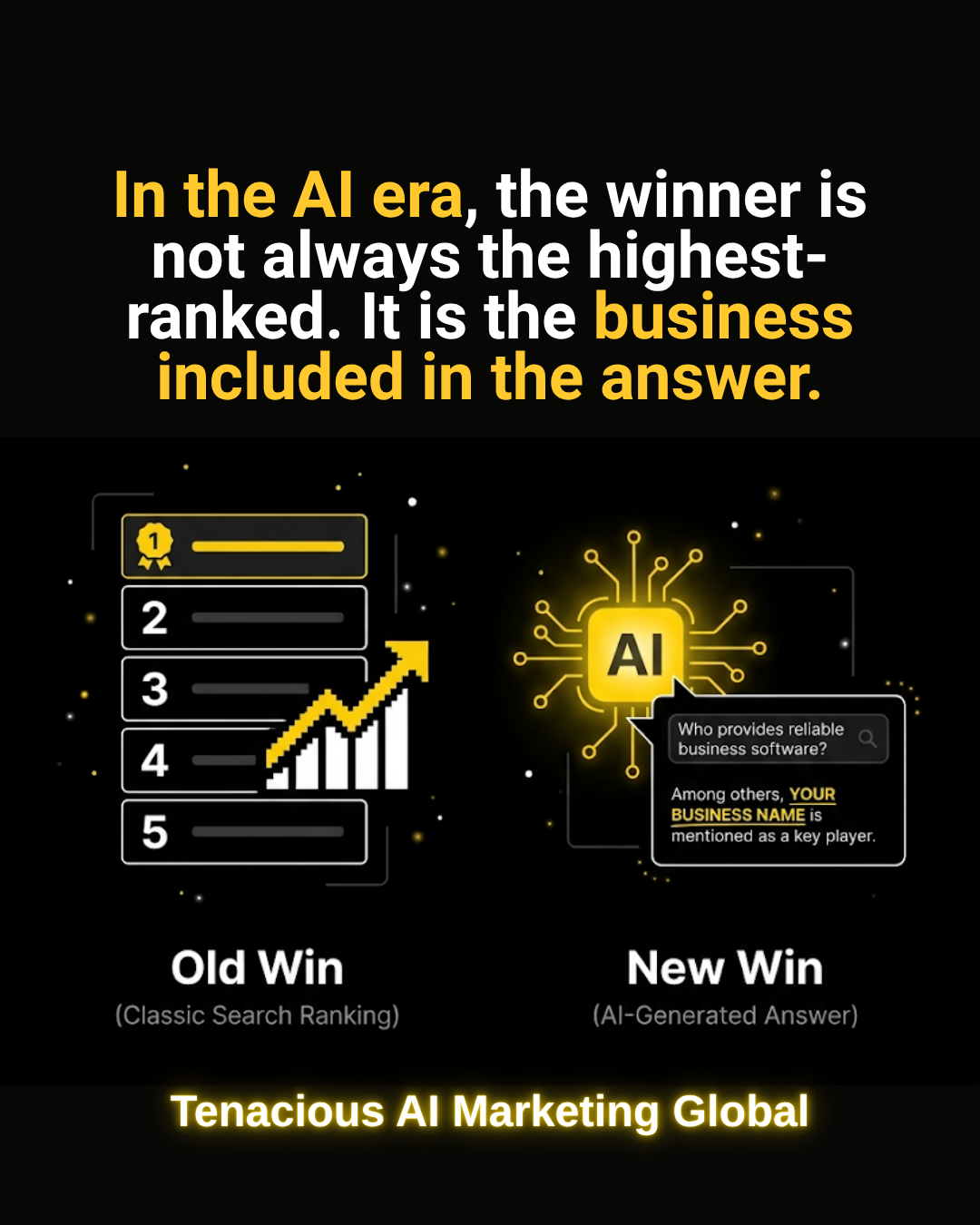
Video helps with that, especially long-form YouTube.
A long-form video creates a transcript. That transcript contains your explanations, terminology, examples, stories, frameworks, questions and answers. It gives AI systems more material to understand what you know and what you are credible for.
A short-form answer reel may help visibility and audience engagement, but a long-form video creates far more depth. It creates proof signals. It gives buyers and AI systems more context. It can sit alongside blog content, schema, internal links, service pages and case studies to reinforce your authority.
This is why video now matters for GEO.
Not because everyone needs to be famous.
Because AI visibility increasingly rewards brands that can answer clearly, prove expertise and build authority across multiple surfaces.
For more on this, read GEO vs Traditional SEO: Which Drives AI Search Traffic in 2026?.
Dimension | Short-Form Video | Long-Form Video |
| Best use | Answering specific questions quickly | Building proof, trust and depth |
| Typical length | 60 to 90 seconds | 8 to 30 minutes |
| Style | Raw, direct, useful | Structured, deeper, more complete |
| Buyer role | Creates familiarity and answers one question | Builds confidence and reduces risk |
| Sales role | Opens curiosity | Supports sales conversations |
| AI visibility role | Helps distribute questions and ideas | Creates transcript depth and topic authority |
| Best formats | Reels, Shorts, TikToks, LinkedIn clips | YouTube videos, podcasts, case studies, webinars |
| Production level | Can be unedited or lightly edited | Should be clearer and more considered |
| Shelf life | Usually shorter | Longer, especially on YouTube |
| Main risk | Attention without depth | Depth without distribution |
| Goal | Be useful quickly | Become trusted deeply |
The mistake is treating short-form and long-form as alternatives.
They are different layers of the same system.
Short-form answers the questions your audience is already asking. It keeps you present. It creates repeated familiarity. It helps people see that you understand their problems.
Long-form gives them somewhere deeper to go. It gives your audience more proof, more context, more trust and more confidence. It also gives your sales team assets they can use and gives AI systems more structured material to understand your expertise.
The ideal system looks like this:
That is the real content machine.
Not posting for vanity.
Not trying to become an influencer.
Building useful answers and proof assets that compound.
Yes, but not only that.
The original article rightly made the point that long-form can be repurposed into short-form clips. That is still true. A podcast or 20-minute video can produce several clips for Reels, Shorts and LinkedIn.
But your point is stronger: businesses should also record short-form separately as direct, unedited answers to questions.
Both approaches matter.
Repurposed clips are useful because they come from deeper conversations and carry more context. But standalone answer reels are useful because they are focused, quick and based on specific buyer questions.
So the best system is:
Content Source | Best Use |
| Standalone short-form answer reels | Quick answers to specific buyer questions |
| Repurposed long-form clips | Strong moments from deeper trust content |
| Long-form YouTube videos | Proof, trust, expertise and sales enablement |
| Podcast-style content | Relationship, personality and thought leadership |
| Case study videos | Evidence and risk reduction |
| Behind-the-scenes videos | Process and delivery confidence |
Do not force everything through one format.
Use the right format for the job.
Short-form video is mainly a distribution and audience signal. It can help people discover you. It can keep your face and ideas visible. It can create repeated familiarity. It can drive people to longer content.
Long-form video is a deeper authority signal.
A YouTube video with a clear title, description and transcript can be indexed, searched, embedded, cited, clipped, linked and reused. It gives Google, YouTube and AI systems more material to work with.
For B2B businesses, this matters because buyers are not just searching on Google anymore. They are asking ChatGPT, Gemini, Perplexity and Google AI Overviews for explanations, comparisons and recommendations.
If your business has a long-form library answering those questions clearly, you are giving AI systems more evidence that you are a useful source.
This is why YouTube should not be treated as a nice-to-have. It is becoming a core part of visibility infrastructure.
For more on YouTube’s role in B2B growth, read YouTube vs LinkedIn for B2B Lead Generation in 2026.
The biggest objection is time.
Most business owners are already stretched. They do not want another content hamster wheel.
The answer is to separate the jobs properly.
Short-form answer reels can be simple. Choose 10 buyer questions. Record 10 direct answers. Keep them raw, clear and useful. Do not over-edit them. Do not turn them into mini adverts. Answer the question properly.
Long-form content should be planned with more intention. Choose formats that support the sales process and AI visibility.
A practical monthly rhythm could look like this:
Monthly Asset | Output |
| 8 to 12 short-form answer reels | Quick answers to buyer questions |
| 1 podcast-style long-form video | Builds authority and familiarity |
| 1 case study or proof video | Supports sales and trust |
| 1 behind-the-scenes or process video | Shows how the business delivers |
| 1 detailed explainer | Builds AI visibility and buyer education |
This is enough to create momentum without trying to become a media company overnight.
The key is not volume for its own sake. The key is usefulness.
Every video should answer something, prove something or clarify something.
Start with the questions.
Not the camera. Not the platform. Not the editing style.
Write down the 30 questions your best buyers ask before they buy.
Then split them into two groups.
Short-form questions are simple, specific and answerable in 60 to 90 seconds.
Long-form questions need proof, story, nuance, process or examples.
For example:
Buyer Question | Best Format |
| What is GEO? | Short-form answer reel |
| How does GEO actually work over six months? | Long-form explainer |
| Is YouTube worth it for B2B? | Short-form answer reel |
| How did YouTube change one client’s sales process? | Case study video |
| What should I ask before hiring an agency? | Short-form answer reel |
| What does a proper AI visibility strategy include? | Long-form trust video |
| Why do companies rank on Google but not appear in ChatGPT? | Long-form explainer |
This makes the content strategy much easier.
Short-form answers the quick questions.
Long-form handles the deeper trust.
Here is the practical first-month plan.
Week | Action | Outcome |
| Week 1 | List 30 buyer questions | Build the content foundation |
| Week 2 | Record 8 short-form answer reels | Start answering questions publicly |
| Week 3 | Record one long-form trust video | Create a deeper sales and AI visibility asset |
| Week 4 | Publish, link and repurpose | Connect the content into one system |
Speak to sales, customer service, delivery and leadership. Collect the questions buyers ask before they trust you.
Do not guess. Use real sales calls, DMs, discovery calls and objections.
Record simple 60 to 90-second answers. One question per video. Speak plainly. Do not over-edit. Do not perform.
Just answer the question better than your competitors.
Choose one deeper question and create a proper long-form video.
This might be a case study, a podcast-style conversation, a founder explainer, a behind-the-scenes walkthrough or a detailed educational video.
Publish the videos. Embed the long-form video in a relevant blog. Link it from service pages. Send it to prospects. Cut useful moments into clips. Track whether buyers mention it. Track whether AI tools start recognising the topic.
That is how video becomes infrastructure.
Usually, no. Short-form can create visibility, familiarity and useful question-led content, but serious B2B buyers usually need more proof before they enquire. Short-form works best when it leads into long-form content, case studies, service pages or sales conversations.
Not always. For B2B answer-led content, raw or lightly edited videos can work well because buyers care more about usefulness than polish. The priority is a clear answer, good audio and a specific point. Editing should help clarity, not turn every video into an advert.
Long-form video should be used for trust-building assets: case studies, podcast-style conversations, behind-the-scenes content, sales objection videos, detailed explainers, client stories and proof-led videos. These are the videos your sales team can use to shorten the buying journey.
No. The goal is not to become an influencer. The goal is to become useful, visible and trusted. For B2B businesses, video should help buyers understand your expertise and help AI systems understand why you are a credible source.
Long-form YouTube videos create transcripts, titles, descriptions and topic depth that can help search engines and AI systems understand your expertise. When those videos are connected to blogs, service pages and related content, they strengthen your GEO and AI visibility footprint.
They can, but they should not always be identical. A short-form video can answer the simple version of a question. A long-form video can explore the deeper version with examples, proof, objections and context.
A practical starting point is 8 to 12 short-form answer reels per month and 1 to 2 long-form videos per month. The exact cadence depends on team capacity, but consistency matters more than intensity.
Related Reading
The State of AI Search in May 2026
Beyond the Search Bar: Why AEO Testing Is Now a Business Visibility Metric
Why YouTube Is Now Essential for Business Visibility in the AI Era
What Is GEO in 2026, and How Do You Get Cited in AI Answers?
The New Rules of AI Search in 2026
Search Everywhere Optimisation: AI Visibility in 2026
How to Audit Your Website for AI Visibility in 2026
Short-form and long-form video are not competing formats.
They are different parts of the same visibility and trust system.
Short-form gives your market quick answers to the questions they are already asking. It helps people discover your thinking, understand your point of view and see that you can explain things clearly.
Long-form gives buyers the depth, proof and confidence they need before they choose you. It gives your sales team useful assets. It gives AI systems more structured material to understand, cite and connect to your brand.
This is not about becoming an influencer.
It is about being useful enough to be remembered, trusted enough to be chosen and clear enough to be surfaced by AI when your future clients ask for the best answer.
If you want to understand where your business currently appears in AI answers, check your visibility with Answer Architect.
You can also take the Organic Visibility Scorecard or talk to the Tenacious team about building a video and GEO strategy that supports visibility, trust and real commercial demand