
Search Everywhere Optimisation is the process of making your brand visible, trusted and citable across every platform buyers and AI systems use to make decisions.
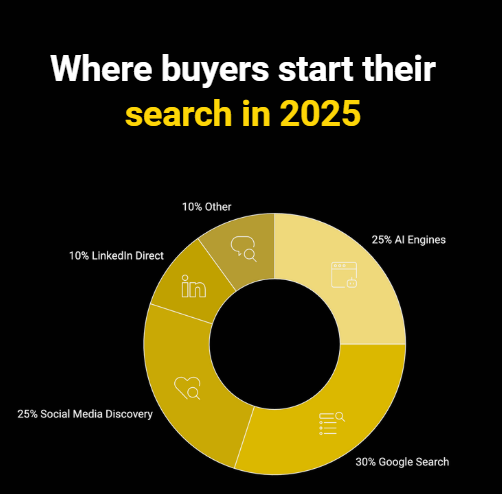
Traditional SEO is no longer enough on its own. Your buyers are searching across Google, ChatGPT, Gemini, Perplexity, LinkedIn, YouTube, Reddit, directories, reviews, podcasts and social platforms before they ever land on your website.
To win, your brand needs to become a clear, consistent and verifiable entity. Your website, founder profiles, social channels, videos, reviews, directory listings and third-party mentions should all reinforce the same message.
The strongest brands in AI search are not always the loudest. They are the easiest to understand, the easiest to verify and the easiest to cite.
For B2B service businesses, Search Everywhere Optimisation is not just a content strategy. It is a trust-building system that helps humans and AI systems recognise why your brand should be recommended.
Search Everywhere Optimisation is the strategy of building visibility across every major discovery surface your buyers and AI systems use.
That includes Google, Google AI Overviews, ChatGPT, Gemini, Claude, Perplexity, LinkedIn, YouTube, Reddit, podcasts, directories, review platforms, Google Business Profile, industry listicles, your own website and your blog.
The goal is not to post everywhere for the sake of it. That is how brands create noise, not authority.
The goal is to make your brand consistently visible, useful and trustworthy wherever buyers are looking for answers. In the old SEO model, businesses tried to rank one page on Google. In the new model, businesses need to become the answer across multiple platforms.
Your content, social proof, expert opinions, videos, founder profile, reviews and third-party mentions all work together to help AI systems understand who you are, what you do and why you should be trusted.
Ranking on Google still matters, but it is no longer the whole game.
A future buyer might ask ChatGPT, “Which agency can help a B2B consultancy improve AI search visibility?” They might ask Perplexity, “What are the best GEO agencies in the UK?” They might search YouTube for “How do I get my business found in ChatGPT?” They might then check LinkedIn to see whether the founder actually knows what they are talking about.
That is the buying journey now. It is fragmented, fast and trust-led.
People do not make decisions from one blue link anymore. They compare search results, AI answers, YouTube videos, LinkedIn posts, Reddit threads, reviews, directories, podcasts and listicles. The brands that win are the ones that show up consistently across those surfaces with a clear, credible message.
If your website says you are an expert, but your LinkedIn is quiet, your YouTube has no useful videos, your directories are inconsistent, your reviews are thin and no third-party sources mention you, AI systems have less evidence to work with.
In AI search, proof is distributed. Your website is the hub, but the rest of the internet helps validate the claim.
| Old SEO | Search Everywhere Optimisation |
|---|---|
| Rank on Google | Be found across Google, AI, YouTube, LinkedIn and trusted third-party sources |
| Optimise individual pages | Optimise the whole brand entity |
| Focus on keywords | Focus on buyer questions, prompts and intent |
| Track rankings and traffic | Track prompts, mentions, citations and answer share |
| Build backlinks | Build trust signals across platforms |
| Write blog posts | Create answer assets across website, video, social, FAQs and third-party media |
| Win clicks | Win trust, citations, recommendations and inbound demand |
Search Everywhere Optimisation does not replace SEO. It expands it.
SEO helps search engines find your content. AEO helps your content answer specific questions. GEO helps AI systems understand, cite and recommend your brand. Search Everywhere Optimisation connects all of it into one visibility system.
Think of AI like a busy researcher. It does not want vague claims. It wants clear identities, consistent information, credible sources and proof.
That means your brand needs to be easy to understand and easy to verify.
Start with your entity home. Your website should clearly explain who you are, what you do, who you help, where you operate, what services you provide, what makes your approach different, who leads the business, what proof supports your claims and where else your brand can be found.
For a B2B service business, this means your homepage, About page, service pages, author bios, case studies, reviews and social profiles should all tell the same story.
If your website says one thing, your LinkedIn says another and your directory listings use old wording, AI systems receive mixed signals. Mixed signals create doubt. Doubt kills citations.
A citable brand needs more than content. It needs a clear, connected body of evidence.
Your About page should explain your mission, services, founder information, credentials, awards, press, social profiles and proof. Your service pages should explain exactly what you offer, who it is for and what outcomes it creates. Your founder and author profiles should show real expertise, not anonymous content.
Your social profiles should be consistent across LinkedIn, YouTube, Google Business Profile and key directories. Your website should use structured data such as Organisation, Person, WebSite, BlogPosting, FAQPage and VideoObject schema where relevant.
You also need original insights, frameworks, case studies, client examples and first-party data. These help your brand move beyond generic marketing claims and into something more useful, specific and citeable.
Internal links should connect your blogs, service pages, tools and proof pages. Third-party validation from reviews, directories, podcasts, listicles, PR and partner websites helps reinforce that your expertise is recognised beyond your own website.
This is how you move from “we say we are experts” to “the web shows we are experts.”
That is the difference AI systems need.
| Trust Signal | What It Means | How to Build It |
|---|---|---|
| Authority | Are you recognised in your category? | Founder content, expert blogs, PR, podcasts, listicles, backlinks and case studies |
| Accuracy | Is your information clear and consistent? | Updated pages, clear service descriptions, FAQs, sources and matching profiles |
| Accessibility | Can search engines and AI systems understand your content? | Schema, transcripts, clean navigation, internal links, sitemaps and crawlable pages |
If you want to be cited by AI and trusted by people, you need all three.
Authority without accuracy creates confusion. Accuracy without accessibility means your content may not be understood. Accessibility without authority means you are easy to crawl but not necessarily worth recommending.
The strongest brands build all three together.
A wider online presence is not vanity. It is how buyers and AI systems triangulate trust.
Your audience is not only using Google. They are watching videos, reading LinkedIn posts, checking reviews, browsing Reddit threads, asking AI tools for recommendations and comparing suppliers through third-party content.
For B2B service businesses, the priority platforms are usually LinkedIn, YouTube, your website, Google Business Profile, directories, listicles, podcasts, PR, Reddit, forums and selected short-form video platforms.
The point is not to be everywhere badly. The point is to be visible in the places that help buyers and AI systems trust you.
LinkedIn is one of the most important platforms for B2B trust because it connects the business to the people behind it.
A strong company website can explain what you do, but LinkedIn helps prove how you think. It shows whether the founder has a real point of view, whether the team understands the market and whether the brand is active in the conversations buyers care about.
Use LinkedIn to publish strong opinions on your category, lessons from client work, short educational posts, founder-led insights, market observations, carousel-style frameworks, answers to common buyer questions and commentary on industry changes.
The goal is not just engagement. The goal is entity reinforcement.
If your website says you help B2B service businesses improve AI visibility, your LinkedIn content should repeatedly support that position with useful insights, examples and proof. Over time, this helps both humans and AI systems associate your brand with the topic you want to own.
YouTube is not just a video platform. It is a search engine, a trust engine and a content source that can support AI visibility.
For B2B brands, YouTube gives buyers a way to see how you think before they book a call. It also gives search engines and AI systems more context through titles, descriptions, transcripts, chapters and linked resources.
Use YouTube to answer the questions your buyers are already asking. Examples include “What is GEO?”, “How do I get found in ChatGPT?”, “How do I audit my AI visibility?”, “How does LinkedIn support AI search?”, “How long does generative engine optimisation take?” and “What is Search Everywhere Optimisation?”
To make videos easier to discover and understand, add clear titles, detailed descriptions, chapters, transcripts, SRT subtitles, links back to related blogs or service pages and pinned comments with useful resources.
A good YouTube video can become a blog, a LinkedIn post, a short-form clip, an FAQ section and a sales asset. That is how one piece of expertise becomes a visibility system.
Reddit and forums are not places to spam links. They are places to understand how real people ask questions, compare options and describe problems.
This matters because AI search is becoming more conversational. People are not just typing “marketing agency UK.” They are asking specific questions, comparing options and looking for honest answers. Communities reveal that language better than keyword tools alone.
Use Reddit, forums and niche communities to find recurring buyer questions, understand objections, spot comparison language, see what people distrust, identify gaps in existing content and contribute useful answers where appropriate.
If you join conversations, do it properly. Add value first. Share frameworks, examples and practical answers. Only reference your own content when it genuinely helps and be transparent when you do.
AI systems and buyers both favour useful, specific, human answers over obvious promotion.
TikTok, Instagram Reels, YouTube Shorts and LinkedIn video can all support Search Everywhere Optimisation, but they should not replace your core website, LinkedIn and YouTube strategy.
Short-form video works best when it creates repetition around a clear idea. For example, you might repeatedly reinforce ideas like “AI citations are the new rankings,” “Your website is not enough anymore,” “If ChatGPT cannot understand your brand, it cannot recommend you,” “Search Everywhere means being visible wherever buyers make decisions,” or “FAQ pages are becoming citation assets.”
Say the key phrase clearly. Put it on screen. Use descriptive captions. Link back to a useful resource where possible.
The mistake is treating short-form as random content. The opportunity is using it as a repetition engine for your strongest category messages.
Short-form content should reinforce the same language your website, LinkedIn and YouTube already use. That consistency is what helps humans remember you and helps AI systems understand you.
You do not always need more content. You need better distribution from the content you already have.
Most businesses publish a blog, share it once on LinkedIn, then wonder why nothing happens. That is not a content strategy. That is throwing a paper aeroplane into a hurricane and hoping it lands in the right inbox.
Search Everywhere Optimisation works differently.
You start with one strong pillar asset, then turn it into multiple platform-native assets that all point back to the same expertise. This helps humans discover your ideas in different formats, and it helps AI systems see consistent signals across your website, LinkedIn, YouTube, social platforms and third-party sources.
Start with one pillar guide of around 1,500 to 2,500 words. It should answer one important buyer question in depth. For example, “How do B2B service businesses get found in ChatGPT?” or “What is Search Everywhere Optimisation?”
From that one pillar, extract 10 to 15 useful insights. These could be statistics, frameworks, short explanations, common mistakes, client examples, comparison tables, FAQs, founder opinions or step-by-step advice.
Then repurpose the pillar into different assets.
| Original Asset | Repurposed Into | Purpose |
|---|---|---|
| Pillar blog | YouTube video | Creates searchable video proof |
| Pillar blog | LinkedIn carousel | Builds founder and brand authority |
| Pillar blog | LinkedIn text posts | Starts conversation and reinforces expertise |
| Pillar blog | FAQ section | Helps AI systems extract answers |
| YouTube transcript | Blog update | Adds depth and search relevance |
| Client question | Short-form video | Creates social discovery |
| Framework | Infographic or carousel | Makes the idea easier to remember |
| Blog insight | Reddit or forum answer | Contributes to real buyer conversations |
| Summary | Email newsletter | Nurtures your existing audience |
| Checklist | Downloadable lead magnet | Captures first-party data |
The key is to cross-link everything properly. Your YouTube video should link back to the pillar blog. Your LinkedIn post should reference the core idea. Your blog should link to your service page, related blogs and tools. Your email should send people back to the guide. Your FAQ should support the same topic.
This is how you stop creating isolated content and start building a connected visibility system.
For example, a B2B founder could record a 12-minute video explaining how they help clients improve AI visibility. That video can become a YouTube walkthrough, two LinkedIn posts, one carousel, a short-form video series, a blog FAQ update and a checklist. Over time, those assets reinforce the same message across multiple surfaces.
That is Search Everywhere Optimisation in action.
Great content still needs a map.
If search engines and AI systems cannot crawl, understand or connect your content, you make their job harder. The easier your content is to parse, the easier it becomes to retrieve, cite and recommend.
Machine-readable content starts with clean structure.
Use clear headings, direct answers, short paragraphs, internal links, external sources, schema, transcripts and consistent naming. Avoid burying your main point halfway down the page. AI systems and human buyers both prefer clarity.
Your technical checklist should include:
| Area | What to Check |
|---|---|
| Schema | Organisation, Person, BlogPosting, FAQPage, WebPage and VideoObject schema where relevant |
| Navigation | Clear topic hubs, service pages, breadcrumbs and internal links |
| Transcripts | Add transcripts to YouTube videos, podcasts and webinars |
| Captions | Add SRT subtitles where possible |
| Sitemaps | Keep XML sitemaps updated and submitted |
| Internal links | Connect related blogs, service pages, tools and proof pages |
| External links | Cite reputable sources to support key claims |
| Metadata | Use clear titles, meta descriptions and featured images |
| Canonicals | Make sure the correct version of each page is indexed |
| Author signals | Show real authors, bios and expertise |
Google’s own structured data documentation explains how schema can help search engines understand the meaning of a page and its entities: https://developers.google.com/search/docs/appearance/structured-data/intro-structured-data
For video content, Google also provides guidance on VideoObject structured data, which can help search engines understand titles, descriptions, thumbnails, upload dates and other video details: https://developers.google.com/search/docs/appearance/structured-data/video
For Search Everywhere Optimisation, this matters because your content is not just being read by humans. It is being crawled, parsed, summarised, compared and potentially cited by AI-powered systems.
Do not make them guess.
Vanity metrics are loud. Real evidence is quieter, but much more useful.
Likes, impressions and views can be helpful, but they do not tell the whole story. Search Everywhere Optimisation should be measured by whether your brand is becoming easier to find, easier to trust and easier to recommend.
Track these metrics:
| Metric | What It Shows |
|---|---|
| AI prompt visibility | Whether your brand appears when buyers ask AI tools relevant questions |
| Citation rate | Whether your pages or third-party mentions are cited in AI answers |
| Share of answer | How often your brand appears compared with competitors |
| Branded search growth | Whether more people are searching for your name and topic together |
| LinkedIn authority signals | Comments, saves, profile views, inbound messages and connection requests |
| YouTube visibility | Search impressions, watch time, retention and clicks back to your site |
| Third-party mentions | Listicles, directories, podcasts, PR, reviews and partner pages |
| Assisted conversions | Leads influenced by content, video, social or AI search discovery |
| Source quality | Whether trusted sources are reinforcing your brand positioning |
| Entity accuracy | Whether AI systems describe your business correctly |
You should also manually test important prompts every month across ChatGPT, Perplexity, Gemini and Google AI experiences.
Test prompts like:
Which agencies help B2B companies improve AI search visibility?
What is Search Everywhere Optimisation?
Who are the best GEO agencies in the UK?
How do I get my business found in ChatGPT?
Which company helps with AEO, GEO, LinkedIn and YouTube visibility?
Record whether your brand appears, which competitors appear, which sources are cited and whether your services are described correctly.
This is where tools like Answer Architect can help you move faster. Answer Architect helps you scan your website, understand your AI visibility score, find prompts to track, monitor visibility, write citation-ready blogs and identify listicles where your brand should be included: https://www.answerarchitect.ai/
You can also use the free Organic Visibility Scorecard to get a quick view of where your website stands and what to fix first: https://organicvisibility.tenaciousmarketing.co.uk/
For wider context on how online behaviour is changing in the UK, Ofcom’s Online Nation research is useful because it shows how people use search, social, video and digital platforms as part of daily online behaviour: https://www.ofcom.org.uk/media-use-and-attitudes/online-habits/from-apps-to-ai-search-how-the-uk-goes-online-in-2025/
A seven-day sprint is useful for momentum, but for most B2B service businesses, a 30-day sprint is more realistic and more effective.
The goal is to build one connected visibility system, not a random burst of posts.
| Week | Action | Outcome |
|---|---|---|
| Week 1 | Refresh your entity foundations | Clearer website, About page, author bios, service pages and schema |
| Week 2 | Publish one pillar guide | A strong asset that answers one high-intent buyer question |
| Week 3 | Repurpose into LinkedIn, YouTube, short-form and email | Multi-platform visibility from one core idea |
| Week 4 | Track prompts, citations, traffic and engagement | Clear data on what is working and what to improve |
Start with your entity foundation. Update your About page, founder bio, service pages, social profile descriptions, Google Business Profile and key directory listings. Make sure they all describe the business consistently.
Then publish one strong pillar guide. Do not make it generic. Make it answer a real buyer question. For example, “How do B2B service businesses improve AI visibility?” or “How does Search Everywhere Optimisation help brands get cited by AI?”
Next, turn that pillar into platform-native assets. Record a YouTube video, publish a LinkedIn post, create a carousel, cut short-form clips, add an FAQ section and send an email summary to your list.
Finally, track what happens. Check branded search, prompt visibility, citations, referral traffic, LinkedIn engagement, YouTube watch time and inbound enquiries.
This is how you create a repeatable engine.
Search Everywhere Optimisation works because it connects the three visibility layers businesses now need.
SEO helps your website get discovered by search engines.
AEO helps your content answer specific questions clearly.
GEO helps AI systems understand, trust, cite and recommend your brand.
Search Everywhere Optimisation connects those layers across the platforms where buyers and AI systems gather proof.
That means your website, blog, LinkedIn, YouTube, Reddit, directories, reviews, podcasts, listicles and tools all need to support the same clear brand position.
For a deeper explanation of GEO, read:
https://blog.tenaciousmarketing.co.uk/what-is-geo-in-2026-how-to-get-cited-in-ai-answers
For a practical checklist on auditing your website for AI visibility, read:
https://blog.tenaciousmarketing.co.uk/how-to-audit-your-website-for-ai-visibility-in-2026-aeo-geo-and-citation-readiness-checklist
For the bigger picture on how AI search is changing brand visibility, read:
https://blog.tenaciousmarketing.co.uk/the-new-rules-of-ai-search-4-strategies-every-brand-needs-to-win-citations
For timing and expectations, read:
https://blog.tenaciousmarketing.co.uk/how-long-does-generative-engine-optimisation-take-to-work
And to understand how Tenacious helps B2B service businesses build this system, visit:
https://www.tenaciousmarketing.co.uk/
Search Everywhere Optimisation is not about gaming algorithms. It is about making your expertise visible wherever people and AI systems look for proof.
Your website is still important, but it is no longer enough on its own. Buyers now discover, compare and validate brands across Google, AI tools, LinkedIn, YouTube, Reddit, reviews, podcasts, directories and third-party content.
The brands that win will be the ones with a clear entity, strong content, consistent messaging, visible experts, useful videos, trustworthy external proof and measurable AI visibility.
Start with one pillar guide. Turn it into multiple useful assets. Link everything together. Add schema, transcripts and clean internal links. Track your prompts, citations and brand mentions. Then repeat the process every month.
That is how your content stops being noise and starts becoming evidence.
If you want to see how visible your brand is right now, start with Answer Architect:
https://www.answerarchitect.ai/
Or get a quick free score here:
https://organicvisibility.tenaciousmarketing.co.uk/
If you want Tenacious AI Marketing Global to help build the full Search Everywhere system for your business, visit:
https://www.tenaciousmarketing.co.uk/
Your expertise should not be hidden. It should be easy to find, easy to trust and impossible for AI systems to misunderstand.
Search Everywhere Optimisation is the process of making your brand visible, trusted and easy to find across every platform buyers and AI systems use to make decisions. This includes Google, AI search tools, LinkedIn, YouTube, Reddit, directories, reviews, podcasts, social platforms and your own website.
Search Everywhere Optimisation matters because buyers no longer rely on Google alone. They ask ChatGPT, Gemini, Claude and Perplexity for recommendations, watch YouTube videos, check LinkedIn profiles, read reviews and compare brands through third-party content before making decisions. Brands need to be visible across all of these discovery points.
Traditional SEO focuses mainly on ranking web pages in Google. Search Everywhere Optimisation focuses on building visibility, trust and authority across multiple platforms, including search engines, AI answer engines, social media, video platforms, directories, reviews and third-party websites.
No. Search Everywhere Optimisation does not replace SEO. It expands it. SEO helps search engines find your content, AEO helps your content answer specific questions, and GEO helps AI systems understand, cite and recommend your brand. Search Everywhere Optimisation connects those layers across the platforms where buyers look for proof.
Search Everywhere Optimisation helps AI visibility by creating consistent signals across your website, social profiles, videos, reviews, directories, podcasts, listicles and third-party mentions. These signals help AI systems understand who you are, what you do, who you help and why your brand should be trusted.
For B2B service businesses, the most important platforms are usually your website, blog, LinkedIn, YouTube, Google Business Profile, directories, reviews, podcasts, Reddit, industry listicles and AI search tools such as ChatGPT, Gemini, Claude and Perplexity.
LinkedIn matters because it strengthens founder authority, company positioning and market trust. For B2B brands, LinkedIn helps buyers and AI systems see what the founder or team is known for, what topics they discuss and whether their expertise matches the services on the website.
YouTube matters because videos, transcripts, titles, descriptions and chapters can answer buyer questions in a format search engines and AI systems can understand. A strong YouTube video can also be repurposed into blogs, FAQs, LinkedIn posts, short-form clips and sales assets.
Third-party mentions help prove that your brand is trusted beyond your own website. Reviews, directories, podcasts, listicles, PR, partner pages and community discussions give AI systems more evidence that your business is credible, active and relevant in its category.
A brand is easier for AI systems to cite when it has clear positioning, consistent business information, structured content, visible experts, useful FAQs, schema markup, internal links, external proof, reviews, videos, transcripts and third-party validation.
A citable brand entity is a business that search engines and AI systems can clearly understand, verify and associate with a specific category or expertise. It has consistent information across its website, profiles, content, videos, reviews, listings and external mentions.
You can measure Search Everywhere Optimisation by tracking AI prompt visibility, citations, brand mentions, branded search growth, LinkedIn authority signals, YouTube visibility, third-party mentions, referral traffic, source quality and whether AI systems describe your business correctly.
A business should run a Search Everywhere audit at least quarterly, or monthly if it is actively publishing content, improving AI visibility or running GEO campaigns. Regular audits help identify visibility gaps, outdated profiles, weak content, missing schema and competitor movement.
Tenacious AI Marketing Global helps B2B service businesses improve visibility across Google, ChatGPT, Gemini, Perplexity and AI search through Search Everywhere Optimisation, AEO, GEO, structured content, LinkedIn authority, YouTube visibility, schema improvements and AI visibility tracking with Answer Architect.