.jpg)
AI visibility is not the same as being crawlable. Every public website is technically accessible to AI systems, which has been true for years.
Being AI visible means something more specific. It means that when a user asks ChatGPT, Perplexity, Google's AI Mode, or Claude a relevant question, your business is part of the answer. Not just indexed. Included. Cited. Recommended.
If you want to zoom out before going deeper into entity, schema, and content foundations, read What Is GEO in 2026 and How Do You Get Cited in AI Answers?
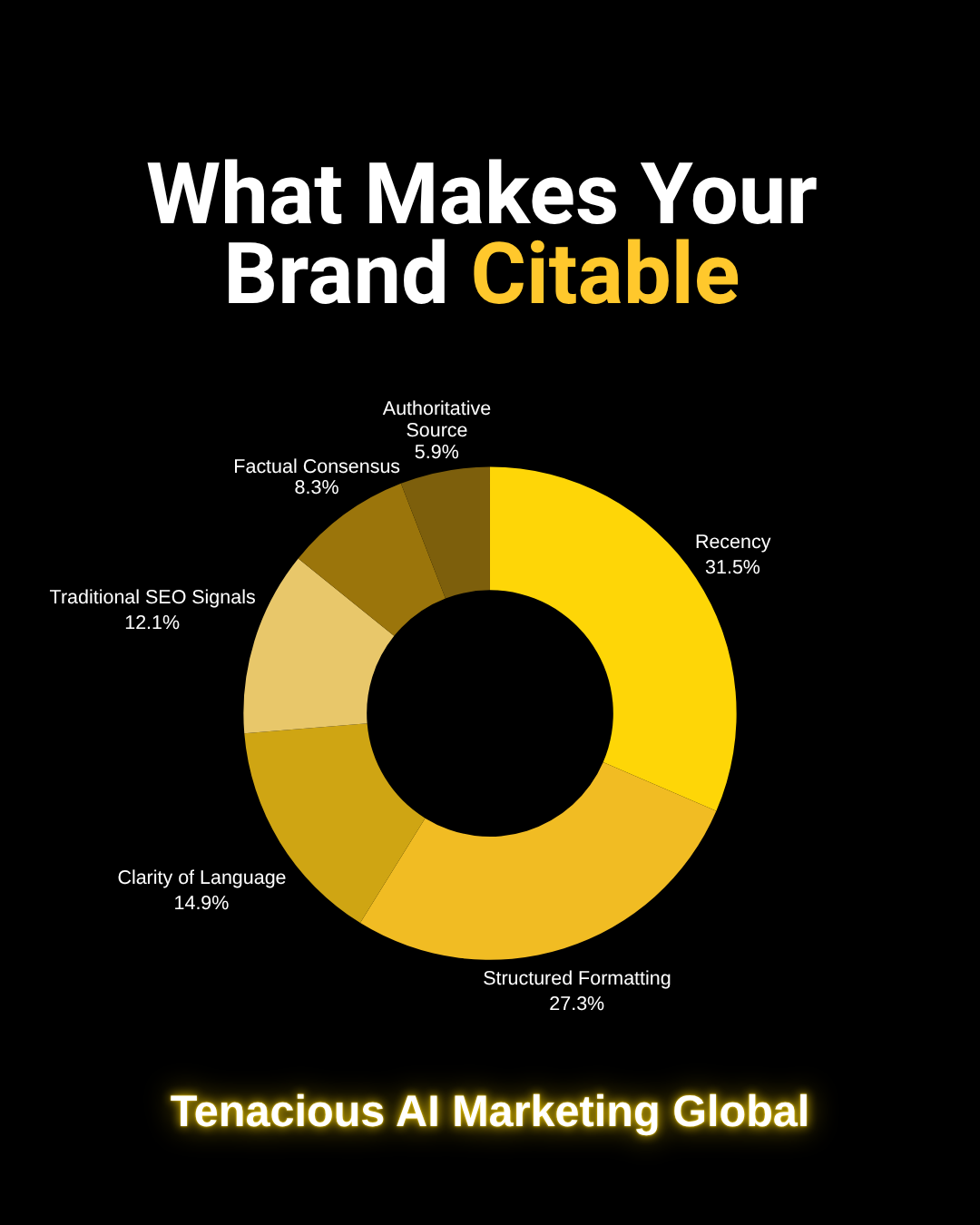
That happens when three conditions are met.
First, the AI system can confidently understand who you are, what you do, who you serve, and what makes you credible. That requires structured data, canonical entity signals, clean, consistent metadata, and strong content across your site and third-party profiles.
Second, you have enough corroborating evidence for an AI system to trust a claim about your business. Reviews, references, linked profiles, well-structured service pages, policy information, pricing logic, and documented expertise all feed into that.
Third, your content is written in a way that can be cleanly cited, specific, clear, organised into logical blocks, and tied to a stable canonical URL.
Without those foundations, even the most sophisticated integration in the world won't change what AI says about you. You'll be accessible. You won't be chosen.
This is not a sprint. It is a compounding system.
When you implement structured data and publish citable content, the signals don't immediately cascade across AI platforms. Search engines need to crawl, re-index, and verify. Knowledge graphs need to be consolidated. Citation patterns need to emerge organically through content performance, consistent entity signals, and time.
That process, done properly, takes somewhere between nine and twelve months to produce meaningful results, and that assumes the work starts now and is done right.
The businesses that begin this month will have a structural advantage by early 2027. Their entities will be established. Their content will have citation history. Their structured data will be validated and reinforced. Their brand will be one that AI systems have consistently seen across multiple contexts, backed by multiple sources.
The businesses that wait until "AI search is clearly mainstream" will start that process twelve months behind. At the pace things are moving, that is not a recoverable position in a competitive market.
Bain research from early 2025 found that 80% of consumers were already relying on AI-generated results for at least 40% of their searches. Adobe reported traffic from generative AI sources to retail websites had grown by more than 1,000% in the same period. This is not a future problem. It is a current one. To plan for this shift in the right way, read The New Rules of AI Search: 4 Strategies Every Brand Needs to Win Citations.
Here is the confusion that trips up most businesses when they first hear about this topic.
They hear "AI can access my website" and conclude that AI visibility is already handled. It isn't.
"Accessible" means an AI system can technically retrieve your content. "Chosen" means the AI has enough confidence to include you in a recommendation, a shortlist, or an answer.
The gap between those two states is significant, and content is the layer that most often determines whether a business makes it across.
| Layer | What it means | What it requires |
| Accessible | AI can technically reach and read your content | Public website, crawlable URLs, no major technical blocks |
| Parseable | AI can understand what your business is and what it does | Structured data, entity signals, consistent naming and categorisation |
| Credible | AI can find enough corroborating evidence to trust claims about you | Third-party profiles, reviews, backlinks, policy pages, author credibility |
| Citable | AI can attribute something specific to you | Clear content structure, permanent canonical URLs, descriptive titles, factual specificity |
| Chosen | AI includes you in an answer, shortlist, or recommendation | All of the above, consistently, over time |
Most businesses are sitting at "accessible" and assuming the work is done. The businesses being cited in AI answers today have invested time building across all five layers, and they started content at the same time as everything else.
The "citable" layer is not optional, and it is not something to schedule for later. It is what gives your entity signals something to point to. Schema tells AI systems what you are. Content tells them why you're worth recommending.
To find the practical gaps behind that assumption, read our blog on “How to Audit Your Website for AI Visibility.”
MCP, the Model Context Protocol, is a genuinely important development. It is the emerging standard that allows AI agents to connect securely to live systems, query data sources, take actions, and retrieve fresh information in real time. OpenAI, Anthropic, and Microsoft are all moving in this direction.
For businesses with dynamic inventory, live pricing, booking flows, or internal data that needs to be surfaced in agent workflows, MCP is going to matter. That is true.
But here is the trap: MCP is an access layer, not a recommendation layer.
Think of it this way. Having an MCP integration is like having a phone line. It means an AI agent can call you if it decides to. It does not mean the agent will choose your number. That decision who gets called, who gets recommended, who ends up in the answer still depends on everything true before the integration existed: authority, reputation, content quality, entity clarity, and evidence.
If a thousand businesses all have MCP connections to a shopping agent, and a user asks, "Who is the best supplier of X in the UK?", the agent still has to rank them. And it will use the same signals it always has: structured data quality, review signals, brand authority, content credibility, and how confidently it can describe each option to the user.
The MCP integration is table stakes once agent workflows mature. The visibility work, including the content that makes you describable, comparable, and trustworthy, is what determines where you land on the list.
Right now, agent workflows are still relatively early. The category is real, the adoption is genuine, and the infrastructure is solidifying but most consumers are not yet running AI agents that autonomously query business databases to complete transactions on their behalf.
That changes over the next twelve to twenty-four months.
The interesting inflection point is not when the first few businesses get MCP connections. It is when hundreds or thousands of businesses in a category all have them. At that point, the integration is no longer a differentiator. It is a prerequisite. And the competitive question becomes: among all these connected businesses, which one does the AI recommend?
The answer will be determined by AI visibility the entity authority, content quality, citation history, and credibility signals that have been accumulating over the preceding year.
The businesses that will win agent-led discovery in 2027 are not the ones that sprint to build an MCP server in Q4 2026. They are the ones that started building entity authority, structured content, and citation foundations in early 2026, then layered agent access on top of something that already had credibility.
This is where most roadmaps get it wrong.
They present AI visibility as a sequence where technical foundations come first, content comes later, and integrations come last. The implication is that content is something you layer on after the real work is done.
That is the wrong way to think about it.
Content is not a finishing touch. It is half the foundation. Entity signals tell AI systems what your business is. Content tells them why your business is worth recommending. You need both, from day one, or the whole structure is incomplete.
Here is what month one should actually look like:
A schema without content is an empty signpost. It tells AI systems you exist, but gives them nothing to say about you. Content without schema is a library without a catalogue, harder to find, harder to classify, harder to recommend.
The citation history that compounds over nine to twelve months starts accumulating from the first piece of well-structured, genuinely useful content you publish. Every month you delay, that is a month of compounding you never get back.
Businesses that treat content as a month three or four activity will arrive at month six with entity signals in place and nothing to cite. The technical layer will be ready. The recommendation layer won't be.
Once the foundations are running in parallel entity, schema, and content together, the later phases build on something solid.
The sequence still matters. But the starting gun fires on all three foundations at once: entity, schema, and content, not on a staggered timetable where content waits its turn.
The honest answer is: they get left out of answers.
Not penalised. Not blacklisted. Just absent. When a user asks an AI assistant to recommend a solicitor, a logistics partner, a software vendor, or a marketing agency, and your entity is unclear, your structured data is missing, and your content has no citation history you simply don't appear. The AI doesn't have enough confidence to include you.
Meanwhile, the businesses that started twelve months earlier will be showing up consistently. Their names will appear in AI summaries. Their content will be cited. Their structured data will reinforce the recommendations. That compounds. The more often an entity appears in AI answers, the more frequently it gets referenced, the more evidence accumulates, and the stronger the recommendation signal becomes.
Organic search worked the same way, but the compounding cycle for AI visibility is faster in some respects and slower in others. It is faster because AI platforms are updating frequently, and new citation opportunities emerge constantly. It is slower because genuine entity authority and citation history cannot be faked or rushed.
The businesses that start now have an advantage that lasts. The businesses that start late are doing remedial work while their competitors are already compounding.
MCP integrations, API connections, and agent-ready infrastructure are coming, and they will matter. That is not in question.
But they are a second layer. They amplify visibility that already exists. They do not create it.
The work that determines whether an AI recommends your business, the entity signals, the structured data, the citable content, and the corroborating evidence takes between nine and twelve months to build properly. And that compounding clock starts ticking from the first month you do the work, not the month you finally feel ready.
Entity. Schema. Content. All three, in month one.
When agent workflows mature, and the competitive question becomes "among all these connected businesses, which one should we recommend?" that question is answered by the visibility foundations you built a year earlier. Not by your MCP server.
If you want to understand where your business currently stands, what's working, what's missing, and what to prioritise, an AI visibility audit is the right place to start. And if you need outside support to build the foundations properly, check our list of the Top 15 GEO Agencies in the UK, or if you need help with GEO and MCP integration that grows your business, contact our team today.
Related Sources
What Is GEO in 2026, and How Do You Get Cited in AI Answers? - A simple starting point for understanding GEO, AI citations, and what it means to become part of the answer.
The New Rules of AI Search: 4 Strategies Every Brand Needs to Win Citations - Explains why AI search is changing discovery and why brands need to build trust signals before the market gets crowded.
How to Audit Your Website for AI Visibility in 2026 - A practical checklist for checking whether your website, schema, internal links, and content are ready for AI extraction.
Search Everywhere Optimisation: How to Be Cited by AI and Trusted by People - Shows how authority builds across your website, third-party sources, social platforms, video, and the wider web.
The Top 15 Best GEO Agencies in the UK, 2026 - Useful if you want to compare specialist partners who can support GEO strategy, AI visibility audits, and citation tracking.
No. Entity clarity, structured data, and well-structured content are just as accessible to small businesses as to large ones. Smaller businesses often have an advantage, as a focused offer with clear positioning is easier for AI systems to classify and cite than a sprawling enterprise site with dozens of competing signals.
Because content is the citability layer, it is what AI systems actually reference when they recommend your business. Structured data tells AI what you are. Content tells AI why you're worth recommending. Without both running in parallel, you are building half a foundation. The citation history that compounds over nine to twelve months starts from the first piece of well-structured content you publish. Every month you delay it is a month of compounding you don't get back.
Yes, but only partially. The technical foundations overlap canonical URLs, crawlability, quality content, and strong backlinks. But AI visibility requires additional layers that classic SEO doesn't cover: schema implementation, entity consistency, citability structure, and feed accuracy. Businesses that treat them as the same thing will underinvest in what matters most for AI search.
Early signals improved appearance in AI answers for specific queries, and better structured data validation can appear within weeks. The compounding effect, where citation frequency and recommendation confidence build steadily, takes six to twelve months of consistent work. There is no shortcut to the compounding part.
MCP (Model Context Protocol) is a standard that allows AI agents to connect securely to live data sources, for example, querying current stock levels, pulling fresh pricing, or retrieving booking availability in real time. Most businesses don't need one yet. When agent workflows mature and live data access genuinely improves what an AI can do for a user on your behalf, it becomes worth building. The priority before that point is the visibility foundations that make your business worth connecting to in the first place.
Parts of it can be handled internally, particularly content, if the right expertise exists. The parts that require structured data architecture, entity mapping, cross-platform testing, and ongoing citation monitoring typically benefit from specialist support. Not because the skills don't exist internally, but because the time requirement is significant and most in-house teams don't have the feedback loops in place to optimise against AI behaviour specifically.