.jpg)
Most founders treat LinkedIn like a digital CV. They polish their photo, list their past jobs, and hope "networking" happens. They treat it as a human-to-human interface.
That strategy works fine if you are looking for a job. But if you are looking for Market Dominance, you are missing the point entirely.
To an AI model like ChatGPT, Gemini, or Perplexity, LinkedIn is not a social network. It is The Source of Truth. It is the largest, most structured dataset of business professionals on the planet.
To understand why this shift is happening, read Why Your LinkedIn is the Secret Weapon for AI Search Visibility.
When a user asks an AI, "Who is the leading expert in Answer Engine Optimization?", the AI doesn't just guess. It scans its training data for "Entity" validation.
If your LinkedIn profile is optimized for a human recruiter, you are likely invisible to the AI algorithm.
This shift isn't theoretical. According to Gartner, traditional search engine volume is predicted to drop by 25% by 2026 as users migrate to AI chatbots and virtual agents.
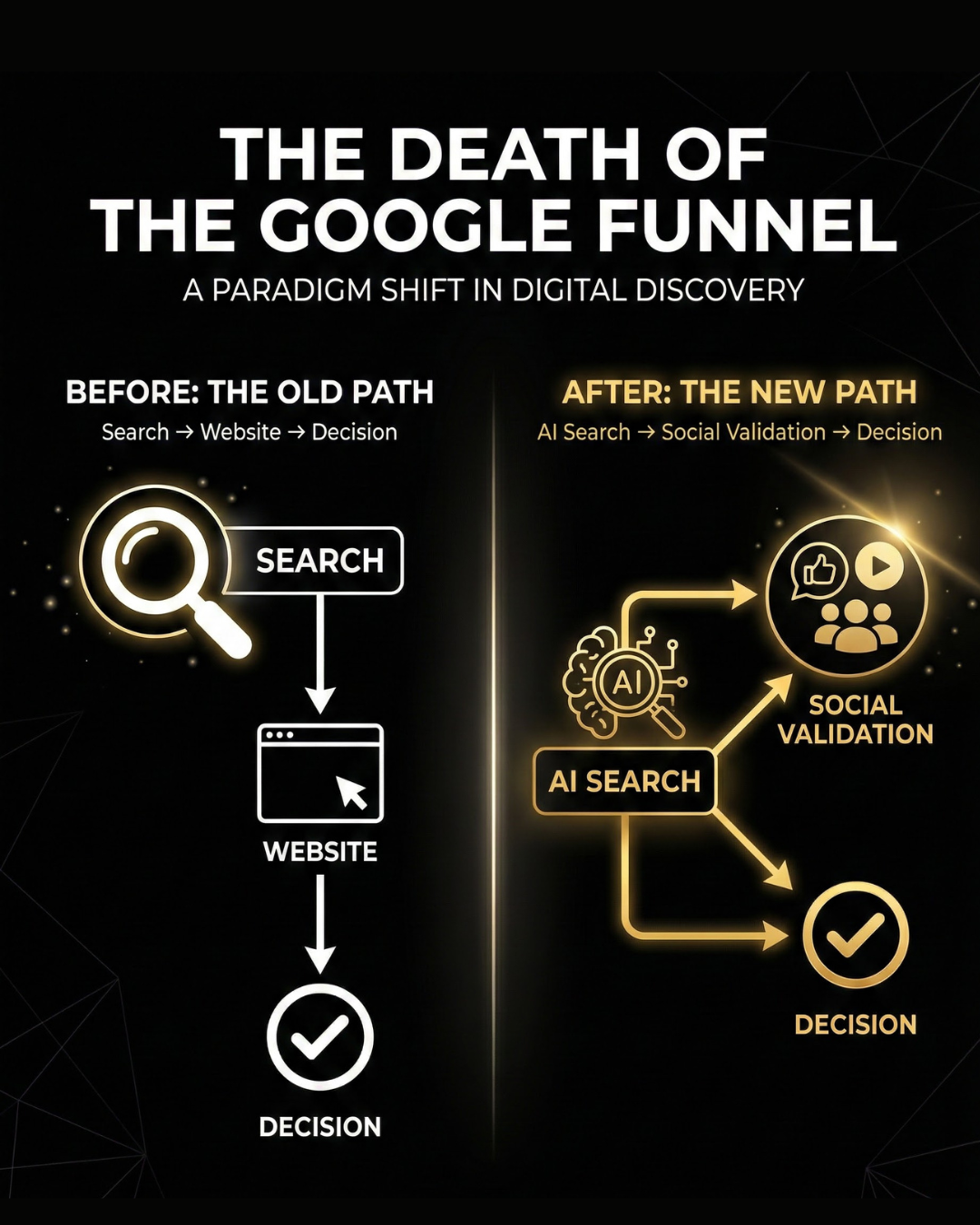
If you are invisible to the chatbots, you are losing access to a quarter of your market
At Tenacious AI Marketing, we don't look at LinkedIn as a place to get "likes." We view it as a primary signal for your Entity Authority. If your LinkedIn profile isn't optimized for machines, you are effectively a "ghost" in the modern search landscape.
Here is how to stop optimizing for recruiters and start optimizing for the Algorithm.
You need to shift your mindset from "Social Media" to “Knowledge Graph.”
Google and Bing (which powers ChatGPT's web browsing) use Knowledge Graphs to understand the world. A Knowledge Graph is a network of nodes (Entities) connected by edges (Relationships).
In this graph, you are a node. Tenacious AI Marketing is a node. AEO is a node.
LinkedIn is one of the few platforms that provides structured, verified data connecting these nodes. It explicitly tells the crawler:
It is so trusted that Microsoft (LinkedIn’s owner) has now verified the identities of over 100 million members, creating a massive "Truth Set" that AI models prioritize over random websites.
We explore the deep mechanics of this connection data in Visibility Through Verifiability: AEO and GEO Explained for 2026.
If this data is messy, the AI breaks the connection to prevent “hallucinations.”
We know that AI models (LLMs) are incredibly smart, but they are also incredibly "lazy" when processing real-time data. They prefer structure over storytelling.
Most founders write their LinkedIn "About" section as a wall of text, a 4-paragraph story about how they “fell in love with marketing at age 12.”
The Problem: Text-heavy narratives are hard for an AI to parse quickly. If the AI cannot extract what you do in the first 200 tokens (words), it moves on.
In 2024, a study by SparkToro revealed that 58.5% of Google searches in the US ended without a click (Zero-Click searches).
The Tenacious Solution: Rewrite your "About" section using Headers and Lists. You want to serve the data to the robot on a silver platter.
Structure it like this:
WHAT WE DO: We help Series A startups dominate AI search results using Answer Engine Optimization (AEO)
WHO WE HELP:
CORE EXPERTISE:
Why this works: When a user asks Perplexity, "Who specializes in AEO for Startups?", the AI scans your profile. It sees the explicit header WHO WE HELP and the bullet point SaaS Founders.
It creates a high-confidence match. You didn't just tell a story; you gave the AI a database entry.
Yes. And most people get this wrong.
In the era of Generative AI, Identity Verification is the new currency. AI models use computer vision to verify that the "Dean Whitby" on LinkedIn is the same "Dean Whitby" speaking at a conference on YouTube.
If your LinkedIn photo is from 2015, your Twitter avatar is an NFT, and your website photo is a candid shot, the AI struggles to merge these visual nodes.
The Visual Node Strategy:
Dean shares the 10 non-negotiable rules for building a personal brand that sticks, including Rule #3: The V.I.T.A.L Framework for consistency.
LinkedIn "Skills" are not just badges for recruiters; they are Topic Tags for the Knowledge Graph.
If you list generic skills like:
You are competing with 500 million other profiles. You are “noise.”
To be cited by AI, you need to map your skills to Niche Entities.
The Semantic Strategy: Audit Your Topics: What specific terms do users type into ChatGPT when looking for your solution?
The Shift:
Not sure what terms to use? Check out our guide on What is Generative Engine Optimisation in 2026 and how to get ai referrals to find the right keywords.
Tenacious Tip: Pin your top 3 most "niche" skills to the top of your profile. This signals to the algorithm which topics carry the highest weight for your entity.
This is where the VITAL Framework becomes critical.
Most people post "fluff" on LinkedIn, motivational quotes, "hustle culture" selfies, or generic company updates. AI models ignore fluff. They are hungry for Data and Unique Insights.
If you want your content to be ingested into the training data of the next GPT model, you must feed it "High-Information Density" content.
The "Feed the Machine" Content Diet:
You can have the best profile in the world, but if the door is locked, the AI can't come in.
Many founders accidentally block AI crawlers via their privacy settings. LinkedIn allows you to hide your profile from “Search engines off LinkedIn.”
The Audit:
If this is "No," you are telling Google (and by extension, Gemini and ChatGPT) not to index your profile. You are voluntarily removing yourself from the Knowledge Graph.
The URL Factor: Look at your public profile URL.
Yes. In graph theory, this is called “Neighborhood Authority.”
If you are a "Marketing Expert," but 90% of your connections are "Real Estate Agents," the algorithm gets confused. It wonders, “Why is this marketing node clustered with real estate nodes?”
However, if you are connected to other High-Authority Nodes in your niche (e.g., other recognized AEO experts, founders of AI companies, marketing thought leaders), the AI borrows their authority and applies it to you.
The Strategy:
It sounds cold, but it is the reality of the AI era. To the machine, you are a collection of data points.
If those points are connected, clear, and authoritative, you get recommended. You get the lead.
You get the deal. If they are messy, disconnected, or generic, you are ignored.
Stop treating LinkedIn like a resume to impress a hiring manager. Treat it like the structured database it is. Impress the machine, and the machine will bring the humans to you.
Is your Entity visible to the AI? Don't guess. Check your brand's visibility with a Free Audit from Tenacious AI Marketing.
Build Your Legacy.
Why isn't my LinkedIn profile showing up in AI answers?
AI models likely view your profile as "unstructured data." If your headline, summary, and skills aren't optimized for semantic search (Entities), the AI ignores you to prevent hallucinations.
What is the most important part of my profile for AI?
Your Headline and About section. The Headline establishes your identity ("Entity Name"), while the About section provides the structured context (Who, What, Where) that AI crawlers scrape to verify your expertise.
Does my profile picture really matter for AI?
Yes. AI uses image recognition to verify identity. Using the exact same high-quality headshot across LinkedIn, Twitter, and your website helps the AI confirm you are the same person ("Entity Resolution").
Should I list generic skills like "Leadership"?
No. Generic skills create noise. List niche, topic-specific skills (e.g., "Answer Engine Optimization" instead of "Marketing") to increase your chances of being cited as an expert in specific queries.
How do I let AI crawlers see my profile?
Go to your LinkedIn Settings > Visibility and ensure "Profile visibility off LinkedIn" is set to "Yes." If this is off, you are blocking Google and AI bots from indexing your data.