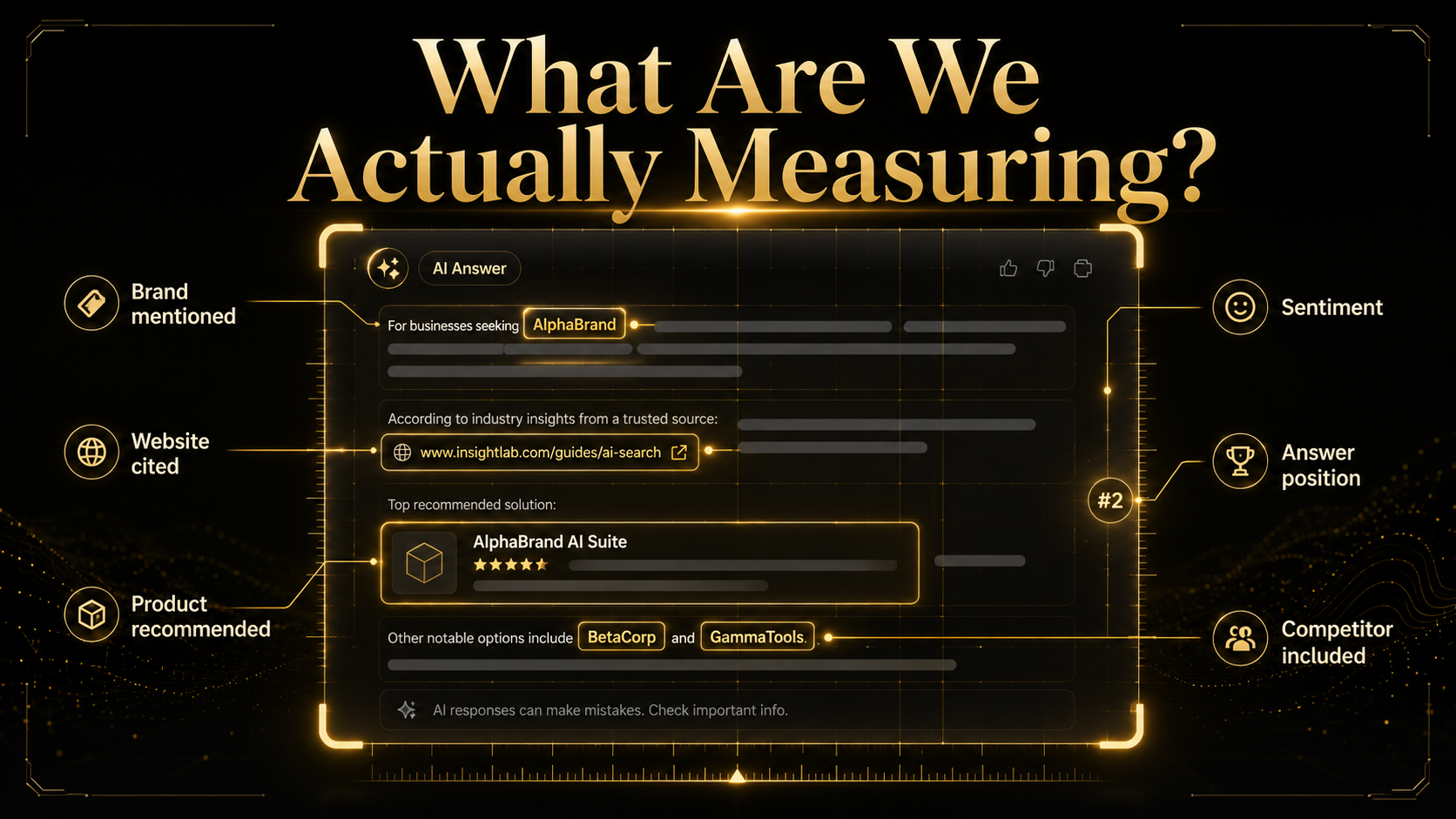
AI search visibility is measured by how often, how accurately and how confidently your business appears inside AI-generated answers.
That means tracking whether platforms like ChatGPT, Gemini, Perplexity, Claude, Copilot and Google AI Overviews can:
This is the shift most businesses still have not fully internalised.
Visibility is no longer only about where you rank. It is about whether you are part of the answer.
If AI engines do not mention, cite or recommend your business when buyers ask relevant questions, you are invisible at the point where trust is being formed.
For years, businesses measured search visibility through familiar metrics:
Those metrics still matter. SEO has not disappeared.
But they no longer show the full picture.
The shift is already visible in search behaviour.
Gartner predicted that traditional search engine volume would drop by 25% by 2026, with search marketing losing market share to AI chatbots and other virtual agents.
That does not mean SEO stops mattering. It means businesses also need to measure whether they are visible inside AI-generated answers, not just whether they rank in search results.
A business can rank well on Google and still be absent from AI-generated answers.
It can receive organic traffic and still be missing from the shortlists buyers see inside ChatGPT or Perplexity.
It can have backlinks and still be poorly understood by AI systems.
That is the new gap.
Traditional SEO asks: Where do we rank?
AI visibility asks: Are we included in the answer at all?
That difference matters because buyers are no longer only clicking through search results. They are asking AI platforms to summarise the market, compare providers, explain options and recommend who is worth considering.
If your business is not part of that answer, you may never enter the buyer’s mind.
AI search visibility is the degree to which your business appears, is understood and is recommended across AI-powered search and answer platforms.
It includes visibility in:
But this is not just about whether your name appears once.
A proper AI visibility check asks:
That is why measurement needs to move beyond dashboards built for the old search model.
AI search is not just changing how buyers find information.
It is changing how they compare businesses.
The old buying process looked like this:
Google search → shortlist → website visits → manual comparison → decision.
The new buying process often looks more like this:
AI search → “Compare these companies” → AI creates the shortlist → buyer visits one or two websites.
That is a huge shift.
A business may have strong website traffic and still lose commercial opportunities if AI compares it poorly against competitors.
Buyers now ask AI questions like:
AI is now performing the first stage of the tender process.
That means businesses are no longer fully in control of how they are compared.
If you do not create accurate comparison content, AI will build the comparison from whatever information it can find elsewhere.
That is why businesses should proactively publish fair comparison content.
This does not mean pretending to be better than everyone.
It means clearly explaining:
The businesses that do this well give AI better evidence.
The businesses that avoid comparison content leave AI to guess.
Your AI visibility may be weak if:
That last point is important.
If AI knows you only when prompted directly, that is not real commercial visibility.
Real visibility is when AI includes you in category, comparison and buying-intent questions.
To measure AI visibility properly, you need to track several signals together. No single metric tells the whole story.
| Metric | What it measures | Why it matters |
| AI citations | Whether AI engines reference your content as a source | Shows whether your content is trusted enough to support an answer |
| Brand mentions | Whether your business is named in AI answers | Shows whether AI sees you as relevant to the topic |
| Share of Model | Your share of AI answers compared with competitors | Shows whether you are gaining or losing recommendation space |
| Citation velocity | How often and how quickly your citations increase | Shows whether your authority is improving over time |
| Entity recognition | Whether AI understands your business clearly | Shows whether your brand is machine-readable and consistent |
| Sentiment and framing | How AI describes your business | Shows whether AI’s perception supports your positioning |
| Prompt coverage | How many relevant buyer questions you appear for | Shows whether your visibility is broad or fragile |
| Competitor dominance | Which competitors AI recommends instead | Shows where the market’s trust is currently going |
| Source strength | Which pages or third-party sources influence answers | Shows what AI is relying on to form its recommendations |
| Follow-up resilience | Whether you stay visible when prompts become more specific | Shows whether your authority holds beyond surface-level queries |
The point is not to collect vanity data.
The point is to understand whether AI systems are helping buyers trust you or quietly sending them somewhere else.
Share of Model is the percentage of relevant AI-generated answers in your category that include your brand compared with competitors.
In simple terms, it asks: When buyers ask AI who to trust, how often are you part of the answer?
For example, if you test 50 high-intent prompts and your brand appears in 5 answers while a competitor appears in 30, that tells you something important.
It means the competitor has a stronger footprint in the AI discovery layer.
That does not always mean they are better. It often means AI has more evidence to work with.
They may have clearer service pages, stronger third-party mentions, better comparison content, more consistent entity signals, stronger YouTube content, better structured data or more answer-ready explanations.
Share of Model helps turn that invisible gap into something you can track.
Citation velocity measures how quickly and consistently AI engines begin citing your brand or content over time.
This matters because AI visibility is not fixed.
Models change. Search features change. Competitors publish. New listicles appear. YouTube videos get indexed. Third-party articles get cited. Service pages improve. Brand signals strengthen.
If your citation velocity is increasing, it suggests AI engines are finding more reasons to trust and reference you.
If it is flat or declining, your content and authority signals may not be strong enough.
A useful monthly review should look at:
Citation velocity turns AI visibility from a snapshot into a trend.
AI systems need to understand your business as a clear entity.
That means they need to connect the dots between:
If those signals are inconsistent, AI may struggle to understand who you are and what you do.
That creates problems.
AI might describe a specialist consultancy as a general marketing agency. It might miss the services that now matter most. It might rely on old content, outdated descriptions or generic directory listings. It might understand the brand name, but not the category the business deserves to be associated with.
This is why old content needs to be reviewed carefully.
It may have been right when it was written. But if a company has evolved, and the website still sends mixed signals about what it sells, AI engines can inherit that confusion.
For example, a business may now want to be known for AI Visibility and GEO, but its old pages may still over-emphasise standalone social media, LinkedIn marketing, lead generation, content marketing or traditional SEO.
None of those tactics are automatically wrong. The problem is when they make the business harder to understand.
The goal is clarity.
AI engines should be able to understand what a business does, who it helps, why it is credible and when it deserves to be recommended.
The click gap is becoming measurable too.
Pew Research Center found that when Google users encountered an AI summary, they clicked a traditional search result in 8% of visits, compared with 15% of visits when no AI summary appeared.
In other words, the presence of an AI answer can reduce the likelihood that users continue into the traditional results.
That is why AI visibility needs its own measurement model.
| Traditional SEO Measurement | AI Visibility Measurement |
| Keyword rankings | Prompt visibility |
| Organic traffic | AI answer inclusion |
| Click-through rate | Mentions, citations and recommendations |
| Backlinks | Entity authority and source trust |
| Impressions | Share of Model |
| Page one ranking | Being part of the generated answer |
| Content performance | Content extractability and citeability |
| Competitor ranking position | Competitor dominance inside AI answers |
| Conversion from organic traffic | Influence before the website visit |
SEO still matters. But AI visibility adds another layer.
The question is no longer only: Did we rank?
The new question is: Did AI recommend us?
Measuring visibility tells you where the gaps are.
Improving visibility means building stronger evidence.
AI systems do not only compare websites. They compare signals.
Those signals can include:
This is why AI visibility is not solved by publishing more blogs.
One business may need clearer service pages.
Another may need stronger comparison content.
Another may need better third-party proof.
Another may need founder-led video and transcripts.
Another may need old content cleaned up because AI is still inheriting outdated positioning.
The measurement shows the problem.
The visibility system fixes it.
If you ask AI about your company by name, it may know you. That does not mean buyers will find you. You need to test category, comparison and buying-intent prompts. Most buyers start with the problem, not the provider.
AI engines do not simply rank pages one to ten. They summarise, compare and recommend. So the report needs to measure mentions, citations, sentiment, entity accuracy, prompt coverage and competitor dominance, not just traffic.
AI answers change. Models update. Competitors publish. New pages get indexed. Third-party sources appear. Search features evolve. One test is not enough.
Your website matters, but AI engines often rely on corroboration. That means third-party articles, listicles, directories, reviews, podcasts, LinkedIn, YouTube and industry mentions can all influence whether AI trusts you. You cannot solve every AI visibility problem by publishing more blogs on your own site.
AI visibility measurement should not sit in a vanity dashboard.
It should influence:
The test tells you where the market is forming opinions.
The strategy should respond.
A useful AI visibility measurement process should produce more than screenshots.
You should come away knowing:
That is how AI visibility measurement becomes commercial.
It shows where trust is being built before the buyer reaches your website.
Measurement is not the finish line.
It is the starting point.
The goal is not simply to say, “You appeared in ChatGPT twice this month.”
The goal is to understand why, why not, and what to do next.
That means looking at:
This matters because AI visibility is not one tactic.
It is a system.
SEO foundations help AI access and interpret the site. Answer-ready content gives AI something useful to extract. GEO strengthens citations and recommendations. LinkedIn and YouTube reinforce authority. Structured data removes ambiguity. Measurement shows whether the work is moving the needle.
Measurement only matters if it leads to action.
Action is what improves visibility, authority and enquiries.
AI search has changed what visibility means.
It is no longer enough to rank, publish or hope.
You need to know whether AI engines can understand you, cite you, compare you fairly and recommend you when buyers are making decisions.
That means measuring:
This matters because AI is becoming the first comparison layer.
Buyers may ask AI to compare providers before they visit a website, book a call or speak to a salesperson.
If the comparison is inaccurate, incomplete or competitor-led, revenue can be lost before the buyer ever reaches you.
That is why AI visibility measurement is not just a search report.
It is a commercial visibility system.
The brands that win will not only be the ones people can find.
They will be the ones AI systems can confidently understand, compare and recommend.
How do you know if AI visibility is improving?
AI visibility is improving when your business appears in more relevant buyer questions, gets cited by more AI engines, is described more accurately, and starts appearing alongside or ahead of competitors in comparison-style answers. The key is movement over time, not one good screenshot.
What should a business test first in AI search?
Start with the questions a buyer would ask before choosing a provider. These are usually problem, comparison, pricing, “best company”, and “who should I trust” questions. Branded prompts are useful, but they do not show whether new buyers can discover you.
Can AI visibility be measured without a specialist tool?
Yes, but only at a basic level. You can manually test prompts across ChatGPT, Gemini, Perplexity and Google AI Overviews, then record mentions, citations and competitors. A specialist tool becomes useful when you need consistent tracking, competitor benchmarking and reporting over time.
Why might a competitor appear in AI answers when we have better SEO?
AI engines do not only look at rankings. They also look for clear explanations, consistent entity signals, third-party validation, citations, comparison content, reviews, video, LinkedIn authority and structured information. A competitor may be easier for AI to understand, even if your website ranks well.
How long does it take to improve AI search visibility?
Most businesses should think in months, not days. AI visibility usually improves as stronger content, clearer service pages, better entity signals, internal links, third-party mentions and authority assets start to reinforce each other. The first step is getting a baseline, then tracking movement monthly.
What is the difference between being mentioned and being recommended by AI?
A mention means AI knows your business exists. A recommendation means AI sees your business as a relevant answer to the buyer’s problem. Recommendations are more commercially valuable because they influence who gets considered.
Should AI visibility measurement include YouTube and LinkedIn?
Yes, where they support authority. AI engines often use signals beyond your website to understand people, brands and expertise. Founder-led video, LinkedIn content and third-party mentions can all help reinforce what the business is known for.
What happens if AI describes our business incorrectly?
That is a visibility and positioning problem. It usually means the public signals around the business are unclear, outdated or inconsistent. The fix is not just rewriting one page. You need to clean up service positioning, content structure, schema, internal links and external proof so AI has a clearer picture.
What is AI comparison visibility?
AI comparison visibility measures how your business appears when buyers ask AI to compare providers, shortlist companies or recommend the best option. It looks at whether AI describes your business accurately, includes the right proof and compares you fairly against competitors.
Why does comparison content matter for AI visibility?
Comparison content gives AI systems accurate material to use when buyers ask how your business compares with others. Without it, AI may rely on third-party sources, outdated information or competitor-led content.