Google I/O 2026 was not just another tech event. It was a warning shot for every business still treating search like it is 2016.
For years, businesses have thought about Google as a list of blue links. You typed in a keyword, looked at the top results, clicked a few websites, compared suppliers, and made a decision.
That model is not dead, but it is no longer the whole game.
Google has now made the direction obvious. Search is becoming conversational. YouTube is becoming more searchable by intent. AI agents are starting to perform tasks on behalf of users. Google AI Studio is making app and workflow creation easier. And visibility is no longer just about ranking. It is about being understood, trusted, selected and recommended.
For B2B businesses, this matters more than most realise, because the next version of search will not just show people who exists. It will help people decide who to trust.
At Tenacious AI Marketing Global, this is exactly why we talk about GEO, AEO, AI visibility, founder authority, YouTube, LinkedIn, structured content and multi-platform trust signals as one connected system.
The new game is not just search rankings. The new game is AI recommendation.
The biggest announcement was Google’s move into a more AI-powered version of Search.
Google said it is bringing advanced model capabilities directly into Search, including AI features that let users use agents just by asking a question. Google also described the new intelligent AI-powered Search box as the biggest upgrade to Search in more than 25 years. (Google Search I/O 2026 announcement)
That is not a small feature update. That is Google saying the search box is becoming an AI interface.
The old search behaviour was short and keyword-led. People searched things like “marketing agency UK”, “accountant Leeds” or “business coach for SMEs”.
The new search behaviour is longer, more specific and closer to how people actually think. People are increasingly asking questions like, “Who is the best agency to help a B2B service business get found in ChatGPT, Gemini and Google AI search?” or “Which company can automate admin tasks for my business without me hiring a full-time AI operations person?”
That is the real shift. Businesses are no longer just trying to rank for keywords. They are trying to become the answer to commercial questions.
For the wider context behind this shift, read our breakdown of how AI search changed in May 2026 and what business owners need to know.
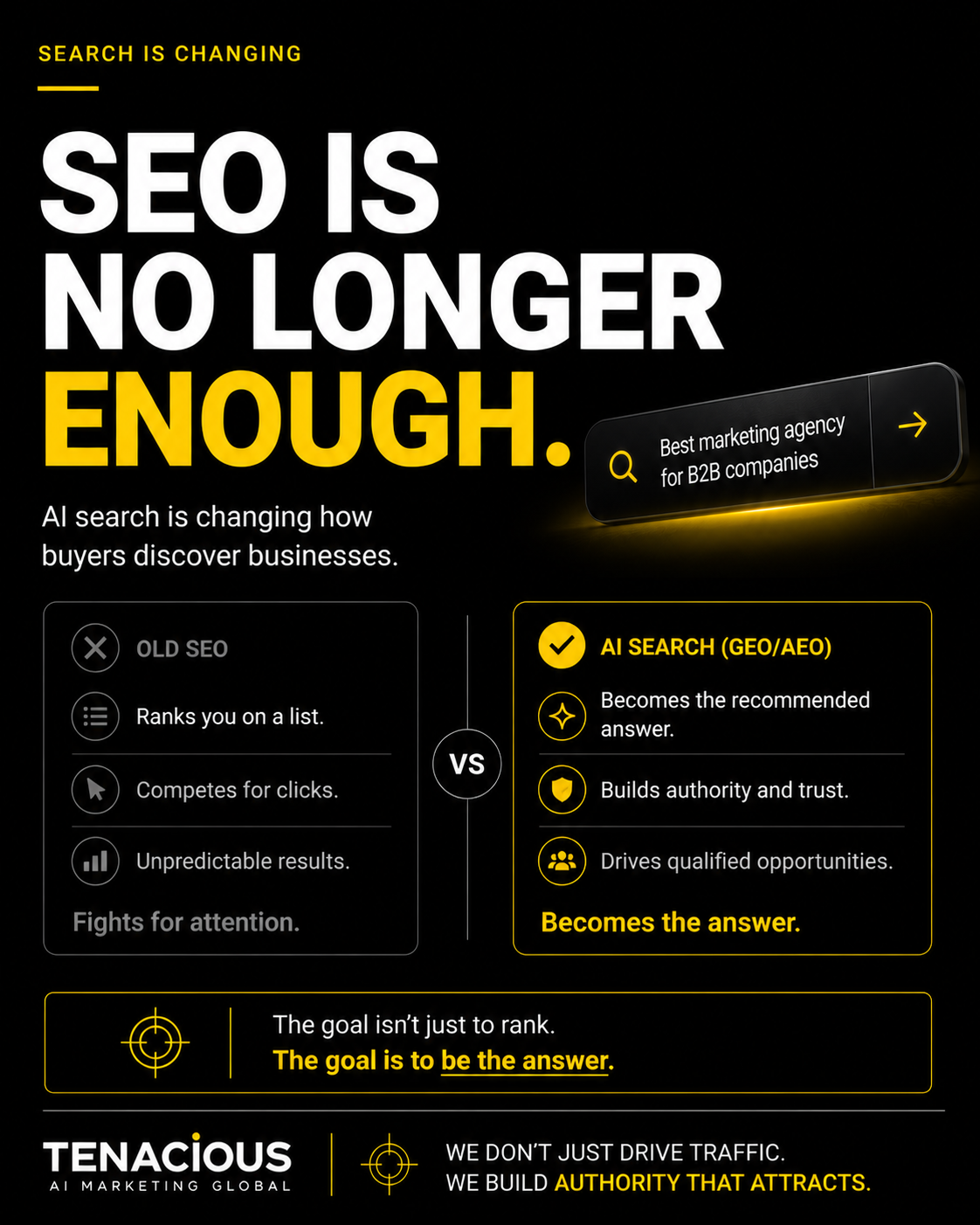
One of the biggest signals from I/O was the scale of Google’s AI search push.
Google’s I/O announcements focused heavily on AI-powered Search, AI agents, Gemini and more conversational search experiences across its ecosystem. (Google I/O 2026 AI announcements)
That tells us something important. People are not just playing with AI search. They are changing how they search.
When users ask more detailed, conversational questions, Google needs more than a keyword-matched page. It needs to understand who the business is, what the business does, who it helps, why it should be trusted, what proof exists, where else the brand appears, and whether the content answers the question properly.
This is where traditional SEO starts to look incomplete. Not useless. Incomplete.
Technical SEO still matters. Website content still matters. Backlinks still matter. But AI visibility adds another layer. Businesses now need clear service pages, question-led content, strong FAQs, schema markup, reviews, case studies, YouTube content, LinkedIn authority, founder visibility, PR mentions, directory consistency, clear entity signals and proof that real people trust them.
The businesses that win will not just be the ones with the best keyword plan. They will be the ones AI can understand quickly, trust confidently and recommend without hesitation.
This is why we keep saying: AI citations are the new rankings.
For the core definition, read what GEO means in 2026 and how brands get cited in AI answers. And for the practical system behind it, read the Tenacious GEO framework for becoming visible in AI search.
One of the most important announcements for B2B businesses was around YouTube.
YouTube announced conversational search and Gemini Omni AI tools at Google I/O 2026, saying these updates will help users find videos and remix Shorts more easily. (YouTube Google I/O 2026 announcement)
This matters massively because, for years, many B2B companies treated YouTube as a nice-to-have. That is now a mistake.
YouTube is no longer just a social media channel. It is becoming a searchable proof engine.
A good YouTube strategy does three things at once. It helps humans trust you faster. It gives your sales team assets they can send before, during and after conversations. And it creates transcripts, titles, descriptions, chapters and structured content that AI systems can understand.
This is why founder-led video is becoming so powerful. Not because every founder needs to become an influencer, but because every expert-led business needs evidence.
If a buyer asks an AI platform who to trust, the business with clear videos, expert explanations, case studies, interviews, proof, thought leadership and consistent messaging has a better chance of being understood.
In simple terms, video is becoming a trust signal.
That is why Tenacious treats YouTube visibility as part of modern SEO, AEO and AI search strategy, not just a content channel. For more on this shift, read our article on why video content has become the number one AI citation source.
Another major theme from Google I/O 2026 was agents.
Google announced Managed Agents in the Gemini API, allowing developers to define agents as files, run them in secure cloud sandboxes, use tools, execute code and build custom agents with their own instructions, skills and data. (Google Managed Agents announcement)
Google’s developer highlights also focused on taking ideas from a prompt to a production-ready application, including updates to Antigravity, Gemini API and native Android support in Google AI Studio. (Google I/O 2026 developer highlights)
That matters beyond developers. It signals where work is heading.
AI is moving from “answer this question” to “complete this task”.
That shift is huge for SMEs. Every business has repetitive tasks that should not still be done manually: copying data between systems, chasing leads, summarising calls, creating reports, updating CRMs, drafting follow-up emails, organising documents, creating content briefs, checking spreadsheets, sorting customer enquiries and turning meeting notes into actions.
These are zombie tasks. They look alive because people are doing them every day, but they are quietly eating productivity, profit and energy.
The businesses that win over the next few years will not just “use AI”. They will redesign workflows around AI.
That means businesses will need a new kind of support internally. Not just a marketer, operations assistant or developer, but people who understand AI operations, automation, content systems, prompts, workflows, agents and business context.
This is why AI agents replacing sales admin tasks is no longer theory. It is becoming a practical operational advantage.
It is also why businesses need to think seriously about talent. The companies that can spot, design and manage AI workflows will move faster than the companies still throwing humans at repetitive admin. For the talent angle, read why your 2026 growth strategy may need a GATE intern.
Google also announced major Google AI Studio updates at I/O 2026, including native Android vibe coding support, Google Workspace integrations, an AI Studio mobile app and more. (Google AI Studio I/O 2026 updates)
This is important because it reduces the distance between idea and implementation.
A business owner can now look at a messy internal process and ask, “Could we build something for this?” More often than not, the answer will be yes.
The bottleneck will not be whether the technology exists. The bottleneck will be whether the business has someone who can spot the opportunity, define the workflow, build the first version, test it and improve it.
That is where the next competitive advantage sits. Not in buying more software, but in turning business processes into intelligent systems.
This is exactly where Tenacious AI Marketing Global sees the market going: businesses need visibility systems on the outside and automation systems on the inside.
One gets you found. The other gives you the operational capacity to handle the growth.
Whenever search changes, people rush to say SEO is dead.
It is not.
But the lazy version is.
The version where a business writes a few keyword blogs, tweaks some metadata, gets a few backlinks and waits for leads is not enough anymore.
The modern version of search requires a broader visibility system. You need to be findable in Google, understood by AI platforms, credible on LinkedIn, proven on YouTube, validated by reviews, supported by case studies and clearly structured across your website.
You also need content that answers real buyer questions, schema that helps machines understand your expertise, consistent positioning across the web and authority signals that show you are not just another business saying the same thing as everyone else.
The new game is not just ranking. The new game is recommendation.
This is also why AEO and LinkedIn marketing now work together to win AI citations. LinkedIn is not just a posting platform anymore. For B2B companies, it is part of the authority graph AI uses to understand people, companies and expertise.
Keywords still matter, but they are not enough.
Start collecting the real questions your buyers ask before they buy. What is the best option for my business size? How much should this cost? What should I compare before choosing a supplier? What are the risks? Who is best for my specific situation? What should I do if I already tried this and it failed?
These are the questions AI tools are built to answer. Your content should be structured around them.
For a deeper checklist, use our guide on how to audit your website for AI visibility, AEO, GEO and citation readiness.
A blog should not just be a blog. It should become a structured answer asset.
That means clear headings, direct answers, FAQs, examples, comparison sections, proof points, internal links, schema and a clear next step.
The goal is not to write more content. The goal is to create content that both humans and AI systems can understand.
This is why AI visibility content needs a strategy, not just volume. As we explain in why publishing AI content alone will not make you visible in AI search, generic content without authority, structure and entity clarity is just noise at scale.
Every serious B2B business should be thinking about video. Not necessarily high-production influencer content. Useful content.
That means explainers, FAQs, founder opinions, case studies, client conversations, product walkthroughs, sales objections and industry commentary.
If buyers are asking more complex questions, video helps you answer them with depth, tone and trust. And with YouTube becoming more conversational and AI-assisted, that content becomes even more valuable.
For B2B brands, the real question is not “should we be on YouTube?” The real question is: what questions should our YouTube channel answer so buyers and AI systems understand why we are credible?
If AI cannot clearly understand what you do, who you serve and why you are credible, it is unlikely to recommend you.
Your website should make the basics obvious. Who you help. What problems you solve. What services you offer. What makes you different. Where you operate. Who leads the business. What proof you have. What results you create. What questions you answer.
Most businesses make this far too difficult. They use vague language, weak service pages, thin case studies and generic positioning.
AI does not reward confusion. Neither do buyers.
This is why entity clarity matters. If you want to understand why AI trusts some brands more than others, read our guide on entity authority and why AI chooses certain brands.
AI visibility is one side of the opportunity. AI automation is the other.
Every business should now audit its internal processes and ask what it is still doing manually that should be automated. What admin tasks happen every week? What work drains the team but adds little value? What repeatable decisions could be supported by an agent? What content, reporting or follow-up could be systemised?
The aim is not to replace everyone. The aim is to stop wasting human talent on robotic work.
If your team is still copying data between systems, manually chasing follow-ups, rewriting the same emails, producing reports by hand or doing repetitive research every week, that is not “being busy”.
That is margin leaking out of the business in slow motion.
The companies that benefit most from AI will not be the ones that occasionally ask ChatGPT to write a post. They will be the ones that build AI capability into the team.
That could mean an AI Ops Lead. It could mean AI-trained interns. It could mean automation support. It could mean training existing staff to use AI properly.
But doing nothing is not a strategy.
The businesses that wait until this is “normal” will be buying the same talent at a much higher price later.
This is why projects like The Gate Project matter. Businesses need access to people who can support content, automation, workflows and AI operations without needing to hire expensive senior AI roles straight away.
Google has made the direction clear.
Search is becoming AI-led. Discovery is becoming conversational. YouTube is becoming an answer engine. Agents are moving into everyday workflows. Apps and automations are becoming easier to build. Trust signals across the web matter more than ever.
The businesses that win will not be the ones shouting the loudest. They will be the ones with the clearest expertise, strongest proof, best structured content and smartest systems.
This is the moment to stop treating AI as a side project. AI is becoming part of how people search, decide, buy, build, work and trust.
So the question for business owners is simple:
When your next customer asks AI who they should trust, will your business be in the answer?
If you want to understand whether your business is ready for AI search, start with Tenacious AI Marketing Global and review your website, content, YouTube, LinkedIn, schema, reviews and authority signals through the lens of AI recommendation, not just Google rankings.
Google I/O 2026 confirmed that search is becoming more AI-led, conversational and agentic. Google is moving beyond simple keyword searches and blue links towards search experiences where users ask longer questions, receive AI-generated answers and increasingly expect Google to help them take action, not just find information.
AI Mode is Google’s more conversational, AI-powered search experience. Instead of only returning a list of links, it helps users explore complex questions, compare options and receive more complete AI-generated responses. For businesses, this means visibility depends less on keyword ranking alone and more on being clearly understood, trusted and cited by AI systems.
No, traditional SEO is not dead, but it is no longer enough on its own. Technical SEO, website structure, backlinks, content quality and crawlability still matter. However, businesses now also need GEO, AEO, schema, FAQs, YouTube content, founder authority, reviews, case studies and strong entity signals to be recommended inside AI-led search experiences.
Google I/O 2026 means business owners need to think beyond rankings. The next version of search will help buyers decide who to trust, compare suppliers and take action faster. Businesses that want to win need clear service pages, answer-led content, visible expertise, proof, video content and consistent signals across Google, YouTube, LinkedIn and other trusted platforms.
YouTube is becoming more important because Google is making video easier to search, understand and use inside AI-assisted discovery. For B2B companies, YouTube is no longer just a content channel. It is a trust engine. Videos, transcripts, titles, descriptions and chapters can help humans and AI systems understand your expertise.
AI agents are systems that can complete tasks, not just answer questions. Google I/O 2026 showed that agents are moving closer to mainstream business use, especially through Gemini, Google AI Studio and developer tools. This matters because businesses will increasingly use agents to automate admin, reporting, follow-ups, research, content workflows and customer support.
Businesses can prepare by auditing how clearly their website explains who they help, what they do and why they are credible. They should create content around real buyer questions, add FAQ schema, improve internal linking, publish useful YouTube videos, strengthen LinkedIn authority, collect reviews, publish case studies and track whether AI platforms mention or recommend them.
The biggest takeaway is that search is becoming recommendation-led. Buyers will not just search for websites, they will ask AI who to trust, what to compare and which solution fits their situation. The brands that win will be the ones with clear expertise, structured content, strong proof and enough authority for AI systems to confidently recommend them.