
Most businesses do not have a content shortage.
They have a visibility problem.
They are publishing blogs, LinkedIn posts, videos, newsletters and AI-generated articles, but still not appearing when buyers ask ChatGPT, Gemini, Perplexity or Google AI search who to trust.
That is because content writing and GEO solve different problems.
Content writing asks: What should we publish?
GEO asks: What evidence does AI need before it can understand, cite or recommend us?
That difference matters.
A well-written article can still do nothing for AI visibility if it is disconnected from the wider business, weak on proof, unclear in structure or too generic to be selected as a source.
GEO is not about producing more content.
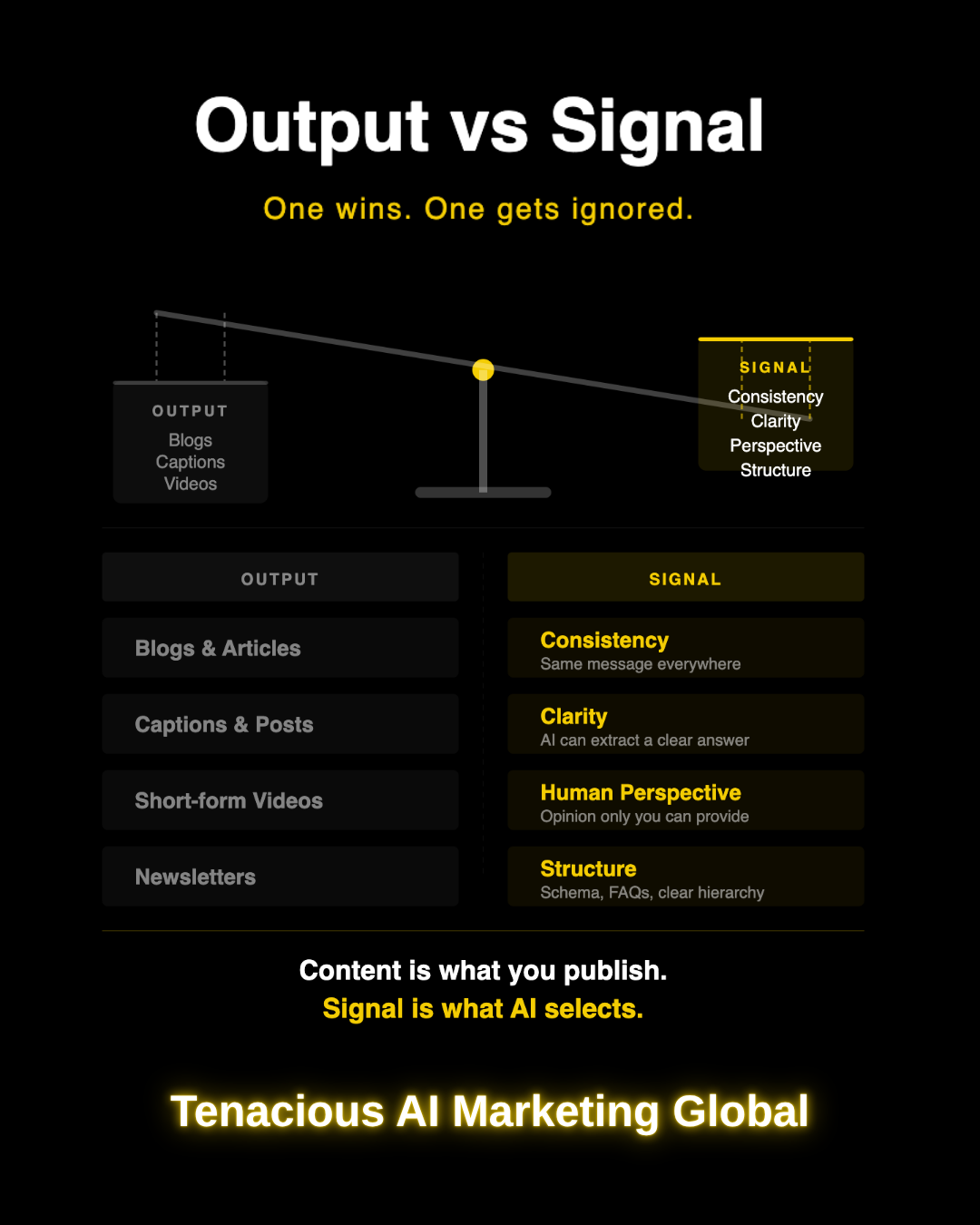
It is about turning content into a clearer signal.
That means stronger questions, better structure, sharper positioning, visible proof, internal connections, third-party validation and consistent authority across the places buyers and AI systems check.
So the real comparison is not: GEO vs content writing.
It is: content as output vs content as evidence.
And in AI search, evidence is what gets cited.
Content writing is the act of producing content.
That content may include:
GEO, or Generative Engine Optimisation, is different.
GEO is the process of improving how visible, understandable and citable a business becomes inside AI search and generative answer systems.
So the difference is not just format. It is purpose.
Content writing asks: What should we publish?
GEO asks: What needs to be true across our content and wider presence for AI systems to trust us as a source?
That is a much more strategic question.
Most people still explain GEO as SEO for AI. That understates what is actually happening.
Citation engineering is the process of structuring content, authority signals and discoverability systems in ways that increase the probability of AI systems surfacing and citing a brand inside AI-generated answers.
Unlike traditional SEO, which focuses primarily on rankings and traffic, citation engineering focuses on recommendation visibility and AI selection confidence.
At Tenacious AI Marketing, GEO is approached through one core lens: what increases the probability of an AI system citing your brand?
That changes the strategy entirely. Once you understand that AI visibility is driven by citation selection, the focus shifts from publishing content to engineering discoverability. That includes question architecture, answer clarity, semantic reinforcement, entity consistency, cross-platform authority, comparison positioning and citation pathways.
Traditional content marketing rarely thinks this way. Most content strategies still optimise for rankings, sessions, pageviews and publishing cadence. GEO optimises for citations, discoverability, authority reinforcement, answer selection and recommendation visibility. That is a completely different strategic objective.
Traditional search rewarded discoverable pages.
AI search rewards usable answers.
That is the big shift.
A normal SEO article might rank because it covers a keyword well. But an AI answer needs more than a keyword match. It needs information that can be extracted, summarised, compared and supported by credible sources.
Semrush analysed more than 10 million keywords and found that Google AI Overviews appeared for 15.69% of searches by November 2025, after peaking at nearly 25% in July. Informational searches were especially exposed to AI Overviews, which matters because much of traditional content marketing is built around informational content.
Seer Interactive's 2026 AIO impact study analysed 5.47 million tracked queries and found that comparison queries triggered AI Overviews 95.4% of the time, while question-format queries triggered them 85.9% of the time. That matters because many content strategies are built around exactly those formats: "X vs Y", "how", "what", "why" and "best" searches. In AI search, those pages need to be built for citation, not just clicks.
That means many businesses are still publishing into a search environment that no longer behaves the way it used to.
The question is not whether content matters. It does. The question is whether the content is structured and supported well enough to be selected.
A long article that says what everyone else says is not much of an asset. A clear answer, connected to proof, reinforced across multiple surfaces and tied to a known entity is far more useful.
This is the part most content strategies miss entirely, and it is bigger than positioning.
Brand positioning is what a company wants people to think.
Brand coherence is whether every public signal actually tells the same story.
Here is a simple way to picture it. Imagine picking 45 random people off the street. You give each of them the name of your business and ask them to research it online. An hour later, you ask them:
Would all 45 people come back with almost the same answer? Or would you get 45 slightly different versions?
That is close to how AI systems interpret a business.
If AI finds one story on your website, a different one on LinkedIn, a vaguer one on YouTube and something else again in directories and third-party mentions, it becomes uncertain. Uncertainty does not get cited.
This is exactly why publishing more content does not automatically fix visibility. You can produce a blog, a LinkedIn post and a video every week and still weaken your position if each one describes the business slightly differently.
The businesses that win in AI search are not always the ones with the cleverest positioning.
They are the ones with the highest level of brand coherence, where the website, the founder's LinkedIn, the company page, the YouTube channel and the third-party mentions all reinforce the exact same story about what the business does, who it helps and why it is credible.
Content writing produces the individual pieces. GEO is partly the discipline of making sure those pieces agree with each other.
Most content writing focuses on producing the page.
GEO focuses on whether that page creates a useful signal.
That includes:
That is why GEO is not just "SEO for AI." It is visibility engineering. The aim is to increase the chance that an AI system can confidently use your business, your content or your expertise when answering a buyer's question. That requires more than words on a page. It requires context.
AI tools have made content production easy. That is useful. But it has also created a problem.
Businesses can now produce large volumes of content without adding any new thinking. A company can publish daily blogs, automated LinkedIn posts, AI-written captions, short-form video scripts, generic newsletters and rewritten FAQs, and still not become more visible in AI search.
Because output is not the same as authority.
The issue is not that AI tools are bad. The issue is when AI replaces the thinking instead of supporting it.
Generic AI content usually has the same problems: it explains the obvious, it avoids a clear point of view, it uses common phrases, it lacks examples, it has no original evidence, it does not reflect real client conversations, and it is not connected to a wider visibility system.
That kind of content may fill a calendar. But it rarely builds a position. And in AI search, weak positioning is a serious problem.
Google's Search Essentials still points site owners towards creating helpful, reliable, people-first content rather than content made only to perform in search systems. The same principle applies to AI search. Content needs to help the buyer first. Then it needs to be structured clearly enough for AI systems to understand.
You think in terms of platforms: your website, LinkedIn, YouTube, social media.
AI doesn't.
It looks for patterns across everything. It evaluates whether a business is consistent, whether it clearly explains a topic and whether the message reinforces over time. If that pattern is unclear,
AI cannot confidently use you as a source.
This is why "we'll just publish across more platforms" is not a strategy on its own. When a business expands onto more channels without a clear system, each platform ends up saying something slightly different, depth gets lost, and context disappears. Instead of strengthening the presence, it gets diluted.
Scaling AI-generated content across more channels does not improve visibility by itself. It amplifies inconsistency instead of strengthening authority, unless every channel is reinforcing the same signal.
There is one thing most AI-generated content strategies remove: the human behind the content.
When everything is an AI-written blog, an AI-generated caption and an AI-scripted video, what disappears is opinion, experience and perspective. That is exactly what AI systems look for when deciding what to select, because AI does not just evaluate information. It evaluates who is behind it, whether they consistently show expertise and whether their perspective is clear and repeatable.
AI systems are trained on human knowledge. So when content sounds generic, avoids taking a stance and doesn't show real-world understanding, it becomes less valuable than content with a clear human perspective. This is why founder-led content, opinion-driven insight and real explanations consistently perform better. Not because they're louder, but because they're more identifiable, more consistent and more trustworthy.
This doesn't mean abandoning AI tools. It means using them differently. The human element shows up as clear opinions rather than neutral summaries, real explanations rather than rewritten information, and consistent thinking across every platform. Instead of content that could be written by anyone, you create content that can only come from you.
The old buying process looked like this:
Google search → shortlist → website visits → manual comparison → decision.
The new buying process increasingly looks like this:
AI search → "compare these companies" → AI builds the shortlist → buyer visits one or two websites.
That is a huge shift, and it explains why publishing more content on its own does not fix visibility.
Buyers now ask AI questions like:
AI is now performing the first stage of the tender process. That means businesses are no longer fully in control of how they are compared. If you do not create accurate, fair comparison content,
AI will build the comparison from whatever information it can find elsewhere, including your competitors' pages.
A 2025 UK consumer report from Invoca found that over 41% of UK consumers had already used a generative AI tool such as ChatGPT, Gemini or Claude to research a high-stakes purchase. Comparing companies and brands was one of the top-reported use cases. That is the commercial reality behind this shift. Recommendation visibility is not a future concern. If your business is not visible during AI recommendations, comparison prompts and evaluation questions, you are increasingly excluded from the buying journey before it ever reaches Google.
This is why comparison content, built fairly and specifically, is one of the highest-value assets in a GEO strategy, and it is a different job from simply publishing more blogs.
Content writers are still valuable. But the role needs to evolve.
A content writer working for GEO cannot only think about word count, keywords and publishing dates. They need to think about answer selection. That means asking better questions before writing.
Every useful GEO page should answer a clear question, not a vague topic.
Weak topic: AI marketing trends
Stronger GEO question: How can a B2B business improve visibility in ChatGPT and Google AI search?
The second version is easier to answer, easier to structure and easier for AI systems to connect to user intent.
The page should make one thing clearer. It might clarify what the business does, who the service is for, what the problem means, how the two options compare, what buyers should look for, what process is involved or what proof supports the claim.
If the content does not make anything clearer, it is just another page.
AI visibility is not built on claims alone. A page should include evidence where possible: examples, case studies, data, client questions, process detail, comparison logic, founder insight, screenshots, third-party citations, reviews or original research.
The stronger the evidence, the easier it is for a buyer or AI system to treat the content as useful.
A page should not sit alone. It should connect to related service pages, blogs, FAQs, videos and proof assets. That is how topic authority builds. If one article says the business specialises in one thing, but the rest of the website gives no support to that claim, the signal is weak. GEO strengthens the connection between the topic, the business and the evidence around it.
AI visibility is not driven by one tactic. It comes from several layers working together.
| Visibility Driver | Why It Matters |
| Question-led content | Matches conversational search behaviour |
| Comparison pages | Supports recommendation and shortlist prompts |
| FAQ ecosystems | Creates direct citation opportunities |
| Brand coherence | Gives AI one consistent story instead of several competing ones |
| Multi-platform reinforcement | Strengthens authority signals across the web, not just the website |
| Semantic topic clustering | Improves entity understanding |
| YouTube and transcripts | Creates highly citable, human-backed educational content |
| Structured formatting | Makes content easier for AI systems to surface and extract |
That is what most content calendars miss. They measure activity. GEO measures visibility.
AI tools are not the enemy. Used properly, they can speed up research, structure and repurposing. The problem starts when businesses let AI decide the message.
A better approach: use human insight to decide the point of view, use AI to organise the structure, add real examples from client work or sales conversations, add proof where possible, edit for clarity and specificity, connect the asset to related pages and platforms, and track whether it improves AI visibility.
That is AI-assisted content. Not AI-replaced thinking. There is a big difference. AI can help produce the draft, but the business still needs to provide the judgement. That judgement is what makes the content worth citing.
A traditional content brief often includes a target keyword, title, word count, headings, internal links, competitors, meta title and meta description.
A GEO brief needs more. It should include the buyer question, prompt intent, which AI systems to test, entities to clarify, comparison points, proof required, sources to cite, related internal pages, external authority gaps, expected answer format, schema opportunities, a repurposing plan and a measurement plan.
That sounds more involved because it is. But it also creates better content. Not longer content. Better content. Content with a job.
The shift does not require throwing away your content strategy. It requires upgrading it.
Before publishing more, check how AI systems describe your business and your category. Test prompts such as: who are the best providers for this service, what should I compare before choosing a provider, which companies help with this problem, what is the difference between these approaches, and what are the risks of choosing the wrong provider.
Then record which brands appear, which sources are cited and whether your business is mentioned accurately.
Measuring AI visibility properly means using more than one source, because no single platform tells the whole story.
Professional AI visibility measurement needs multiple data sources working together, not one dashboard.
Most websites have pages that exist but do not strengthen the business. They may be outdated, vague, duplicated, thin or disconnected from the current offer.
Do not keep publishing before cleaning the signal. Look for content that targets old services, uses outdated language, says nothing distinct, overlaps with stronger pages, lacks proof, has no internal links, answers weak questions or attracts irrelevant traffic.
Some content should be improved, some should be merged, some should be removed. That is part of GEO. Visibility improves when the signal gets clearer.
GEO works best when content answers the questions buyers ask before they choose: how much does it cost, who is it for, what should I compare, how does the process work, what mistakes should I avoid, how long does it take, what makes one provider different, and what proof should I look for.
These questions sit close to decision-making. They are also the kind of prompts people ask AI systems.
A strong GEO idea should travel. A guide on how to measure AI visibility could become a blog, a LinkedIn post, a YouTube video, a short clip, a FAQ, a comparison section, a newsletter, a sales follow-up asset and an internal link from a service page.
The point is not to copy and paste the same content everywhere. The point is to reinforce the same expertise in different formats. That is how a content idea becomes a visibility signal, and how you build the entity reinforcement loops AI systems need before they trust a brand consistently.
Traditional content marketing often reports sessions, rankings, impressions, clicks, engagement and conversions. Those still matter.
But GEO needs additional measures: is the brand mentioned in AI answers, is the content cited, are competitors appearing more often, what sources are AI systems using, is the business described accurately, which prompts create visibility, which topics are missing, and what content needs strengthening.
This is where the Organic Visibility Scorecard fits naturally. It helps businesses look beyond publishing activity and understand whether they have enough visible evidence across search and AI environments.
Businesses should stop treating content as a volume game. More content is not always better. More generic content is usually worse.
Stop publishing blogs just to hit a schedule, using AI to rewrite what already exists online, measuring content only by traffic, separating blogs from LinkedIn, YouTube and sales content, ignoring third-party validation, writing without a buyer question, creating FAQs that answer nothing useful, chasing keywords without clarifying the business position, and treating GEO as a small SEO add-on.
The issue is not whether content is written by a human or supported by AI. The issue is whether the content creates a signal worth trusting.
Content writing still matters. But content writing alone does not create AI visibility.
The businesses that win in AI search will not simply be the ones publishing the most. They will be the ones AI systems can understand most clearly, validate most easily and cite with the most confidence.
That requires structure. It requires proof. It requires a clear point of view. It requires brand coherence across the website, LinkedIn, YouTube, reviews, case studies and third-party mentions.
GEO is the shift from publishing content to building evidence. And that is the real difference.
Content writing creates the asset. GEO makes the asset work harder.
Want to See Where Your Content Is Actually Creating Visibility?
There are two ways to find out.
Related Reading
Beyond the Search Bar: Why AEO Testing Is Now a Business Visibility Metric
Why YouTube Is Now Essential for Business Visibility in the AI Era
What Is GEO in 2026, and How Do You Get Cited in AI Answers?
The New Rules of AI Search in 2026
Search Everywhere Optimisation: AI Visibility in 2026
How to Audit Your Website for AI Visibility in 2026
What is the difference between GEO and content writing?
Content writing creates pages, posts, scripts and articles. GEO improves how those assets help a business become understood, cited and recommended inside AI search and generative answer systems.
Does publishing more content improve AI visibility?
Not automatically. Publishing more content only helps if it creates clearer signals around expertise, authority, structure and relevance. Generic content can add noise instead of visibility.
What is brand coherence, and why does it matter for AI visibility?
Brand coherence is whether every public signal about your business, your website, LinkedIn, YouTube, directories and third-party mentions tells the same story. If the signals conflict, AI becomes uncertain, and uncertain businesses do not get cited confidently.
Why does AI-generated content often fail?
AI-generated content often fails because it lacks original thinking, proof, examples and a clear point of view. It may be well written, but still too generic to act as a strong authority signal.
Is GEO replacing content marketing?
No. GEO does not replace content marketing. It changes the job of content marketing. The focus moves from publishing assets to building citation-ready visibility systems.
How has AI changed the buying journey, not just search?
Buyers increasingly ask AI to compare and shortlist providers before visiting a website. That means businesses need to be visible and accurately represented before the click happens, not just once someone lands on the site.
How should businesses measure GEO?
Use more than one tool. Answer Architect for AI mentions, citations and Share of Model, Google Search Console for AI-driven search data, Google Analytics for commercial impact, and platforms like Profound or Scrunch for competitor benchmarking and entity understanding.
Can AI tools still be used for GEO content?
Yes. AI tools can support research, structure, drafting and repurposing. But the expertise, examples, proof and point of view should come from the business.
What should a business fix before publishing more content?
Start by auditing existing content, removing weak or outdated pages, fixing brand coherence across platforms, clarifying service positioning, improving proof assets and checking what AI systems already say about the business.