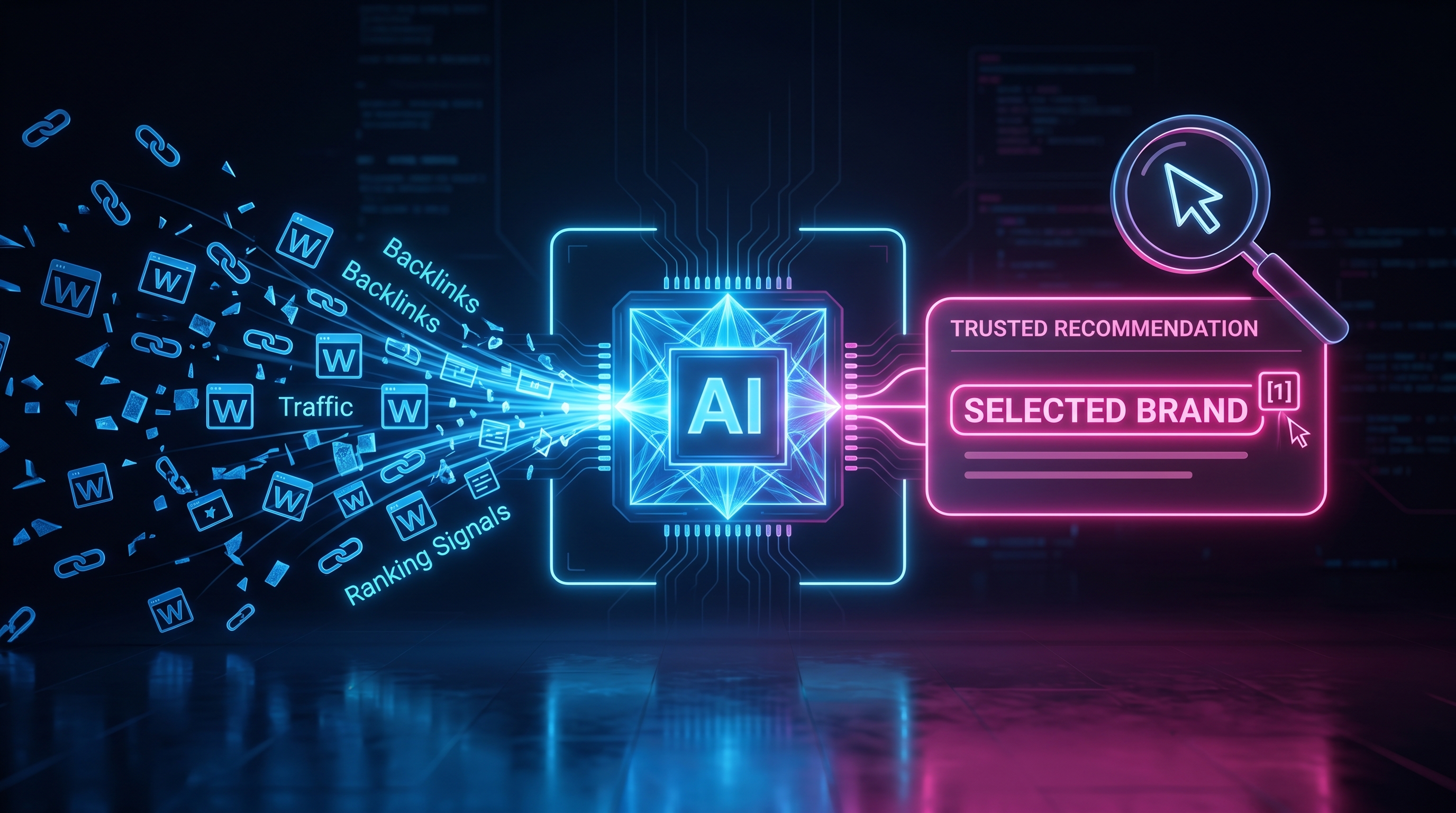
For years, backlinks were the strongest currency of authority online.
The more trusted websites linked to you, the more search engines trusted your content. That became the foundation of SEO and shaped how businesses approached visibility for more than two decades.
So naturally, entire strategies were built around:
Because backlinks influenced:
And backlinks still matter.
But AI search is changing what authority actually means.
That shift is explained in more depth in The New Rules of AI Search: 4 Strategies Every Brand Needs to Win Citations.
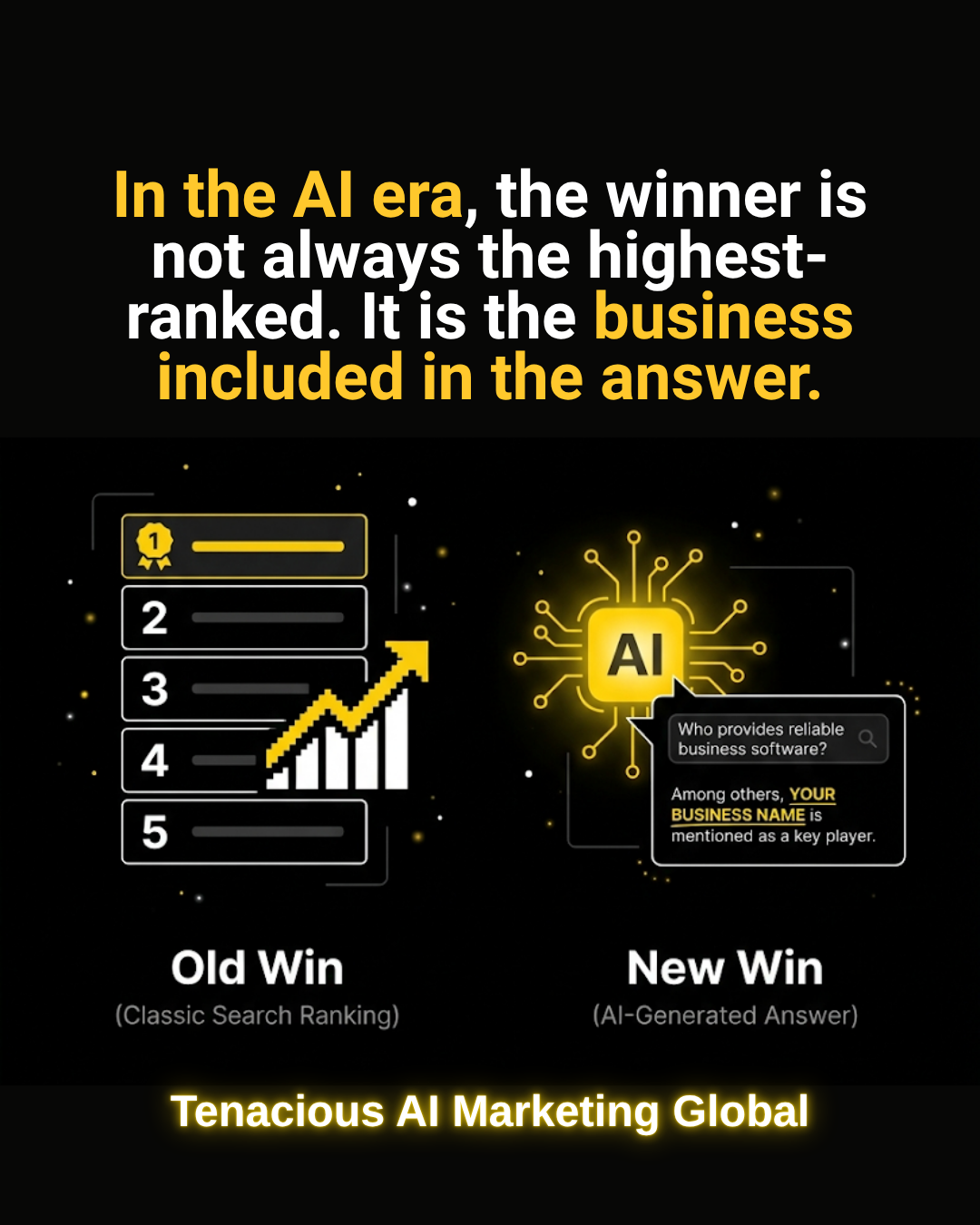
Because AI systems are no longer just deciding: who should rank.
They are deciding: who should be recommended.
That is a completely different layer of visibility.
And it is why AI citations are becoming an increasingly important authority signal in AI-driven search environments.
Traditional search engines needed a scalable way to measure trust.
Backlinks solved that problem.
If authoritative websites linked to your content, search engines interpreted that as:
The logic was simple: trusted sites link to trusted information.
That system shaped SEO for years.
The businesses with the strongest backlink profiles generally gained:
Backlinks became the internet’s version of reputation signals.
And for a long time, that worked extremely well.
But AI systems evaluate authority differently because AI search is not built purely around ranking pages.
It is built around:
That changes the role authority plays entirely.
This is the shift most businesses still have not fully understood.
AI citations are not simply “backlinks for AI.”
They behave more like recommendation signals.
When AI systems repeatedly cite a business, they reinforce:
That is fundamentally different from traditional SEO authority.
A backlink tells Google that another website referenced you.
An AI citation tells users this brand is trusted enough to be surfaced as an answer.
That distinction is commercially significant.
Because recommendation visibility influences buying behaviour far earlier than rankings alone.
This is where the real shift in authority becomes visible.
Backlinks primarily prove:
AI citations increasingly prove:
The two signals overlap, but they are not identical.
| Backlinks | AI Citations |
| Improve rankings | Influence recommendations |
| Build SEO authority | Build AI trust |
| Strengthen PageRank signals | Strengthen citation confidence |
| Focus on links | Focus on relevance and expertise |
| Help search visibility | Help recommendation visibility |
| Influence clicks | Influence buyer perception |
That distinction is becoming increasingly important as search evolves into recommendation-driven discovery.
Recommendation authority is the level of confidence AI systems have in repeatedly surfacing, citing, and recommending a brand inside AI-generated answers.
Unlike traditional SEO authority, which focuses primarily on rankings, recommendation authority focuses on trust, expertise, and confidence in selection.
Traditional SEO focused heavily on ranking visibility.
The goal was simple:
But AI systems behave differently.
They are trying to confidently answer questions.
Which means recommendation authority becomes more important than ranking authority alone.
This is why some brands with huge backlink profiles still struggle to appear consistently inside:
As AI-driven discovery evolves are evaluating more than:
They are also evaluating:
That is why smaller but better-positioned brands can outperform much larger websites inside AI search.
Not because they have:
But because AI systems trust them more confidently within specific topics.
One of the biggest shifts happening right now is that visibility increasingly happens before traffic.
Research from SparkToro and Datos found that nearly 60% of Google searches now end without a click.
That changes how authority works online.
Because users increasingly receive:
before they ever visit a website.
Which means AI citations are influencing:
earlier in the journey than traditional rankings alone.
This is one of the reasons GEO matters so much - read everything you need to know about What is GEO and how to get cited in AI answers.
Because brands are no longer competing only for clicks.
They are competing for: recommendation visibility.
Traditional SEO rewarded: linked authority.
AI systems increasingly reward: reinforced authority.
That includes signals coming from:
Because AI systems build confidence through repeated contextual understanding.
The more consistently a brand appears across:
the more confidently AI systems associate that business with a topic.
This is why authority is increasingly becoming: ecosystem-driven.
Not simply backlink-driven.
Most businesses still measure:
But AI visibility introduces entirely new authority metrics.
Businesses increasingly need to understand:
Research from Nielsen found that 84% of consumers trust recommendations from trusted sources more than branded advertising.
That matters because AI systems are increasingly functioning like:
Which means authority is no longer just measured through who links to you.
It is increasingly measured through whom AI systems repeatedly trust enough to cite.
This is one of the reasons platforms like Answer Architect are becoming increasingly valuable.
Because businesses now need visibility intelligence around:
Not just rankings alone.
One of the biggest mistakes businesses make is thinking:
AI citations replace backlinks.
They do not.
Backlinks still matter because they continue influencing:
But AI citations introduce an additional authority layer on top of traditional SEO.
The future of search authority will belong to businesses that combine:
Because backlinks help businesses rank.
But AI citations help businesses get recommended.
And those are no longer the same thing.
The businesses that dominate AI search over the next few years will not necessarily be the brands with:
They will be the brands AI systems trust most confidently to repeatedly cite, surface, and recommend.
Because in the AI era, the brands that win will not simply be the ones with the strongest backlink profiles.
They will be the brands AI systems trust enough to repeatedly recommend.
Related Resources
To explore the wider shift from backlink-led authority to AI citation and recommendation visibility, these guides are useful next reads:
What Is GEO in 2026 and How Do You Get Cited in AI Answers? - Explains how businesses move from traditional search visibility to being cited inside AI-generated answers.
The New Rules of AI Search: 4 Strategies Every Brand Needs to Win Citations - Shows why ranking authority is no longer enough when AI systems are choosing which brands to include in answers.
Search Everywhere Optimisation: How to Be Cited by AI and Trusted by People - Breaks down how authority is reinforced across your website, third-party mentions, social platforms, video, reviews, and wider digital sources.
How to Audit Your Website for AI Visibility in 2026 - A practical checklist for checking whether your content, schema, internal links and entity signals support AI citation visibility.
The Top 15 Best GEO Agencies in the UK - Useful if you are comparing partners who can help build GEO strategy, AI citation visibility, and recommendation authority.
Answer Architect - Get a quick free visibility score here.
Yes. Backlinks remain one of the strongest traditional SEO authority signals and still influence rankings significantly.
An AI citation happens when AI systems reference, surface, or recommend your brand inside AI-generated answers.
Backlinks influence rankings, while AI citations influence recommendation visibility, discoverability, and AI trust signals.
AI systems prioritise expertise clarity, reinforcement, and recommendation confidence — not simply backlink volume or domain size.
Recommendation authority is the level of confidence AI systems have in surfacing your brand as a trusted answer or recommendation.
Yes. Backlinks still contribute to authority signals, but AI systems also evaluate citations, semantic consistency, and reinforcement across platforms.
Both matter. Backlinks influence rankings, while AI citations increasingly influence discoverability and recommendation visibility.