.png)
AI-generated content can help agency marketing when it is used as part of a human-led content system. It works best for research, structure, first drafts, metadata, content repurposing and formatting. It performs badly when businesses publish generic AI-written content at scale without original insight, expert review, real examples or a clear brand voice.
The highest ROI approach is human-led AI content. That means AI improves speed and structure, but a human expert still decides the angle, verifies the claims, adds experience, improves the voice and makes sure the content is genuinely useful.
For agency marketing in 2026, the question is not “AI or human?” The real question is: “Who is leading the thinking?”
The AI content debate has become messy because most people are asking the wrong question. They ask whether AI content works, as if all AI content is the same. It is not.
There is a huge difference between a blog that is generated by AI, barely reviewed and uploaded to hit a publishing target, and a blog where an experienced marketer uses AI to speed up research, structure the argument, draft sections and then adds real experience, judgement and commercial insight.
Both might technically involve AI. Only one is likely to build authority.
That distinction matters because agencies and marketing teams are producing more content than ever. AI has made content production cheaper, faster and easier. The problem is that easier production has not automatically created better performance. In many cases, it has created more content that sounds competent but says nothing new.
That is the quiet danger.
A brand can publish weekly, look active, fill a blog, post on LinkedIn and still fail to become more trusted, more visible or more cited. The content exists, but it does not build authority.
For B2B agencies, professional service firms and marketing teams, this is now a serious commercial issue. Content is no longer only competing for Google rankings. It is also competing to be extracted, cited, summarised and recommended by AI systems like ChatGPT, Perplexity, Gemini and Google AI Overviews.
That means the bar is rising.
Generic content is easier to create than ever, but easier content is not the same as effective content. The brands that win will not be the ones publishing the most AI-generated articles. They will be the ones using AI to create a sharper, faster, more useful human-led content system.
For the wider context on AI search and citations, read The State of AI Search in May 2026.
Before getting into frameworks and workflows, it is worth starting with the honest picture. The enthusiasm around AI content tools has outpaced the evidence. Most teams are not failing because AI is useless. They are failing because they are treating AI as a replacement for editorial thinking rather than a support system for it.
eMarketer reported that only 6% of marketers had fully implemented AI into their workflows, based on Supermetrics’ 2026 Marketing Data Report. That is an important signal because it shows that most marketing teams are still experimenting rather than operating with mature AI systems. Read eMarketer’s report
This is the execution gap. Lots of teams have access to AI tools. Far fewer have strong processes, data, quality control, editorial standards and performance measurement around those tools.
That is why AI content can feel productive while producing very little real ROI.
The same pattern shows up in agency work all the time. A team uses AI to publish more blogs, more posts, more emails and more landing pages. For a few weeks, everything looks busier. But then the real questions arrive. Is organic traffic improving? Are buyers more educated before calls? Is the content being cited by AI systems? Are prospects mentioning it? Is sales using it? Is it creating trust?
If the answer is no, the content system is not working. It is just producing.
That is why the distinction between AI-generated content and human-led AI content matters so much.
There is a lot of confusion about this, and some of it has been deliberately muddied by people with something to sell.
Google’s official position is clear: it does not automatically penalise content because it was produced using AI. Google says its focus is on rewarding high-quality content, however it is produced. Read Google’s official guidance on AI-generated content
That is the bit many people quote.
But it is not the whole story.
Google also places strong emphasis on helpful, reliable, people-first content. Its guidance around content quality includes E-E-A-T, which stands for Experience, Expertise, Authoritativeness and Trustworthiness. Google explains that its quality raters are trained to assess whether content demonstrates strong E-E-A-T. Read Google’s guidance on helpful, reliable, people-first content
Experience is the word that matters most in this debate.
An AI model does not have first-hand experience. It can summarise what others have said. It can imitate the language of expertise. It can produce fluent explanations. But it has not sat in a client meeting, run a failed campaign, dealt with a difficult brief, recovered a damaged account, tested a new content strategy or seen what actually happens after a prospect reads a blog.
That real-world experience has to come from people.
So Google’s position is not “AI content is bad”. The more accurate view is: AI content is fine if it helps create useful content, but AI content without human experience, expertise and quality control is much more likely to become thin, generic and unhelpful.
That is where many teams get caught.
The terminology here is worth pinning down because the difference is practical, not philosophical.
Pure AI-generated content is content where an AI model produces the draft and that draft is published with minimal human review. The research is mostly AI-generated. The structure is AI-generated. The tone is AI-generated. The examples are generic. The editorial judgement is light or absent.
This type of content can look acceptable when you read one article in isolation. At scale, it starts to hollow out a brand. The articles sound professional, but interchangeable. They answer obvious questions, but rarely add anything memorable. They are structured, but not distinctive.
Human-led AI content is different. In this model, a human remains in editorial charge throughout the process. AI may help with research, structure, drafting, formatting, metadata and repurposing, but a human decides what the piece is about, what angle it takes, what claims it makes, what examples it uses and whether it is actually ready to publish.
The difference is not whether AI touched the article. The difference is who is accountable for the thinking.
A blog can be 70% AI-drafted and still be human-led if a genuine expert has defined the angle, added original insight, verified the claims, rewritten weak sections and made it sound like the brand. Equally, a blog can be written by a human and still be weak if there is no expertise, no structure and no editorial judgement.
The quality of human-led AI content depends on the quality of the human leading it.
That is the uncomfortable truth.
Dimension | Pure AI Content | Human-Led AI Content |
Production speed | Very fast | Fast, but with editorial control |
Brand voice | Often generic | More consistent and distinctive |
Original insight | Usually weak | Stronger when expert input is added |
Factual accuracy | Variable | Improved through human checking |
E-E-A-T signals | Weak | Stronger when experience is included |
GEO citation potential | Lower because generic content is less useful | Higher when the content includes clear answers and original perspective |
Google performance | Risky at scale if thin or unhelpful | More sustainable when genuinely useful |
Scalability | High volume, lower quality risk | Scalable with the right workflow |
Authority impact | Can erode trust over time | Builds trust when properly managed |
Best use | Low-stakes drafts or internal material | Published content, authority building and buyer education |
Used well, AI makes a competent content team significantly faster and a good content team genuinely more productive. The issue is not whether AI belongs in the content process. It absolutely does. The issue is where it belongs.
AI is strong at research support and question mapping. It can help identify the questions an audience is asking, group them by intent and suggest related topics. A task that once took half a day can often be compressed into 30 minutes. The human still needs to decide which questions matter, which ones have commercial value and which angle is worth taking, but the raw material arrives faster.
AI is also useful for structure. Turning a rough argument into a clear outline with logical headings, a direct answer, comparison sections and FAQs is one of the areas where AI adds real value. This matters for both humans and AI citation systems because clear structure makes the content easier to understand, extract and reuse.
First drafts are another legitimate use. A first draft from AI is not a finished piece. It is a starting point. Treated properly, it can save time. Treated lazily, it becomes the thing that damages the brand.
Repurposing is also a strong AI use case. A good long-form blog can become LinkedIn posts, email ideas, short video scripts, FAQs, sales enablement snippets and internal training material. AI is useful here because it is extracting and reshaping existing thinking rather than pretending to create original expertise from nothing.
Metadata, alt text, internal link suggestions and formatting are also sensible uses. These are repetitive production tasks. AI can help with them, but a human should still review before publishing.
The rule is simple: AI is excellent at speeding up production. It is not a replacement for judgement.
The damage caused by poor AI content is often slow and cumulative, which is why teams miss it until the decline is obvious.
The first problem is loss of original insight. AI generates from patterns in existing information. That means it naturally gravitates toward what has already been said. If your content sounds like a polished summary of the internet, it is unlikely to make your brand more memorable.
This is a huge issue for agencies because every agency now has access to the same tools. If ten agencies ask AI for a blog on the same subject, the outputs will often have similar structure, similar phrasing and similar advice. That creates content that is readable but forgettable.
The second problem is weak experience signals. The specific client example, the hard-earned lesson, the campaign that failed, the surprising objection from a sales call, the detail that only comes from doing the work, these are the things that make content feel real. They are also the things AI cannot invent responsibly.
The third problem is brand voice erosion. AI models have a default rhythm. They often produce neat, balanced, slightly generic prose. It sounds professional, but it does not sound like you. If your brand publishes too much lightly edited AI content, your voice gradually becomes less distinctive.
The fourth problem is factual risk. In specialist fields, AI hallucinations can create serious credibility issues. Law, finance, healthcare, engineering, cyber security, tax and regulated sectors all need expert review. A confident but wrong sentence can damage trust quickly.
The fifth problem is thin content at scale. Google’s systems are not looking to reward volume for its own sake. A hundred average AI-generated posts do not create authority if none of them add genuine value. They create noise.
And in the AI search era, noise is not enough.
This is the part many content teams still underthink.
When ChatGPT, Perplexity, Gemini or Google AI Overviews answer a question, they need source material that is clear, trustworthy and useful. They are not looking for content that merely exists. They are looking for content that helps answer the question well.
This is where human-led AI content has an advantage.
AI citation systems favour content that has structural clarity. Clear headings, direct answers, concise definitions, comparison tables, FAQs and explicit summaries all make content easier to extract and reference.
But structure alone is not enough. A perfectly structured article with no original value is still weak. Citation-worthy content usually contains something specific: a useful framework, a clear point of view, original data, a named expert, a practical checklist, a strong comparison, a case study or a specific insight that is not present on every other page.
Entity signals also matter. Content attributed to a real person with visible expertise is stronger than anonymous, generic publishing. For Tenacious, this means Dean Whitby as a named author, Tenacious AI Marketing Global as the business entity, Answer Architect as a related tool, and consistent coverage across GEO, AEO, AI visibility, YouTube, LinkedIn and business growth.
Distribution matters too. Content that is linked to, discussed, quoted and referenced elsewhere becomes easier for AI systems to trust. That is why Search Everywhere Optimisation matters. Your website is only one surface. AI systems also look at YouTube, LinkedIn, press mentions, podcasts, reviews, directories, listicles and third-party references.
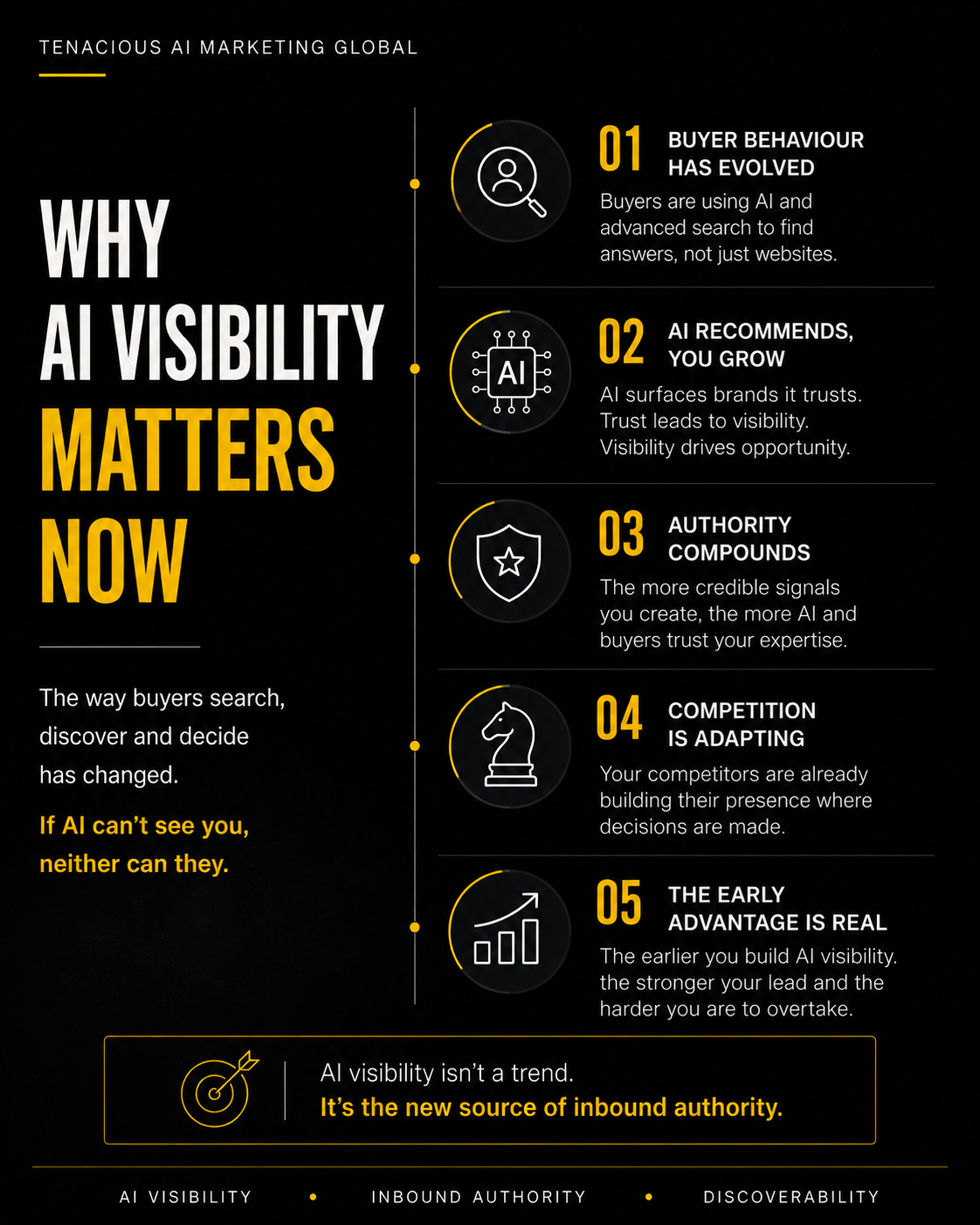
For more on how this wider visibility system works, read Search Everywhere Optimisation: AI Visibility in 2026.
The 80/20 model is not a rigid formula. It is a way of deciding where AI should do the heavy lifting and where humans must stay in control.
The 80% is production support. This includes research, question mapping, first drafts, structure, formatting, metadata, repurposing, internal link suggestions and content scheduling. These tasks require speed, consistency and organisation. AI is good at them.
The 20% is editorial judgement. This includes defining the angle, adding real experience, checking accuracy, sharpening the point of view, improving the brand voice, deciding what to remove, adding examples and making the final call on whether the content is ready to publish.
That 20% is not a quick proofread at the end.
It needs to happen at the start and the end.
The brief is where most of the human value enters the content. A strong brief tells AI what the piece is really about, who it is for, what the argument is, what evidence matters, what the brand believes, what tone to use and what not to say.
A weak prompt creates generic content.
A strong human brief creates useful AI-assisted content.
Workflow Stage | AI Role | Human Role |
Topic research | Find questions, patterns and related topics | Decide what has commercial value |
Briefing | Suggest structure and subtopics | Define the angle, audience and point of view |
Drafting | Produce a first version | Rewrite, challenge and improve |
Evidence | Surface possible sources | Verify, select and interpret sources |
Examples | Suggest generic examples | Add real experience and client context |
Brand voice | Create a baseline draft | Make it sound like the business |
AEO/GEO structure | Add FAQs, tables and direct answers | Ensure the structure serves the reader |
Final edit | Help tighten and format | Approve accuracy, quality and usefulness |
Repurposing | Create posts, emails and snippets | Choose what is worth distributing |
This is how AI becomes useful without taking over the part that actually creates authority.
Most teams measure content performance by volume and vanity metrics. They count posts published, blogs uploaded, impressions, views and maybe keyword rankings. Those numbers matter, but they do not tell the full story.
The real question is whether content is creating commercial movement.
Search performance is one signal. Are the pages ranking for the questions they were written to answer? Are they moving up, holding or declining? If rankings fall after scaling AI content, that is a signal worth taking seriously.
AI citation presence is now another important signal. Run buyer questions through ChatGPT, Perplexity, Gemini and Google AI Overviews. Is your brand mentioned? Is your content cited? Are your frameworks referenced? Are competitors appearing instead?
This is where AEO testing becomes valuable. It turns AI visibility from a vague idea into something you can actually track. For more on that process, read Beyond the Search Bar: Why AEO Testing Is Now a Business Visibility Metric.
Inbound quality is the commercial signal. Are better prospects arriving? Are sales conversations starting with more context? Are buyers mentioning your content before calls? Are they more educated when they enquire?
Sales usage is another underrated signal. If your sales team is sending blogs to answer objections, support proposals or explain your thinking, the content is doing more than filling the website. It is helping revenue.
Content that works changes how buyers arrive. They come in warmer, clearer and more confident.
Content that does not work just sits there.
If you have already been using AI to produce content, the first step is not to delete everything. The first step is to audit honestly.
Look at your last 20 published pieces and ask:
Audit Question | What It Reveals |
Does this content say anything specific? | Whether it has original value |
Could any competitor have published this? | Whether your voice is distinctive |
Is there real experience in it? | Whether it supports E-E-A-T |
Are the claims checked and sourced? | Whether it is trustworthy |
Does it answer a real buyer question? | Whether it has commercial intent |
Is it structured for extraction? | Whether it supports AEO and GEO |
Is there a clear next step? | Whether it supports conversion |
Is it internally linked? | Whether it supports topic authority |
Is it being cited or mentioned by AI tools? | Whether it is visible in AI search |
If the answer is mostly no, the content system is not broken because AI was used. It is broken because AI was not led properly.
For a practical next step, read How to Audit Your Website for AI Visibility in 2026.
For agencies, the best content system is not fully manual and it is not fully automated. It is a human-led AI system with clear ownership.
That means the agency should define the topic clusters, commercial priorities, buyer questions, editorial standards, internal links, external sources and proof points before production starts.
AI can help produce drafts faster, but the agency must still own the thinking.
A good agency content workflow looks like this:
That is not slower than traditional content. It is faster than fully manual production and far stronger than pure AI output.
The win is not “AI writes the blog”.
The win is “AI removes the drag so humans can spend more time on the thinking that matters”.
GEO content has to do more than rank. It has to be understandable, extractable, credible and useful enough to be referenced by AI systems.
That means every serious GEO article needs four things.
First, it needs a clear answer to a clear question. AI systems need to know what the page is about quickly.
Second, it needs entity clarity. The author, business, service, audience and expertise should be obvious.
Third, it needs evidence. That might be external sources, internal data, case studies, examples, or visible experience.
Fourth, it needs structure. Headings, summaries, tables, FAQs and direct answers make the content easier to extract.
Pure AI content can produce the structure. It usually cannot produce the evidence, experience or distinctive point of view. That is why human-led AI content is the stronger GEO model.
For the core definition of GEO, read What Is GEO in 2026 and How Do You Get Cited in AI Answers?.
No, Google does not automatically penalise AI-generated content. Google’s official guidance says it rewards high-quality content, however it is produced. The issue is not whether AI was used. The issue is whether the content is helpful, reliable, people-first and genuinely useful. Read Google’s guidance on AI-generated content
Yes, AI-assisted content can rank if it is useful, accurate, well-structured and satisfies the search intent. But pure AI content that is generic, thin or published at scale without meaningful editorial oversight is much less likely to build long-term authority.
AI-generated content is mostly created by AI and lightly reviewed before publishing. Human-led AI content uses AI to support research, structure and drafting, but a human expert controls the angle, verifies the claims, adds experience and decides whether the content is good enough to publish.
There is no universal minimum. At the very least, human input should include a strong brief, expert review, fact-checking, brand voice editing, original examples and final editorial approval. The more competitive or specialist the topic, the more human judgement is needed.
AI-assisted content can support GEO when it is structured clearly, answers specific questions and includes credible signals. Pure AI content usually struggles because AI citation engines are more likely to reference content with original insight, clear expertise, strong entity signals and trustworthy sources.
Make it specific. Answer a clear question. Use direct definitions. Add comparison tables where useful. Include experience-backed insight, named authorship, credible sources, internal links and FAQs. Generic summaries are rarely citation-worthy.
Yes, but not as an autopilot. Agencies should use AI to improve speed, structure and repurposing, while keeping human editorial judgement in charge. The agency’s value is not the ability to generate words. It is the ability to decide what should be said, why it matters and how it supports commercial outcomes.
Beyond the Search Bar: Why AEO Testing Is Now a Business Visibility Metric
Why YouTube Is Now Essential for Business Visibility in the AI Era
What Is GEO in 2026 and How Do You Get Cited in AI Answers?
The New Rules of AI Search in 2026
Search Everywhere Optimisation: AI Visibility in 2026
How to Audit Your Website for AI Visibility in 2026
The honest answer to “AI content or human content?” is neither.
That is the wrong binary.
Pure AI content, especially at scale, often creates the illusion of productivity while quietly weakening brand authority. It fills the website, but it does not necessarily build trust, generate demand or earn citations.
Human-led AI content is different. It uses AI for what AI is good at: research support, structure, drafting, formatting and repurposing. But it keeps people in charge of the work that actually builds authority: judgement, experience, accuracy, voice and original insight.
For agency marketing, that distinction is now urgent. Every agency has access to the same AI tools. That means the tools are no longer the advantage.
The advantage is the thinking.
The agencies that win in 2026 will not be the ones producing the most AI content. They will be the ones producing the clearest, most useful, most experience-backed content in their market, with AI helping them move faster behind the scenes.
If you want to know whether your current content is building authority or quietly becoming invisible, start with a GEO content audit.
Run your buyer questions through ChatGPT, Perplexity, Gemini and Google AI Overviews. See whether your content appears. See whether your competitors appear instead. Then improve based on what the market and the machines are actually showing you.
You can also use Answer Architect to check your AI visibility and understand where your content is or is not being surfaced.
For a broader visibility check, take the Organic Visibility Scorecard or speak to the Tenacious team about building a content system that supports SEO, AEO, GEO and real commercial demand.