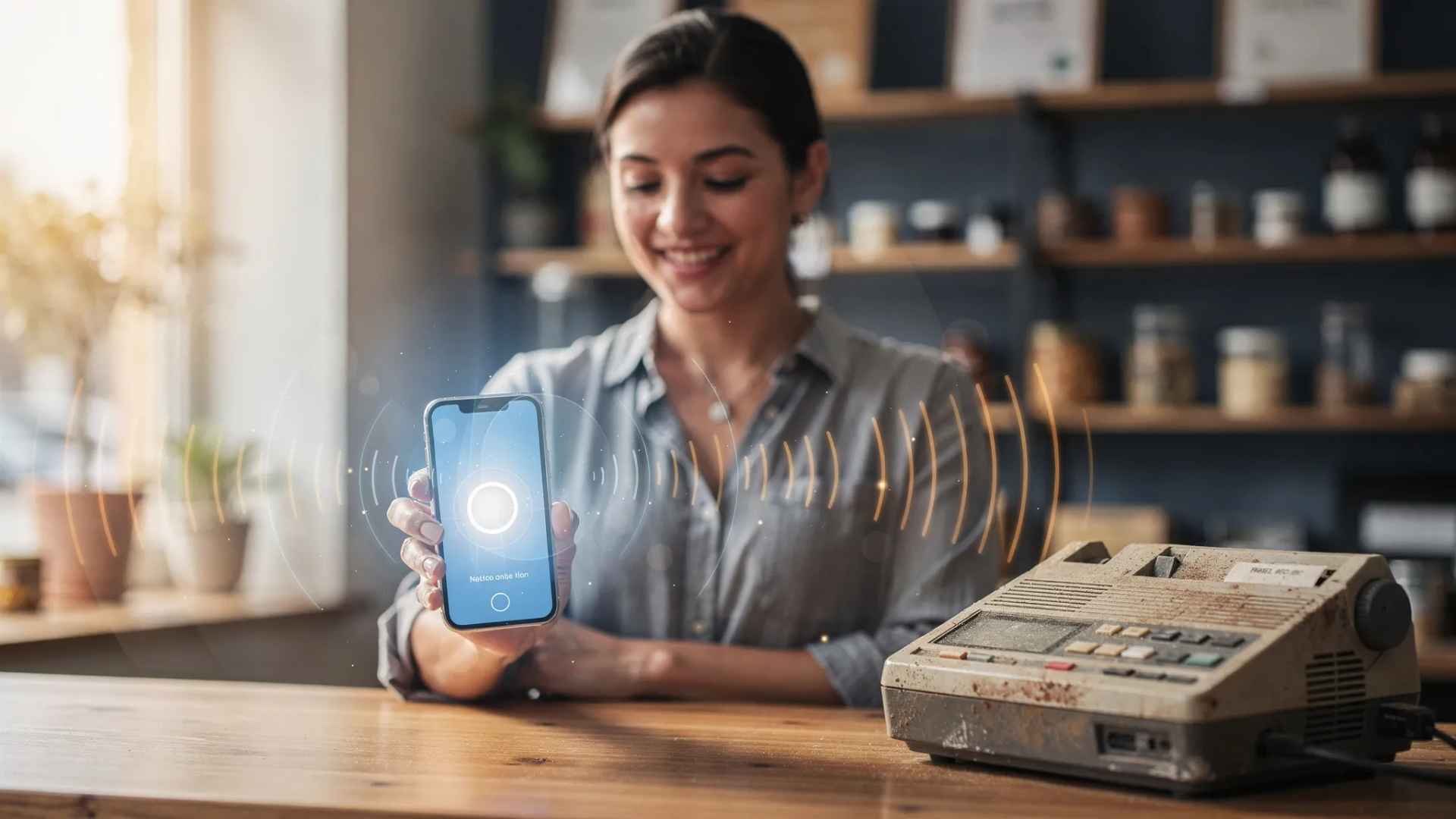
Many customers prefer an AI receptionist over voicemail because they get instant answers, quick routing, and a human-like experience without waiting for a callback. Voicemail still has a role for niche cases, but it often signals delay and drives prospects to competitors. For small local businesses, responsiveness wins—and AI delivers it 24/7.
What you will learn from this blog
- Why customers choose an AI receptionist over voicemail
- How speed and first-contact resolution drive revenue
- Where voicemail still helps—and how to optimize it
- A simple rollout plan for implementing an AI receptionist
- A quick ROI walkthrough tailored to small local businesses
- Practical scripts and prompts to reduce missed calls
The first ring decides it: speed is your silent salesperson
Let's start where customers start: the first 10 seconds. When a caller reaches voicemail, they're reminded they're one of many. With an AI receptionist, they're greeted, understood, and moving forward—right now. That tiny difference expands into real outcomes: fewer missed leads, more booked appointments, and higher satisfaction. Think of it like a checkout line—no one chooses the one that isn't moving.
Summary
- Customers want answers or progress on the first call.
- AI receptionists can route, book, and answer FAQs instantly.
- Voicemail often pushes people to call your competitor “just to see.”
Hypothetical example: imagine a parent calling a local dental office at 7:45 a.m. about a chipped tooth. Voicemail can feel like a dead end. An AI receptionist could check openings, offer a morning slot, and text a new-patient form. That's not just convenient—it's decisive.
The human-feeling bot vs. the lonely beep
Let's be honest—nobody loves talking to a machine. But a well-trained AI receptionist doesn't feel like a machine; it feels like momentum. Voicemail? It's a beep and a prayer. The difference is subtle but powerful: one signals "we're on it," the other “we'll get to it.”
As a hypothetical example, imagine a caller reaching a plumbing business on a rainy Saturday and hearing: "We can dispatch a technician this afternoon. Would you like to confirm your appointment?" That's a confident, guided path. Versus "Please leave a message." In emergencies and everyday needs, guidance beats guessing.
When voicemail still makes sense—and how to make it not hurt
Voicemail isn't evil; it's just not your first-string player. For edge cases—like complex inquiries or regulated disclosures—it's still useful. If you must use it, make it crisp and confidence-building.
Make-your-voicemail-work checklist
- Keep it under 12 seconds. State your promise and a next step.
- Set a clear callback window: “We'll call back within 30 minutes, 9 a.m.–6 p.m.”
- Offer a faster lane: “Press 1 to get a text to book online.”
- Use voicemail-to-text so you (actually) respond quickly.
- Invite context: name, reason, preferred time, and best number.
- Update your greeting for holidays and outages to avoid frustration.
A practical rollout plan: moving from voicemail to an AI receptionist
Switching doesn't have to be a big-bang project. Treat it like upgrading your front door: one hinge at a time.
Step-by-step
- Define success: more booked appointments, fewer missed calls, faster response times.
- Map top 20 call intents: booking, rescheduling, pricing ranges, directions, hours, emergencies.
- Write friendly micro-scripts: short, natural, and action-oriented.
- Connect your tools: calendar, CRM, ticketing, payments (if applicable).
- Set clear handoff rules: when to escalate to a human, after-hours protocols, emergency paths.
- Launch after-hours first, then roll to peak times.
- Measure and tune weekly: call completion rate, time-to-book, abandonment, customer feedback.
- Add SMS follow-ups: confirmation texts reduce no-shows and "Did you get my message?" calls.
Quick ROI walkthrough for local businesses (no spreadsheets required)
Think of it this way: every week your business gets new-customer calls. With voicemail, some callers get busy and never book. With an AI receptionist, more of those callers can book on the spot because it's easy. Each captured appointment adds up, and over a month the extra booked business can be significant. The pattern holds: faster responses plus smoother booking equals more captured demand. Small changes at the front desk ripple all the way to your bottom line.
What about caller preferences? Let's answer the real-life questions
- Do customers really hate voicemail? Not always. They just hate uncertainty. Give them a clear callback window or a faster alternative, and they'll stay with you.
- Will an AI receptionist feel "too robotic"? Not if it's trained on your tone, FAQs, and policies. The key is natural language and respectful pacing.
- Can we keep a human touch? Absolutely. The best setups blend AI for routine requests and humans for nuanced or emotional moments.
Conclusion and next steps
If you run a small local business, your phone is your storefront bell. An AI receptionist picks it up on the first ring, guides people forward, and makes your team look sharp. Voicemail can still help, but it shouldn't be the door everyone walks into.
Ready to test the difference in your own call flow? Schedule a Consultation with Do It 2 Win by Shepard Solutions. We'll help you map your top call scenarios, install a friendly AI front desk, and keep the human touch exactly where it matters most.
Call (562) 564-6630 for a free AI Opportunity Audit