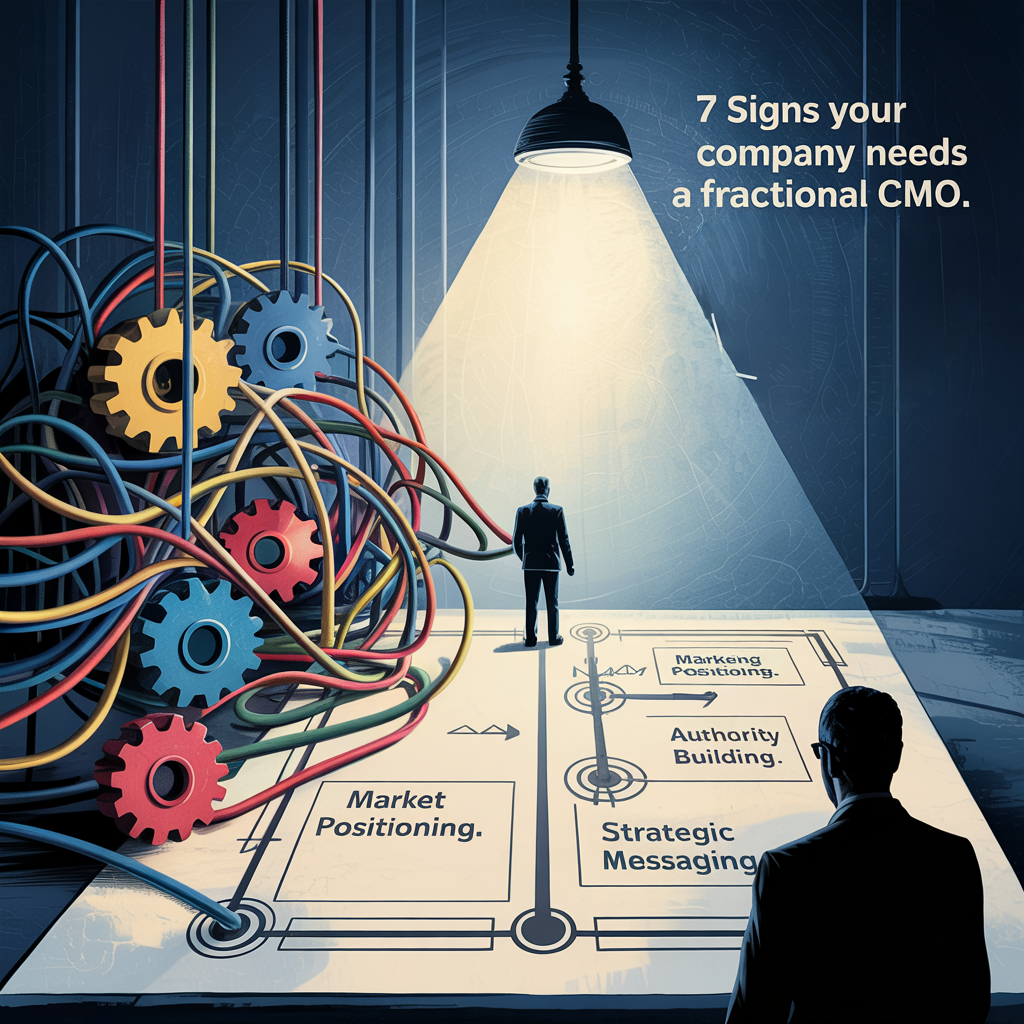
Most companies don’t have a marketing problem.
They have a marketing leadership problem.
This pattern shows up constantly with companies in the $2M–$10M revenue range. By this stage, marketing activity is usually happening across multiple channels:
From the outside, it appears that marketing should be working.
Yet internally, leadership teams often feel something very different:
Growth feels unpredictable.
Some months performance spikes. Other months leads slow down without a clear explanation. Marketing spend increases, but the connection between effort and revenue becomes harder to understand.
That’s when founders and executives start asking a critical question:
“Do we need a marketing agency… or a Fractional CMO?”
The answer depends on something deeper than tactics.
It depends on whether your company needs execution—or strategic marketing leadership.
Many businesses assume agencies and CMOs solve the same problem.
They don’t.
A marketing agency typically focuses on execution:
These are valuable services. But they are primarily tactical functions.
A Fractional CMO, on the other hand, focuses on something different:
strategy and leadership.
Their role is to design the marketing system that makes tactics effective in the first place.
This includes:
In simple terms:
Agencies execute marketing activity.
CMOs build marketing intelligence.
Without that intelligence layer, marketing often becomes reactive rather than strategic.
When companies operate without clear marketing leadership, they often fall into a familiar cycle.
It looks something like this:
New campaign → temporary results → confusion → new vendor → repeat.
Each new tactic promises growth.
A new agency promises better campaigns.
A new platform promises better reach.
But the underlying strategy rarely changes.
The result is fragmented marketing that feels busy but not consistently effective.
This is where many growth-stage companies begin to realize they don’t just need more marketing.
They need a coherent marketing system.
At Wealthy Palette, we approach this challenge through what we call Strategic Marketing Intelligence.
Strategic Marketing Intelligence is the discipline of aligning strategy, creativity, audience psychology, and performance measurement into a unified marketing system.
Rather than focusing only on campaigns, this approach focuses on the intelligence behind marketing decisions.
Our proprietary framework—the Strategic Creative Intelligence™ Authority System—is designed to help companies build the strategic architecture that supports sustainable growth.
This system focuses on five core elements.
Market leaders don’t compete on visibility alone.
They compete on perception.
Authority positioning defines how your company is understood within its market:
Without strong positioning, even great marketing tactics struggle to convert attention into trust.
Many companies understand demographics.
Fewer understand psychographics.
Psychographic intelligence focuses on:
Understanding why buyers make decisions allows marketing strategy to align with how people actually think, not just how companies hope they behave.
Content should do more than fill a calendar.
Strategic authority content builds credibility and influence through a balanced mix of:
This transforms content from simple marketing output into authority architecture.
Not every platform deserves equal investment.
Strategic Marketing Intelligence focuses on influence ecosystems—platforms where decision-makers actually evaluate expertise.
For many growth-stage B2B companies, this often includes:
The goal is not just presence.
The goal is perceived leadership within the market conversation.
Authority is strengthened through signals of credibility and visibility.
This includes:
When these signals align, something powerful happens:
Trust builds faster.
Sales conversations become easier.
Marketing begins supporting revenue in a predictable way.
Companies in the $2M–$10M stage often reach a marketing inflection point.
Early growth may have come from:
But as competition increases, growth becomes dependent on systematic marketing leadership.
This is the stage where companies begin exploring Fractional CMO leadership.
Not because they need more marketing activity.
But because they need someone responsible for designing and guiding the marketing system itself.
Agencies are extremely valuable when a company already has strong strategic direction.
For example, agencies are ideal when a business needs help with:
In these situations, the strategy already exists, and the agency helps bring it to life.
A Fractional CMO becomes valuable when leadership recognizes that marketing lacks strategic direction.
Common signals include:
At this stage, what the company needs most is not another tactic.
It needs strategic marketing intelligence.
When companies ask whether they need a marketing agency or a Fractional CMO, they are usually asking the wrong question.
The better question is:
“Do we have the strategic marketing leadership needed to turn activity into authority and revenue?”
If the answer is unclear, that may be the real opportunity.
Marketing success rarely comes from doing more things.
It comes from doing the right things in the right order with the right strategy behind them.
When strategy, authority, and execution align, marketing stops feeling chaotic and begins operating as a growth system.
That’s the goal of Strategic Marketing Intelligence.
If your company is scaling and marketing feels fragmented, it may be time to evaluate the system behind your marketing efforts.
Wealthy Palette offers Strategic Marketing Intelligence reviews designed to help leadership teams identify where their marketing architecture may be breaking down.
If you’re curious about how your current marketing strategy aligns with authority, growth, and revenue goals, feel free to reach out for a strategic conversation.- [email protected]